

Rating: NR | Runtime: 81 minutes
Release Date: May 8th, 2026 (Canada)
Studio: VVS Films
Director(s): Bretten Hannam
Writer(s): Bretten Hannam
You promised everything was going to be okay.
Mise’l (Blake Alec Miranda) knows exactly what they must do upon seeing a hooded ghost sitting at a table after the bar they’re cleaning has already closed. Without hesitation they pack a bag, say goodbye to their partner, and head away from the city back to where they grew up in hopes of reconnecting with their brother who never left (Forrest Goodluck’s Antle). Ashen leaves float around in the air as they approach, the specter of death growing more powerful. It’s why Mise’l knows they can’t confront this phenomenon alone. That, despite their promise, these siblings must enter the Old Forest one more time.
Written and directed by Two-Spirit L’nu filmmaker Bretten Hannam, At the Place of Ghosts takes these brothers into the fabled Sk+te’kmujue’katik. Known as a place outside of time and space that simultaneously houses the spirits of ancestors and descendants alike, it’s akin to a Heaven on Earth for the Mi’kmaw people—one that colonialism fought to dismantle (along with Two-Spirit representation) to ensure assimilation into the Catholic ideal of eternal life. They must traverse this place of unknown trauma, potential violence, and necessary protection because industrialization threatens to uncover a shared, dark secret.
Antle justifiably believes Mise’l is simply battling guilt. That something has triggered a sense of paranoia and nightmare with no real basis in reality. Part of this is his skepticism about the more supernatural portions of Mi’kmaw tradition and part is because Mise’l promised him everything was going to be alright. It’s not until he feels the ghost’s presence himself—beckoning his young daughter Grace (Ainsley Cope) to enter those woods—that he understands the peril they all face. Antle also knows Mise’l cannot fight what awaits without him. Regardless of their lengthy estrangement, this must be done together.
The horror that results is a means to force them to reclaim their heritage (the shifting seasons of time place them in the middle of war, at the doorstep of a futuristic alcove, and in service to their great-great grandfather Holy Joe, played by Brandon Oakes) as well as their identity (we can clearly see Mise’l’s queerness is a major part of their decision to live in the city and a factor in what happened all those years ago). Because to go back and confront what they did is to finally dare to speak their respective truths removed from the ingrained fear of childhood. It’s ultimately time they each forgave themselves.
It won’t be easy, though. Not just because of the historical threats that await (giant wolves and British muskets), but also that they are both being eaten alive from the inside. Mise’l has a black mark on their arm. Antle has one on his collarbone. It’s a symbol of this evil coaxing them deeper into the forest and a test of their mettle to keep going despite the pain. Because it grows with every step they take towards that cave and every memory played out in front of them by their former selves (Skyler Cope and Atuen MacIsaac). Mise’l’s drive to protect their younger brother returns alongside Antle’s panic.
And through those glimpses—to which they interact with their echoes just as they do the foes and relatives providing real danger and healing respectively, regardless of whether it’s all in their heads—we begin to piece together the trajectory to that fateful day. The abuse at the hands of their father (Glen Gould). The exposure of Mise’l’s sexual orientation. The knowledge that such a discovery could cause a toxic mixture of indoctrination and alcohol to push an elder into wanting to erase them from the map. Why? Because that rhetoric seeps through even to Antle. He doesn’t mean it, but it’s still there.
At the Place of Ghosts would work as a wonderful double feature with another TIFF alum in Justin Benson and Aaron Moorhead’s Synchronic insofar as their shared use of eternalism to blur the line between present selves and past/future shadows. This one obviously feels deeper as a result of it being intrinsically connected to Mi’kmaw culture rather than a science fiction conceit, though. The people Mise’l and Antle meet are personally interwoven into the fabric of their DNA. There’s true beauty in each time shift supplying a lesson with as much chance of stopping them in their tracks as providing the strength to continue.
And it all culminates in a harrowing climax where these siblings are forced by the ghost and their own anguish to reenact what occurred. To see if the choices they made in the past were a product of being scared or a deep-seated value steeped in love—the same love that inevitably caused them to drift apart thanks to the misguided belief that their absence from each other’s lives would help rather than just hurt them both more. Miranda and Goodluck astonish with an emotional vulnerability that shines through their manufactured façades of stoicism to finally find a cathartic release.
Nothing is guaranteed, though. Sk+te’kmujue’katik is all times and all spaces. We assume they’re reliving their pasts and experiencing their futures, but who’s to say they haven’t done this before? Who’s to say they didn’t get eaten by a wolf or scalped by a Red Coat? What if they find what they’re looking for and decide the choices made were wrong? If current resentments cloud judgment into believing the only chance for closure and quiet is to commit an even worse act of violence? Our only hope is that this instance is a good one. Not happy, since the pain will remain. Just good enough to be able to move forward … together.

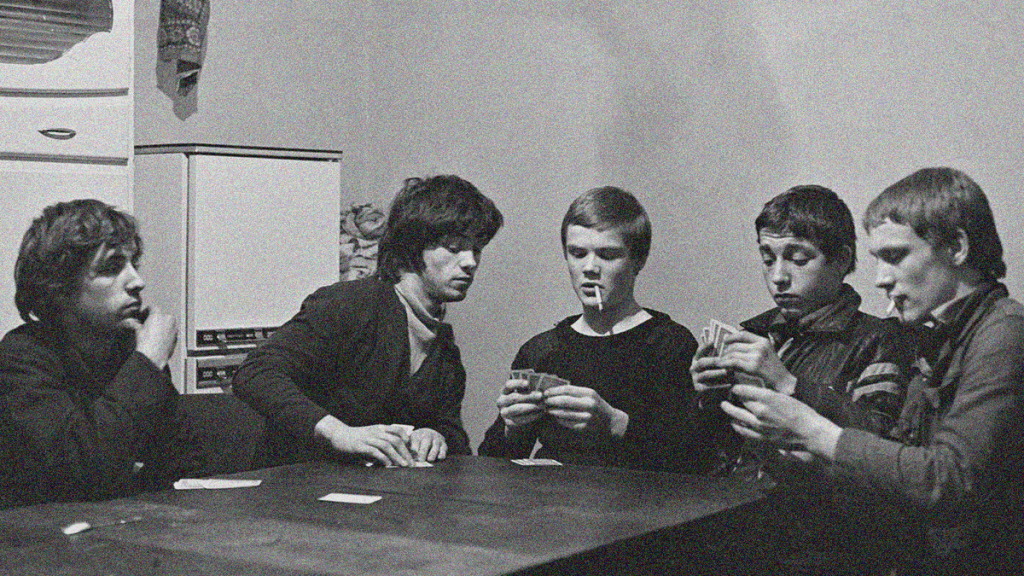
Forrest Goodluck and Blake Alec Miranda in SK+TE’KMUJUE’KATIK; courtesy of TIFF.


 jaredmobarak.com
Leave a comment