
Rating: NR | Runtime: 98 minutes
Director(s): Joscha Bongard
Writer(s): Joscha Bongard & Nicole Rüthers
Only child.
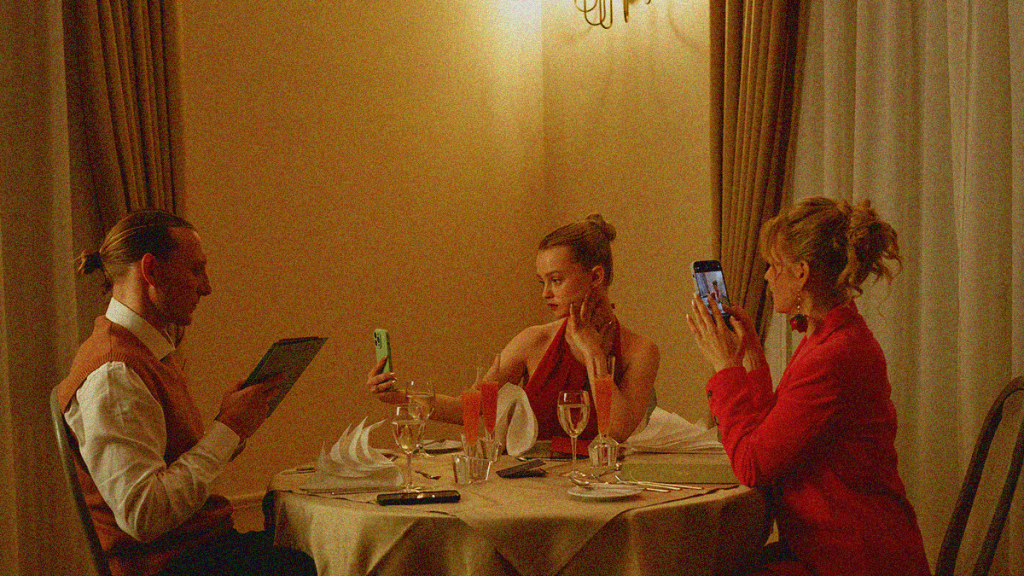
When your life has been used as content for global consumption since the moment of conception, how can you know if the person you see in the mirror each morning is truly you? How would you even realize that’s a question you can ask yourself? Because Stella (Bea Brocks) and Chris (Liliom Lewald) have always asked Luca (Maja Bons) for her input. They’ve always asked for her consent. And from an outsider’s perspective, one could feasibly believe those things are enough. That this sixteen-year-old internet celebrity is a partner in the Our Bright Life empire. But what is consent if saying “No” was never really an option?
As Joscha Bongard’s Babystar (co-written with Nicole Rüthers) progresses, we glean more and more context about this family business. An idealist would presume this whole thing was born with Luca at the center. That Mom and Dad are the supporting players to her brand and she has the final say. A cynic would guess the truth, though. That Stella and Chris have been doing this since well before parenthood. They made money by advertising vacations and luxury products. They traveled the world and put every single second online. And once you accept that fact, you must ask the obvious question: Was Luca ever anything more than a prop?
It’s no coincidence then that the film opens with Stella asking her daughter’s opinion on gaining a sibling. Luca is justifiably averse to the idea. Yes, because she’s only ever known herself as the star of the show and therefore the star of her parents’ lives, but also because she isn’t dumb. Call her naive, sheltered, or ignorant all you want since those labels are a direct result of the manipulation she’s unwittingly been victimized by, but she’s savvy enough to know the line between product placement and authenticity. Luca must wonder, “Why now?” Why wait sixteen years? Have ratings declined? Is it sweeps week? Has she aged out and suddenly become obsolete?
I don’t know whether it’s better or worse to realize it might simply be that Stella and Chris want to diversify the portfolio. Maybe they’ll spin Luca off onto her own channel as she moves towards college, cars, dating, etc. Then they can rewind the clock to turn the home feed back towards “baby time” a full generation later with new technological advancements that ensure little overlap with the archive of videos they created during Luca’s adolescence. You get the bump of a new cast member, the rejuvenated revenue stream of review content, and the potential double-dip of dividing and conquering via parallel life streams.
It might have worked too if they were just honest with Luca. Let her know the plan. Let her know it will provide her more autonomy. Make it a “graduation” of sorts towards greater freedom of choice. But what do they do instead? They treat it like a pitch. And when she declines? They try to manipulate her into changing her mind. Suddenly the veil is lifted. Suddenly she realizes she’s never actually been an only child. No, Stella and Chris’s first and favorite baby was always One Bright Life. Everything they’ve done and mythologized has been solely about them and them alone. Commence the teenage rebellion.
Bongard is keenly aware of the scenario he’s created and never veers off-course insofar as the psychological damage born from it. In a pre-social media influencer world, Luca would have all the power to make their lives a living hell. Now, though? When controversy sells and precise messaging can indoctrinate a horde of parasocial hangers-on to believe whatever lie is constructed to sweep blemishes under the rug? It’s become a game. A public tantrum can be dismissed as a deep fake. A genuine cry for help can be ignored and commodified for more clicks. Luca’s only option is to extricate herself from the entire ordeal.
And therein lies the rub. Luca doesn’t have the ability to know what such a divorce entails. She doesn’t know how to be an independent member of society. The level of second-hand discomfort that arises from her projecting the rituals of her fabricated-yet-not persona onto people outside that realm is extreme. Because everything is filtered through the lens of content creation. Romance (with Joy Ewulu’s Julie). New trends (at the expense of Maximilian Mundt’s Simon). What it means to have a family (the uncanny valley of Luca infiltrating a stranger’s home is wild). She can’t adjust to life outside of her former prison.
Whereas the first two acts of Babystar really show an assuredness both in the filmmaking and concept, however, the conclusion can feel stagnant by comparison. I like where Bongard goes, but everything seems to happen too quickly for it to truly hit home emotionally. So much time is spent setting the table and flipping it over that it can be difficult to parse what’s happening once Luca is forced to confront her state of suspended animation. Is she actually trying to walk everything back and find a way to accept her reality while also tweaking it for more control? Or is she just biding time to do what she ultimately does?
I don’t know. And that’s either a knock on how it unfolds or proof that I got duped too. It’s somehow darker than I expected and not dark enough for the exposed nerve Luca becomes during the table flip. There’s something about just how funny her fish-out-of-water schtick becomes (regardless of the depressing AI subplot that her only friend is a computerized algorithm of herself) that the way things return to the nightmare didn’t quite mesh. It’s still a very good film with impressive performances by Bons, Brocks, and Lewald, but I guess it just runs out of steam a bit in its bid to wrap things up.
PS: Prepare yourself for a full television-style opening credit sequence at the twenty-four minute mark and the insanity of it feeling like a bootlegged third season of “Severance” is about to begin.

Liliom Lewald, Maja Bons, and Bea Brocks in BABYSTAR; courtesy of TIFF.



 jaredmobarak.com
Leave a comment