
Rating: R | Runtime: 91 minutes
Release Date: August 29th, 2025 (USA)
Studio: Music Box Films
Director(s): Angus MacLachlan
Writer(s): Angus MacLachlan
We’ll just be here when they need us.
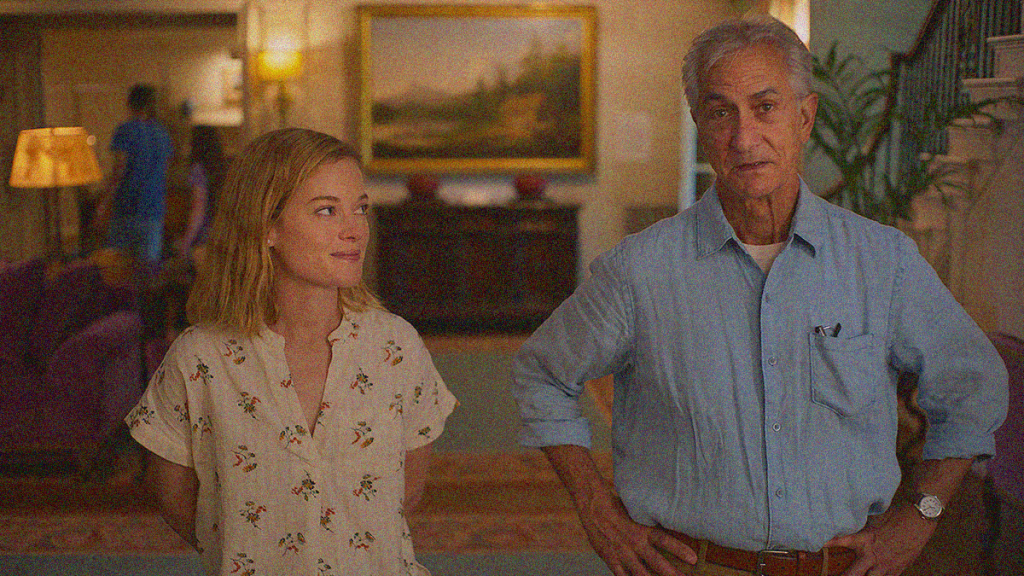
Bill (David Strathairn) cherishes the small things in life. An unknown woman singing at the top of her lungs while passing by the house at 7:30 in the morning. A good painting. An evening cup of tea. He gravitates towards his daughter-in-law Tammy (Jane Levy) as a result because the rest of his family doesn’t have time for such seemingly trivial things like them. They don’t understand the beauty and quiet calm of simply being in this place of deep, albeit often unspoken, love.
His wife Venida (Celia Weston) would have him call the police on that singer. His daughter Patti (Anna Camp) is a selfish mess who uses her own daughter as a bargaining chip to both get what she needs from her parents (money) and her own troubled husband. And his son David (Will Pullen)—Tammy’s husband—can barely be bothered to be present in their home beyond the time it takes to grab his lunch in the morning and stumble into bed at night.
What makes Angus MacLachlan’s A Little Prayer so good, however, is that it never judges any of these characters. It doesn’t put Bill or Tammy on a pedestal as far as them being better than their louder, more chaotic brethren. It merely seeks to express the complexity inherent to finding a balance between one’s insular life and the communal whole. Because they do all love each other. They just can’t always express it or honor it as effectively as they might hope. Some of it is nature. Some of it is nurture. All of it is the unfortunate reality that trying isn’t enough.
You can’t exonerate Bill from being a cause of the drama either. Who he is now is not who he always was. We see it in the way he struggles to fully confront David about what he’s certain is an affair with their family company’s secretary (Dascha Polanco’s Narcedalia). We see it more when Venida confronts him about what he’s not telling her about their son and all but confirms he had a similar fling himself. Then there’s Bill’s moment of clarity when considering what to do with Patti. He wonders aloud if he was a bad, absent father. And rather than assure him of the opposite, his wife can only admit he “did what he had to do.”
Add war (both Bill and David are veterans who treat their employees to drinks every Wednesday at the local VFW) and you could presume MacLachlan is setting up a list of excuses for his characters to hide behind. What his script does instead, though, is prove how we must take personal responsibility for our actions regardless of the suffering, sacrifice, or self-loathing that contributes to them. Because actions have consequences. It’s something Bill attempts to remind David about despite the latter knowing full well since his existence is in many ways a consequence of his father’s.
There is no absolution as a result. Unfortunately, there’s only pain. The hope is that time can bring clarity and acceptance considering forgiveness is perhaps a bridge too far. We assume Venida forgave Bill and they’ve gotten past his transgressions enough to build a nice life. But there’s also mention of a fallen comrade’s ex-wife showing up at his funeral that reminds us how an inability to forgive doesn’t automatically erase the love shared. Some people can’t be helped—at least not yet. So, you must let them go to not fall into darkness yourself.
A Little Prayer is a film of parallels that works to expose the many forms this dynamic takes. Venida stuck by Bill and they overcame it together. Patti continues to stick by her husband despite the damage he causes and has pretty much been dragged down with him. Narcedalia has reached a point where she can no longer accept who David becomes when they are together and knows escape is the only chance she has for survival. And Tammy is still weighing her options. Can she still be David’s Venida? Or is he too far gone?
Don’t think little Hadley (Billie Roy) is merely as a mirror for her mother (Patti) and David either. Yes, she serves that purpose considering Bill admits her personality is a direct result of an unhealthy home (he provided a similar one for his own kids). No, she also feeds the question about bringing more children into such volatile circumstances. It’s a delicate yet crucial topic that MacLachlan handles well to again not pass judgment. Because, regardless of your stance on abortion broadly or case-by-case, a woman’s choice should remain paramount.
In many ways, the film is about Bill coming to terms with that fact. Not just how it concerns a potential grandchild, but also how it infers upon his ability to relinquish control. It’s another facet of his past that David throws in his face and one Venida tries to broach when telling him it would probably be prudent not to give their daughter money this time. He wants to drag his kids into goodness forgetting that he had to pull himself up to get there himself. Bill can only ensure he’s present to offer them protection when they need it.
So, rather than selfishly believe he has all the answers or the control to dictate terms with anyone other than himself, he confronts the reality of his helplessness. He’s helpless to correct his own mistakes or those of his children. All he can do is recognize himself in David and Venida in Tammy and know the difficult truth of where they are and the uncertainty of where they’re headed. It culminates in an unforgettable final scene between Strathairn and Levy that delivers the emotional release they’ve been desperate to achieve and the permission to let go.
Jane Levy and David Strathairn in A LITTLE PRAYER; courtesy of Music Box Films.



 jaredmobarak.com
Leave a comment