
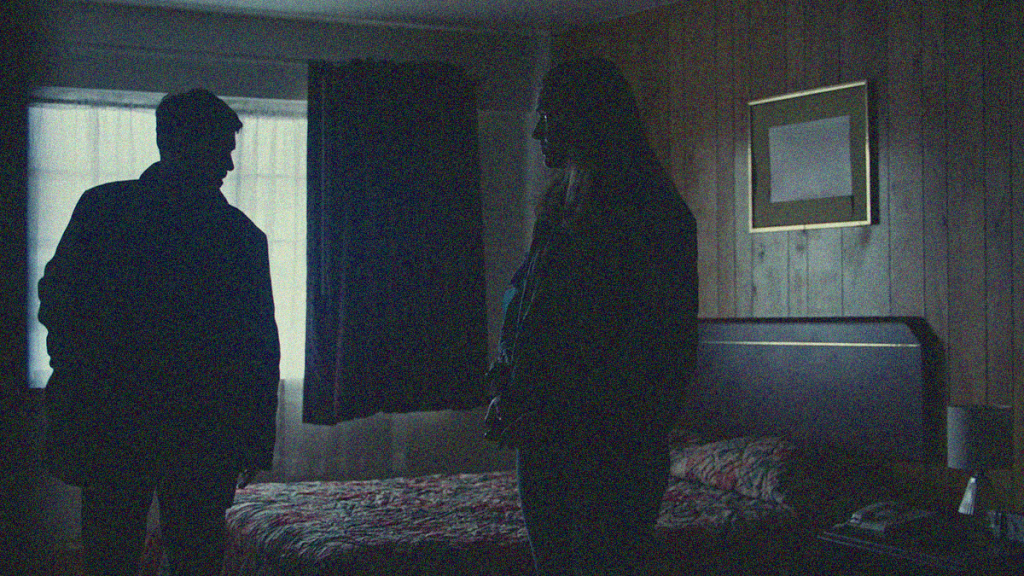
Rating: NR | Runtime: 92 minutes
Release Date: August 1st, 2025 (USA)
Studio: All the Better
Director(s): Kelsey Taylor
Writer(s): Kelsey Taylor
It’s what happens after.
Told in four chapters titled “The Woodsman,” “Grandma,” “The Wolf,” and “Red,” Kelsey Taylor’s feature debut To Kill a Wolf wears its fairy tale inspiration on its sleeve. That doesn’t, however, mean you should assume The Woodsman (Ivan Martin) is a hero, Red (Maddison Brown) has somewhere to go, or the wolf is hiding in the woods. Because Taylor isn’t simply bringing “Red Riding Hood” into the real world. She’s actually reinterpreting its themes to present a story of abuse that, as she explains it, stays in the “gray.”
That’s with all aspects whether characters, setting, or mythology. Because naïveté doesn’t have a place in these dark moments. This tale deals in fear, shame, and regret. Those are the emotions Red is dealing with when she runs blinding into the forest only to end up unconscious in the snow. They’re also what The Woodsman battles as he frustratingly scours those same trees to sabotage a neighboring cattle rancher’s inhumane wolf traps before coming across her body. And it’s why, despite an early level of trust, they hardly speak to each other.
Trouble is obvious, though. You don’t become a hermit or almost die miles from civilization without a reason. It’s precisely because they have their reasons that they don’t pry. She’s grateful he found her. He’s grateful she was found. Now it’s time to go their separate ways and return to their personal anguish. Except, of course, that he’s old enough to have chosen that isolation for himself. She is not. No, she has been forced into this impossible situation with seemingly no escape. So, she embraces avoidance and lies in hopes of never needing to admit the truth.
Enter Chapter Three: “The Wolf.” Delivered as a nightmarish flashback, we finally see what brought Red here. Abandonment. Death. Grief. Confusion. Abuse. It’s where we meet her aunt and uncle (Kaitlin Doubleday’s Jolene and Michael Esper’s Carey) and learn about her grandmother’s fate. It’s where the idea of love as a weapon continues to rear its head considering the same notion plays a role in The Woodsman’s exile—as evidenced by the townspeople’s adoration for someone else leading them to scowl whenever he’s in their presence.
So, we inevitably discover his back story too. And while their pasts are very much not the same, Taylor isn’t afraid to expose the parallel sense of despair permeating through their shared stoicism. The Woodsman doesn’t want to burden Red with the suffering born from his self-imposed imprisonment. She doesn’t want to unburden herself on him and let what happened to her be released into the world. That insularity is a double-edged sword, though, since a refusal to open up risks pushing each other away. And neither is quite ready to go back to being alone.
The truth of what happened to Red is pretty obvious, but Taylor expertly draws it in a way that forces the character to believe it’s grayer than it is. This is crucial to why she did what she did running away and why she doesn’t want to give it life: she believes herself complicit. So, it’s the perfect contrast to The Woodsman’s own predicament since he isn’t afraid to admit what everyone already knows—he just wants to live in this moment of potential redemption a little longer by not telling the one person who doesn’t. They therefore want to help each other but can’t quite help themselves to fully commit.
It leads to an unforgettable final chapter that finally sees the pent-up emotions inside both get released. Why now? Because seeing her gives shape to his victim and seeing him reveals how the truth is the only thing able to set her free. Brown and Martin are fantastic in these moments, but so too is the script for never treating the supporting roles as pieces solely present for the leads’ sake. A lesser film would have a specific character put their own needs aside to worry about Red rather than allow them to react with authentically selfish tunnel vision. But that person deserves their pain just like Red and The Woodsman do.
In the end, our two flawed protagonists do end up saving each other from the wolf. Yes, the figurative one haunting Red, but also the metaphorical one signifying mankind’s fallibility to make mistakes and drown in blame rather than evolve to become better. It’s no surprise that the literal wolves on-screen are conversely presented as victims being killed merely because humans deem them a threat within their own natural habitat. They’re just trying to survive. It’s man that poses the real threat. To the wildlife, to each other, and to themselves. Taylor makes certain to include an example for all three.
Maddison Brown as Dani and Michael Esper as Uncle Carey in TO KILL A WOLF; courtesy of All the Better.




 jaredmobarak.com
Leave a comment