
Rating: NR | Runtime: 77 minutes
Studio: Gébéka Films
Director(s): Momoko Seto
Writer(s): Momoko Seto & Alain Layrac
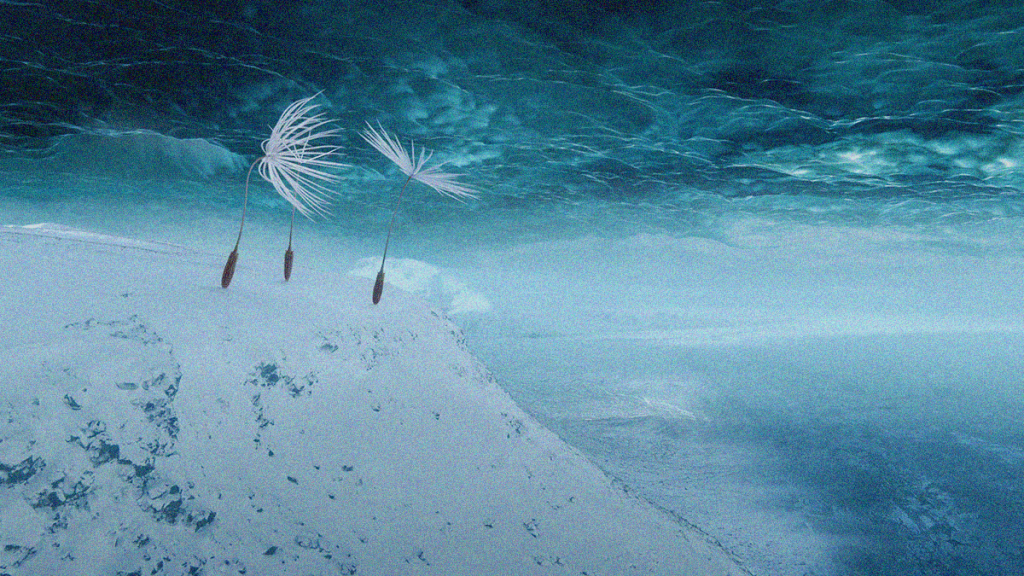
The debate for weed supremacy is over. Dandelions are officially the heartiest of them all with seeds that can survive the vacuum of space to eventually pollinate far off planets that aren’t even prepared for vegetative life until their arrival. Could it therefore be that dandelions are a necessary building block for biological life? Could their appearance on Earth have begun the evolutionary process that eventually led to humanity? Maybe. If we’re taking Momoko Seto’s Dandelion’s Odyssey at face value.
We shouldn’t, though. I should clarify that Seto and co-writer Alain Layrac’s script isn’t a scientific study, but a fantastical journey that showcases their melding of nature photography with animation. Sure, a nuclear extinction remains on the table as political unrest grows globally. And a determined bulb of dandelion seeds could free itself from its stalk to drift off from the fires and potentially escape our atmosphere. But they don’t have consciousness, language (albeit in squeaks and hums), or self-propulsive movement. Everything on-screen is therefore a personified glimpse of nature, uh … finding a way. (Apologies to Dr. Ian Malcolm.)
So, we follow the last four seeds of Earth origin as they soar through space and inevitably land on a frozen planet far, far away. The festival synopsis gives them names (Dendelion, Baraban, Léonto, and Taraxa), but the film does not. There’s a leader of sorts. Its right-hand lieutenant. And their two friends: one with only three white filaments left to its canopy and another with an achene three times the size of its compatriots. They search for ground conducive to their screwdriver twirls so they may burrow underground and be reborn anew. Ice won’t do it. Neither will desert. And certain places might kill them for the attempt.
The nature footage is the highlight for me and culled from 260 days of shooting over two-and-a-half years (with some sequences taking up to a full week to complete). A frog’s eggs become tadpoles, the formation of mushrooms, and the fuzz and slime of flora and fauna gestating and growing is great. There are butterflies with transparent wings and melting ice structures while exoskeletal creatures become dangerous foes for the seeds, sweat glistening off their armor. Those dandelions can often feel fake since they are the sole autonomous (and wholly fabricated) entity allowed to interact with each other and the environment, but they’re mostly just guiding us through.
Scale can prove a bit difficult to reconcile as a result. This is mostly true upon landing on this new two moon planet and surely a product of the place being “unfinished”—a seed of a planet ready to bloom. The time juxtaposition requires adjustment too since the seeds move in our real-time while everything else is sped up via time lapse. Once you regulate to this truth, though, it’s a nice way to usher us through Seto’s creation of Earth 2.0 without spending more than the seventy-minute runtime. Think of it as evolution occurring within the Bible’s “seven days” with the seeds enduring a millennia of events in one brief adventure.
Dandelion’s Odyssey is thus more about appreciation than anything else. Its imaginative use of nature and time is objectively gorgeous, like with its sea creatures flying through the air before being submerged by the ocean of a melting atmosphere, but it’s also somewhat janky in the thought that we might not need those seeds at all—especially without dialogue. So, let the experience wash over you without thinking too deeply about logistics or narrative. The slow pace of a pure nature film makes it something you won’t want to pop in on a whim, but, as an exercise in repurposing that footage, it definitely succeeds.

DANDELION’S ODYSSEY by Momoko Seto © Miyu Productions – Ecce Films – Umedia Production – ARTE France Cinéma – CNRS – 2025.


 jaredmobarak.com
Leave a comment