
Rating: NR | Runtime: 109 minutes
Release Date: March 20th, 2026 (USA)
Studio: Blue Harbor Entertainment
Director(s): Rashad Frett
Writer(s): Lin Que Ayoung & Rashad Frett
I just never thought I’d live this long.
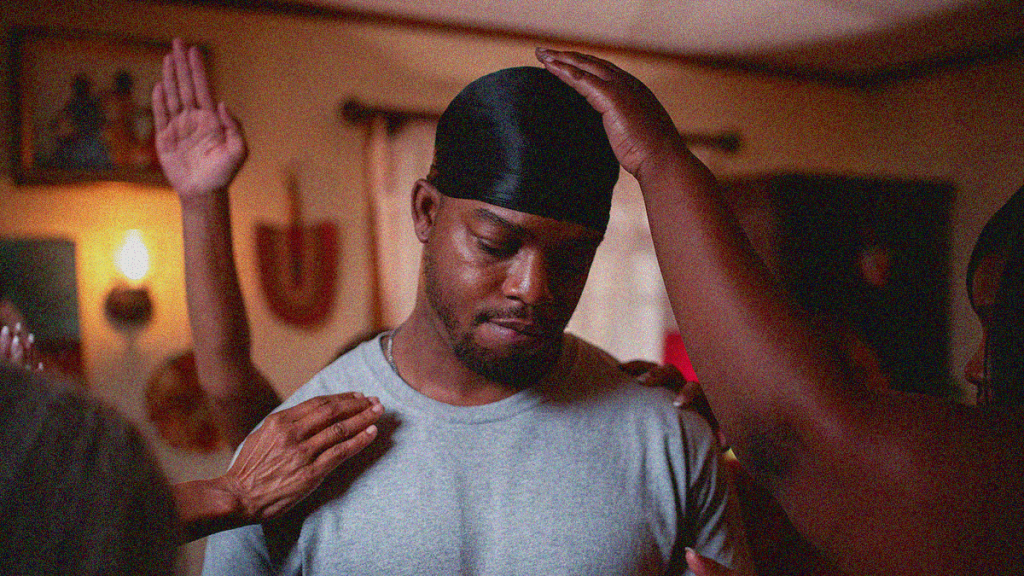
Ricardo Smith (Stephan James) might be physically thirty-years-old when he exits prison, but he’s still a teenager emotionally. How can he not when he went in at fifteen? He’s never driven a car. He’s never held a job. He’s never had sex. People on the streets see him and assume things because he looks like an adult, but he has no experiences to fall back on to live up to that image. Ricky is consumed by fear and shame and anger. He takes everything he hears with an earnestness that makes him seem awkward and childish. Embarrassment crops up when someone jokes with him. Rage appears when trash talk arrives in the heat of the moment. He’s a raw nerve fighting against the world.
That’s what he thinks, at least. The beauty of director Rashad Frett and co-writer Lin Que Ayoung’s Ricky (expanded from his senior NYU thesis short with the assistance of Sundance Labs) is that it doesn’t shy away from the reality that this character is actually fighting himself. And who can blame him when he’s spent half his life—the entirety of his adulthood—in a place where he had no one to rely upon? His coping mechanism was to see himself as a man on an island. A man left behind. So, when things get tough, his knee-jerk reaction is to blame those around him for setting him up to fail. Being late to a parole check-in is his brother’s fault for not driving him rather than his own for not securing the means to be there on time.
I think so much of the messaging stems from a line of dialogue spoken at one of Ricky’s group therapy sessions wherein the idea is presented that an incarcerated person’s family is put in jail with them. They feel the guilt (Simbi Kali, as his mother, states she hasn’t had a good night’s sleep since his arrest because she can’t shake the feeling that kicking him out put him there). They feel frustration (Maliq Johnson, as his younger brother James, is suddenly thrust into the role of big brother by default when he’s still trying to live his own life). And here’s Ricky presuming that having his back means doing everything he needs them to do regardless of his own responsibilities. They forget he’s still intrinsically a boy and he forgets it’s time to become a man.
James said it best during the post-premiere screening Q&A at Sundance when talking about the complexity of the role being as much about acclimating to civilian life as it is a coming-of-age story fifteen years late. Ricky doesn’t quite have the maturation needed to confront his own trauma let alone understand the trauma of those around him. It’s easier to blame Terrence (Sean Nelson) for letting him take the fall than to acknowledge the shame his old friend has carried ever since. It’s easier to let Cheryl (Andrene Ward-Hammond) use him to fill the void in her life that was created from her own incarceration than it is to take accountability for the fact he was using her to do the same. Without the rigid structure of prison, Ricky is learning the nuance of society’s consequences.
Every character on-screen assists in that education from Jaz (Imani Lewis) taking an interest in his kindness to Leslie Torino (Titus Welliver) taking an interest in his humanity to his parole officer (Sheryl Lee Ralph’s Joanne) taking an interest in his rehabilitation. Credit Free and Ayoung, however, for presenting those interests in ways that can still subtly get Ricky believing they cannot be trusted to know his full story when it’s the lack of trust he has in himself that’s really holding him back from appreciating them. It’s the age old notion that one must love oneself before having the ability to let others love them too. Ricky must believe himself to be worthy of their love before he can accept it, but the pain he holds threatens to make it impossible.
While Ricky proves aspirational and feel good by the end insofar as how it allows the character to finally embrace his identity outside of the labels he let society place upon him, it’s not an easy road. Every scene provides a trigger that puts Ricky back into the headspace of being a statistic. Every external glimpse of aggression puts him in fight or flight with little room to escape the jail-fueled desperation of showing strength through violence rather than restraint. This man is devoid of the “turn the other cheek” impulse and it consistently puts him further from the path he must travel to evolve. It all leads back to the nightmare he’s endured and the childhood he lost. And maybe he’ll have to lose it all again—this time by owning his blame—to finally put it behind him. James has never been better en route to giving that struggle the care it demands.

A still featuring Stephan James from RICKY by Rashad Frett, an official selection of the 2025 Sundance Film Festival. Courtesy of Sundance Institute.



Leave a comment