
Rating: R | Runtime: 119 minutes
Release Date: August 16th, 2024 (USA)
Studio: 20th Century Studios / Walt Disney Studios Motion Pictures
Director(s): Fede Alvarez
Writer(s): Fede Alvarez & Rodo Sayagues / Dan O’Bannon and Ronald Shusett (characters)
We simply cannot wait for evolution anymore.
Going from completing her mandatory labor quota in order to leave her planet and venture off to paradise to discovering said quota was doubled “due to lack of workers” (in a way that reveals no one is ever finished because the quota is merely a carrot to be chased for perpetuity), Rain (Cailee Spaeny) agrees to embark on a risky heist that will get her there anyway. Led by Tyler (Archie Renaux), his sister Kay (Isabela Merced), their cousin Bjorn (Spike Fearn), and his girlfriend Navarro (Aileen Wu), the plan calls for Rain’s “brother” (an “Andy” synthetic her father repurposed as her protector, played by David Jonsson) to infiltrate a decommissioned Weyland-Yutani spacecraft and steal its cryochambers.
While this sextet is unaware of what might await them in space, director Fede Alvarez and co-writer Rodo Sayagues ensure the audience has open eyes courtesy of an Alien franchise lore-filled prologue. We watch a rescue ship come up to the USCSS Nostromo and procure a giant rock-like structure from inside that they cut open to leave a xenomorph-shaped fossilized hole in the cross-section. Did the creature therefore get loose and kill everyone on-board before floating to Rain’s colony? Did it leave its eggs of facehuggers for someone to find? Or are we a few more steps removed to discover something even more elaborate than an alien space-hopping from one craft to the next?
Alien: Romulus proves to be an “all of the above” amalgam that not only gives us facehuggers, xenomorphs, and synthetics, but also an eyeroll inducing level of visual and verbal callbacks to the entirety of the franchise. Alvarez has Frankensteined together an IP monster that seeks to satisfy the desires of any fan while also refusing to really provide much of anything new. In many ways it feels like a big budget fan film looking to homage and honor all the filmmakers that came before him. I just wish that a studio might one day allow someone to work within a world and not be forced to connect anything to previous installments. This whole cutesy, closed loop desire for a wink is growing tiresome.
So, I’m going to try and disconnect myself from the noise and judge this single movie on its own merits. Doing so doesn’t make it great, but it also doesn’t make it a try-hard pop culture pastiche either. It instead renders Romulus into a solid horror thriller that succeeds more when we’re not forced to endure the narrative gymnastics. Because the relationship dynamic between human and synthetic does feel fresh when removed from the Ash, Bishop, and David of it all. Beyond the protocols and directives exists a form of love that motivates both Rain and Andy throughout this adventure. Yes, emotions generally cloud judgement to the point of creating disaster, but embracing them might be worth a horrible end.
What’s the alternative? Utilitarian automatons? You might as well just wipe out humanity and let the androids rule the world in that case. It shouldn’t be about synthetics teaching humans to be more pragmatic. It needs to be about humans teaching synthetics that some things are too precious to render collateral damage. That’s not to say Andy’s cutthroat decision-making isn’t a direct factor towards keeping as many of his friends alive as possible, but that it’s okay to sometimes want to take that one percent gamble to save everyone. Better to die trying than to live not knowing, right? Let’s just say a lot of characters on-screen agree because their numbers dwindle fast and often.
They must in this genre. We’re ultimately here to watch them die in brutal ways and to see if those deaths motivate the survivors to keep going. Mortality is the driving force—mankind’s tenacity despite knowing it’s fighting a battle it cannot win. It’s why Alien: Covenant disappointed me: David can’t be an intriguing enough lead because he’s too perfect. We need a human like Rain and a fallible android like Andy. How do they overcome their limitations? How do they humble themselves to realize saving themselves will never bring happiness because they won’t have the other by their side? That’s what it means to protect humanity. Not ensuring humans evolve towards immortality, but that they will freely perish for each other.
As such, like with Prometheus, the “perfect synthetic” must be the villain. Sure, the xenomorphs are roaming around the ship (and there are a lot of them), but they are impediments rather than the goal. The real mission is preserving a serum that could turn humans into Gods—never a good thing when those hoping to do so are billion-dollar corporations led by greedy CEOs bleeding their resources (laborers) dry to secure their own future. That means needing a company man via Rook (Daniel Betts), an identical model to Alien‘s Ash (with permission from the Ian Holm estate) as well as an often off-the-reservation Andy. They’re willing to sacrifice humanity to “save” humanity. Rain is willing to die to save her brother.
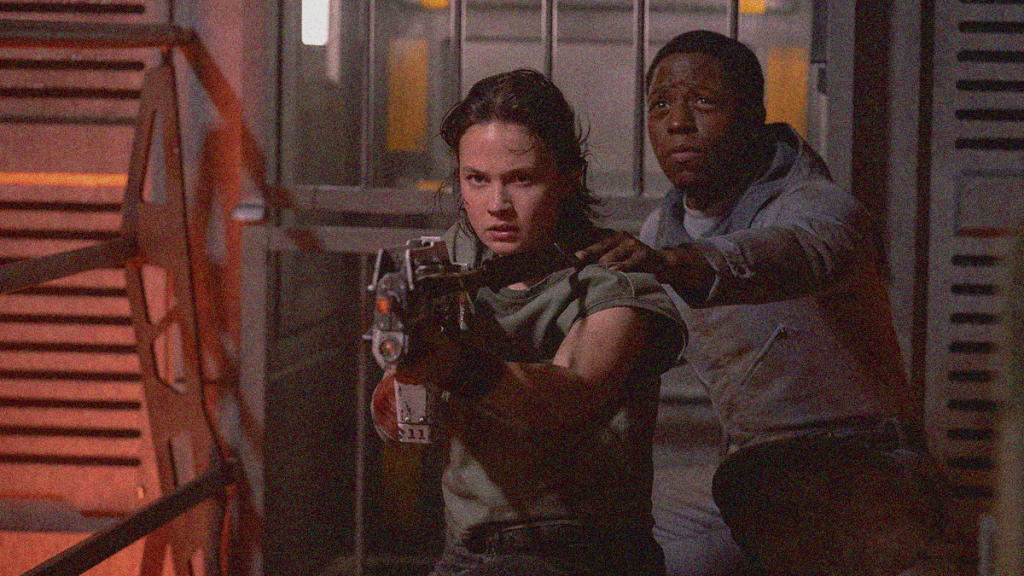
It’s a great through line augmented by wonderful performances from both Spaeny and Jonsson. We care so much about these two that we almost forget the obvious threads to this film’s predecessors that won’t stop popping up. They’re why I wish this was their own movie. Don’t make Rook look like Ian Holm (it mostly looks bad, even after Alvarez asked Disney for additional money after release to make it better for home video). Don’t keep trying to subvert the metaphor of humanity’s monstrousness by always transforming humans into the monsters they fight (I’m unsure why so many people seemed shocked by an ending they should have seen coming a light year away). Stop strangling good ideas to expand your IP with the constraints of needless IP familiarity.

Nominee:
Visual Effects
(L-R): Cailee Spaeny as Rain Carradine and David Jonsson as Andy in 20th Century Studios’ ALIEN: ROMULUS. Photo by Murray Close. © 2024 20th Century Studios. All Rights Reserved.




 jaredmobarak.com
Leave a comment