
Rating: R | Runtime: 128 minutes
Release Date: December 27th, 2024 (USA) / March 21st, 2025 (UK)
Studio: Civic Studios / Metrograph Pictures
Director(s): Sandhya Suri
Writer(s): Sandhya Suri
No one else was prepared to touch the body.
Things aren’t just as they appear in Sandhya Suri’s Santosh. Yes, it’s about misogyny in the sense that Santosh Saini (Shahana Goswami) is left with nothing as a widow of a “love marriage”—her in-laws won’t take her because she “stole” him, her home is government property owned by the police force where he worked, and going back to her parents feels like a death sentence. But that’s more about the why of joining the force herself (if she takes her husband’s job, she gets his salary and widow benefits on top of a room wherever she’s posted) than it is about what she will ultimately see and do as a result. India might be a patriarchal society prone to gender discrimination, but it can also be very racist.
Santosh learns this first-hand upon taking the initiative to find a Dalit man’s fifteen-year-old daughter who’s gone missing. The station itself doesn’t want India’s lowest caste to come to them so it can preserve its “sanitation,” so they force the community to pay others to write their reports for them. While still in training, the newly minted Constable Saini hears his plight while at the cobbler and tells him to follow her so she can write the report herself and ensure an investigation can begin promptly. Her boss refuses. He sends him back to the cobbler with a laugh. Well, you can guess that the next time we see that father will be with tears in his eyes and the dead girl’s body in his arms.
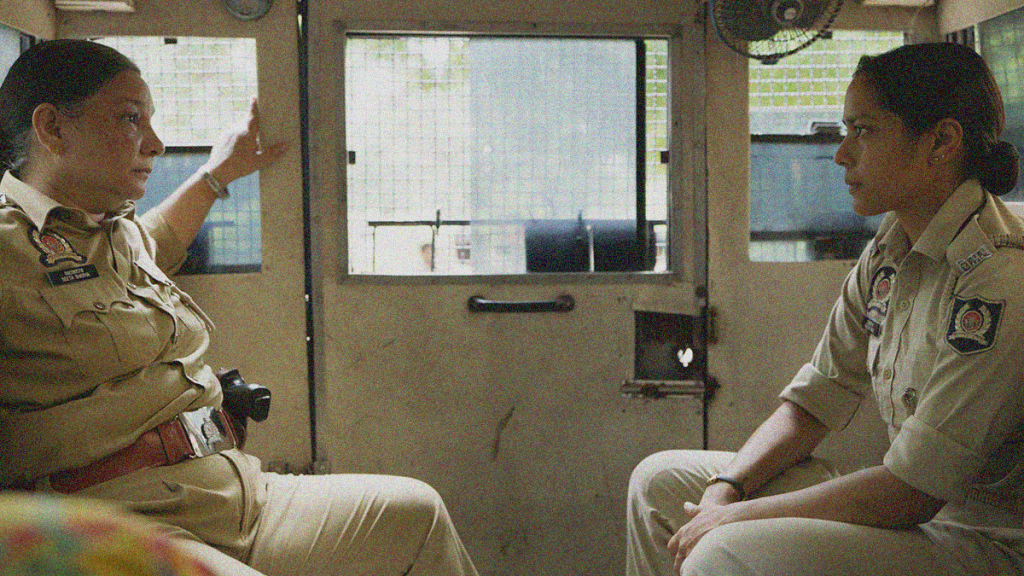
The fallout: a regime change. Not only is the old boss out, but his replacement is a woman. Geeta Sharma (Sunita Rajwar) is a seasoned veteran who takes zero guff from men at the station or on the street. She’s someone who appears to be willing and able to stand-up for the marginalized and try to make a difference. Someone Santosh can look up to with respect as opposed to the bumbling cretins highlighted by a humorous YouTube video comparing Chinese law enforcement to India that she enjoys. Sharma listens to Santosh. She applauds her ambition (we’re talking someone who had no interest in this career until it became her only option for survival actually doing the job while others look for a bribe and/or lunch) and takes her under wing once a suspect is found.
Because we so desperately want this case to be solved and for Santosh to be the catalyst, we quickly forget the obvious politics that Suri has so effectively presented us through the hierarchy of rank, wealth, and caste. With Sharma at her back, every clue Santosh uncovers is a miracle of true police work the others have either botched or ignored. We become so invested in catching Saleem (Arbaz Khan)—a Muslim and thus almost as denigrated by the Hindu population as the Dalit—that we don’t stop to question the ease at which doors have suddenly been opened. And when they do get their man, all the praise and press becomes such a welcome achievement that we again stop short of asking, “Why?”
The tragedy is, of course, that Santosh does too. Here she is getting pats on the back by important people while Sharma takes her to dinner and lets her in on the interrogation. She’s so enamored by the chance to do good that she even finds herself slipping into the very violence and hypocrisy that her attempts to give voice to the voiceless sought to combat. Power is a slippery slope. Santosh is given the keys to her future if she’s willing to play along. If she’s willing to keep quiet. The question then becomes whether she’ll be able to acknowledge her complicity to the system that took her husband’s life and let a young girl die. Are the spoils from embracing corruption worth losing her soul?
Suri weaves a fantastic script that truly does lull us into the copaganda inherent to a police officer being in the lead. She asks us to ignore all the question marks and bigotry by providing her heroine a stage to seek justice. We become as gung-ho as Santosh because we are accustomed to due process. Even if catching Saleem causes some lines to blur a bit, we can accept it since the truth will only be found after he’s in handcuffs. Then the courts will decide … right? Well, as we might discover soon, not all penal systems are equal. Some blur that line with purpose so a few more might get trampled en route to a conclusion that best suits all parties involved regardless of integrity. Perhaps Santosh was the pawn all along.
Goswami is great in the lead role because we always see her compassion—even when the darkness too many others trade in takes hold. Yes, she can get too fixated on her current objective to question it if everyone else is cheering her on, but she’s doing it for a young Dalit girl who had no one in her corner. She’s doing it because no one was willing to do it for her either. And, when she discovers her error, we know the horror is too much to bear. Because she’s not like Sharma. Santosh isn’t interested in politics or power. It’s why Rajwar steals the show, leveraging what we see as maternalism and mentorship into pure exploitation for personal gain. It could become an ends-justifies-the-means event like Sharma tries to spin, but that “maybe” should never be enough to do what they do.
[L-R] Sunita Rajwar and Shahana Goswami in SANTOSH; photo by Taha Ahmad, courtesy of Metrograph Pictures.



 jaredmobarak.com
Leave a comment