
Rating: PG-13 | Runtime: 136 minutes
Release Date: November 17th, 2024 (Brazil) / January 17th, 2025 (USA)
Studio: Sony Pictures Releasing / Sony Pictures Classics
Director(s): Walter Salles
Writer(s): Murilo Hauser and Heitor Lorega / Marcelo Rubens Paiva (memoir)
We’re all in danger.
The larger the number of political prisoners demanded for the release of each subsequent ambassador kidnapped by rebels against the military dictatorship that took control of Brazil’s government during the 1960s, the greater the danger for every citizen in the country. Because it doesn’t matter if you’re in league with the kidnappers or simply trying to mind your own business—totalitarianism means safety and freedom is dictated at the regime’s whims. So, many of those who knew they’d be targeted for reprisal left when they could. Others remained under the assumption the coup wouldn’t last. Rubens Paiva (Selton Mello) chose to stay.
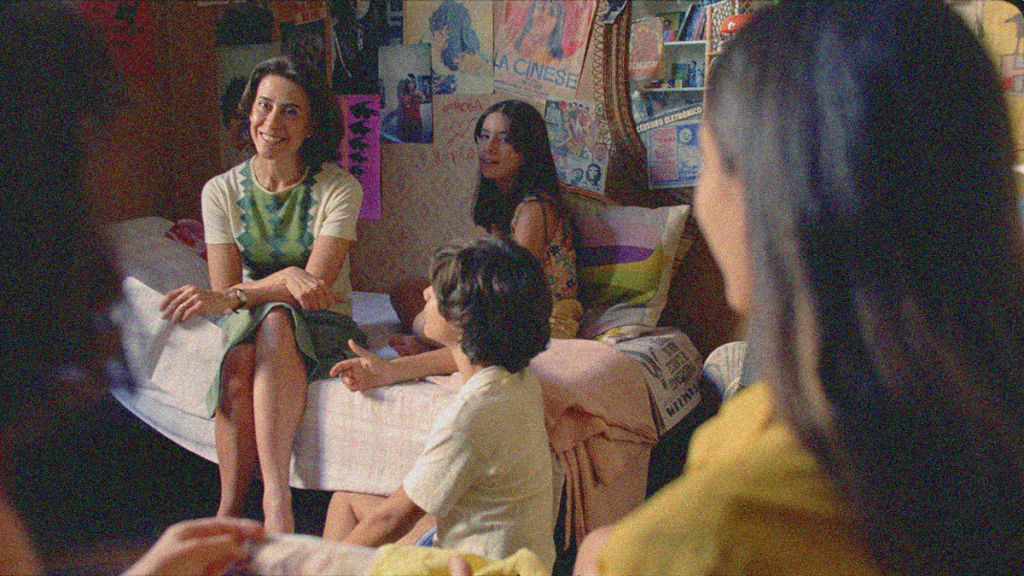
Eunice (Fernanda Torres), however, was willing to go. With five children and zero clue as to what might happen next, you’d be insane not to try. But her husband was confident. Not so confident that Rubens didn’t let his best friend take their eldest daughter (Valentina Herszage’s Veroca) with them to London, but enough to stay the course, see their new home get built, and continue his clandestine work helping to inform those hiding in exile in Chile. So, the Paivas went about their lives as normal. The kids played on the beach, the family held parties, and they given took in a stray puppy to cement their roots further. And just as they started feeling comfortable, a knock at the door changed everything.
Adapted by Murilo Hauser and Heitor Lorega from Rubens and Eunice’s son Marcelo’s memoir, Walter Salles’ I’m Still Here depicts the nightmare that follows with an expert parental gaze. We’re dealing with an eldest daughter abroad reading all about the arrests that occur in the paper, two other daughters (Luiza Kosovski’s Eliana and Bárbara Luz’s Nalu) old enough to understand the truth, and little Babiu and Marcelo proving too young to fully grasp the horrors unfolding. It’s therefore crucial that Eunice takes control of the narrative in her house while desperately searching for answers outside it. Unable to talk freely in case the wrong people are listening, the story must be that Rubens is traveling since the army won’t officially admit he’s been taken into custody.
The film is thus a depiction of Eunice Paiva’s radicalization. First, she must watch as her husband is taken from their house for a “deposition” while armed men remain to ensure no one leaves. Then she is taken in for questioning herself and held prisoner for days while the children were left in the care of the housekeeper. And, finally, the government attempts to gaslight her and the media by saying they don’t know where Rubens is. Eunice does the only thing she can: fight back. She scours the town for evidence proving his arrest, sits down her friends to figure out exactly what Rubens was doing, and puts on a brave face for the children despite ever worsening news.
Juxtaposing the illusion of civil rights at the beginning with the swift arm of oppression is an intentional decision to really drive home just how tenuous our freedoms are in the face of authoritarianism. From a checkpoint where Veroca and her friends are harassed without recourse to interrogation tactics that put Eunice’s mugshot into a book of supposed terrorists, it’s difficult to believe life is still going on outside as though nothing is wrong. The simple fact that Eunice can protect Babiu and Marcelo from the reality of their father’s disappearance is insane, but that’s the game. The longer you allow a dictatorship to infringe upon your sense of independence, the more inured you become to the abuse. Eunice might not have been involved in the resistance before, but she is now.
Intriguingly, Salles chooses not to show us that resistance, though. He utilizes a twenty-five year flash-forward to gloss over the work and instead provide the catharsis inherent to a long-awaited admission. It seems weird at the time because you want to know how Eunice accomplishes what she does to raise her children and get her law degree, but I do believe it was the correct decision. We’ve seen so many examples of regular people joining the fight that nothing Salles could give us during that gap would escape familiarity regardless of its efficacy. He and his screenwriters saw that real draw here was the familial aspect of protecting one’s own while hatching the plan that ultimately allows Eunice to also protect those Brazil wouldn’t.
It’s about the balancing act. About grieving alone so the children can hold onto hope. It’s readjusting priorities and understanding the importance of what Rubens did to get taken so that she could continue that mission in her own way. And it all hinges on Torres being able to pull off the internal emotional struggle to keep moving forward no matter what she discovers. Eunice is a woman who cannot afford to break considering her responsibilities at home, but also one who would refuse to give the regime the satisfaction of thinking it broke her even if she only had to worry about herself. We see it throughout whether from Torres or, briefly, Fernanda Montenegro via epilogue. With Alzheimer’s at its worst, one mention of that period brings clarity back.
I’m Still Here had an Oscars-qualifying run on November 20th, 2024.

Winner:
International Feature
Nominee:
Motion Picture, Lead Actress
Fernanda Torres as Eunice in I’M STILL HERE. Image: Adrian Teijido. Courtesy of Sony Pictures Classics.



 jaredmobarak.com
Leave a comment