
Rating: PG-13 | Runtime: 114 minutes
Release Date: November 1st, 2024 (USA)
Studio: Warner Bros.
Director(s): Clint Eastwood
Writer(s): Jonathan A. Abrams
Sometimes the truth isn’t justice.
The plot of Clint Eastwood and screenwriter Jonathan A. Abrams’ Juror #2 is fantastic. A man (Nicholas Hoult’s Justin) trying to get out of jury duty to be with his wife (Zoey Deutch’s Allison) at the tail-end of her high-risk pregnancy is chosen precisely because he doesn’t want to serve. Thankfully, the murder trial (prosecuted by Toni Collette’s Killebrew, favorite in the upcoming Attorney General election) is apparently open and shut: a man (Gabriel Basso’s Sythe) killed his girlfriend (Francesca Eastwood) after a very public fight at a bar. Unfortunately, it’s not until hearing opening statements that the details start to feel very familiar to Justin. Why? Because he was there. That’s the night he hit what he presumed was a deer right around where they found the victim.
He should stop the trial and tell his side of the story, right? It was dark and stormy. Justin stopped the car, got out to search for whatever he hit, and ultimately saw the “deer crossing” sign directly in front of him. Why should he have assumed anything else? Why should anyone assume anything else? The damage to the car was minimal, so a deer could have simply run away. His line of thinking all makes perfect sense. At worst it’s vehicular manslaughter if it’s proven he hit this woman and he’ll probably get off with probation. The main thing, of course, is that Sythe won’t get life in prison for something it’s beginning to seem like he didn’t do. But there’s one more wrinkle to this tale: the fact that Justin is an alcoholic and no jury would believe he wasn’t drunk.
The film is thus a glimpse into just how complicated the “truth” can be when context is removed and preconceptions are made. The entire reason this case is deemed open and shut is because the world found Sythe guilty before the trial began. His past colors him a bad dude with temper issues and violent tendencies while all the circumstantial evidence points to him being the only person who had motive. Unless a truly awful hand of fate made it so the real perpetrator was an otherwise innocent man without motive who happened to be at the wrong place at the wrong time. To admit that, however, would risk the world finding Justin guilty before his own trial begins. And since neither is in the position of earning a fair shake, why shouldn’t the “truth” become as malleable as their guilt?
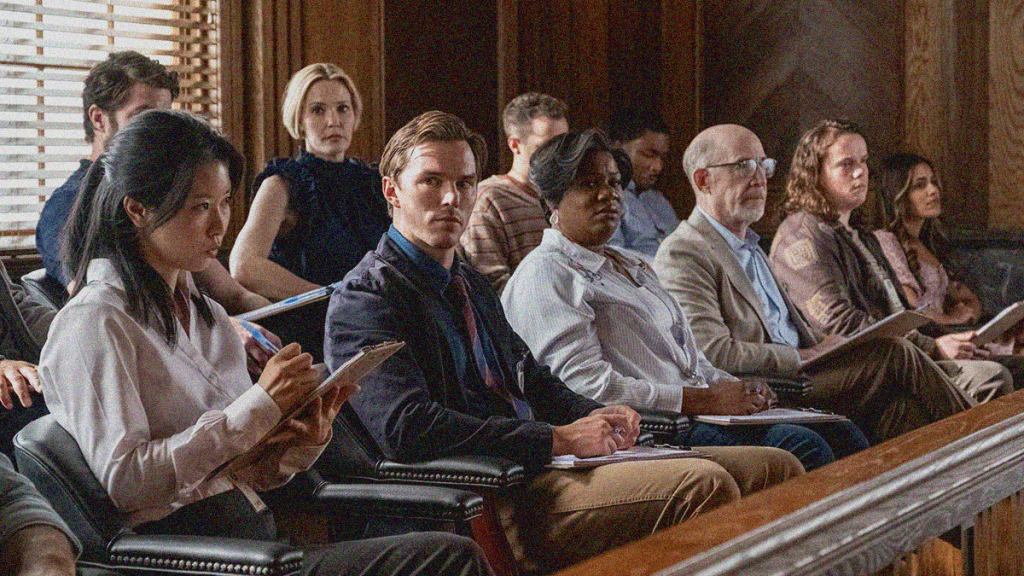
It leads to some serious drama considering Justin seemingly controls the outcome. If he can convince the rest of the jury (consisting of Leslie Bibb, Cedric Yarbrough, J.K. Simmons, and others) to acquit, his conscience will be free as far as sending an innocent man to jail and he’ll be able to go home to his wife and soon-to-be-born baby. It’s a very fine line to toe, though, when questioning Sythe’s guilt inherently means thinking about an alternative cause of death. The further they travel down that road, the greater chance he eventually puts the jury onto his own trail. The one thing he has going for him is that Killebrew needs this conviction to win her election. She won’t let Sythe get away … unless the public defender (Chris Messina’s Resnick) is correct when he says his client is innocent. The longer deliberations go, the more she wonders if he is.
Juror #2 supplies one example of our imperfect system after another. Because if Sythe’s trial is unfair, so would the next. The lawyers have agendas. The jurists do too with some wanting to go home to their kids, some wanting to stay entrenched so they won’t have to go home, and others embracing the idea of handing out justice for past crimes regardless of today’s guilt. Not even the witnesses are absolved from their part when they speak in absolutes that cannot feasibly be absolute. There are a lot of damning moments within this film (and inspiring ones considering some unlikely sources choosing to do right), but the one that sticks with me most is the star witness’s face quickly turning from indignation to fear when asking, “He did do it, right?” days after declaring it under oath.
The stakes become two-fold as a result—and neither concerns Sythe since he tragically has zero control over his own future in this scenario. One follows the ruthless opportunist Killebrew and whether she’ll grow a conscience to dig deeper and see the holes in her case are more than speculative. The other follows the compassionate Justin and whether his mounting guilt will finally push him to tell the truth regardless of the nightmare that would inevitably arise. She wants Sythe in jail until realizing she might have lost her way. He wants Sythe to go free until realizing that sacrificing himself might be the only avenue towards making it happen. Who blinks first? Or, and let’s not pretend this isn’t the more authentic result, perhaps neither will.
So, prepare to watch that night unfold multiple times. Through the eyes of witnesses. Through the vitriol of a prosecutor fighting for the victim’s family. Through the fear of the defendant imploring the jury to believe him. Through the recontextualized memories of a man who must reckon with the fact he might be a killer. Hoult carries it all with an impressive ability to tap into his character’s guilt in a way that has just as much chance of breaking him as it does embolden him. Collette supplies a nice contrast through her character’s unwavering pragmatism and Yarbrough does the same via a depth of emotion that might be the most dangerous mirror on our society of the whole film. Justice is supposed to be blind, but those tasked with serving it rarely are.
(L to r) NICHOLAS HOULT as Justin Kemp, LESLIE BIBB as Denice, ADRIENNE C. MOORE as Yolanda and J.K. SIMMONS as Harold in Warner Bros. Pictures’ “JUROR #2,” a Warner Bros. Pictures release. Photo by Claire Folger. © 2024 Warner Bros. Entertainment Inc. All Rights Reserved.



 jaredmobarak.com
Leave a comment