
Rating: R | Runtime: 90 minutes
Release Date: November 1st, 2024 (USA)
Studio: Searchlight Pictures
Director(s): Jesse Eisenberg
Writer(s): Jesse Eisenberg
It’s good to remember.
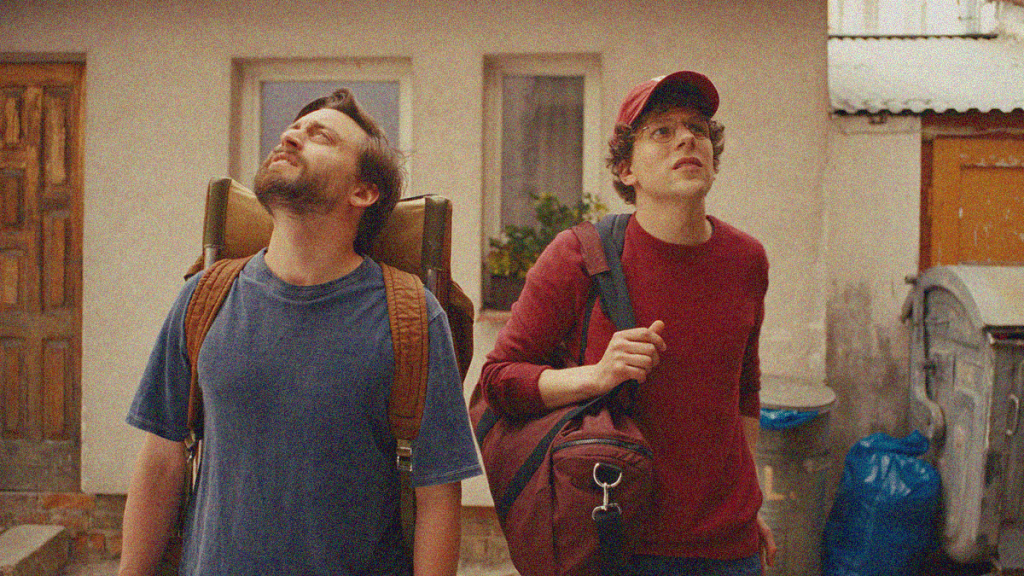
The first time we see Benji Kaplan (Kieran Culkin) is sitting down inside the airport with a thousand-yard stare that doesn’t seem like it would be easy to break. We don’t yet know what haunts him, but it’s obvious something does. And because we get that shot before his manic reunion with cousin David (Jesse Eisenberg), the whole over-the-top excitement carries a deeper level of distraction and avoidance. So too does his penchant for forgetting what it is he’s currently doing and/or the origin of things in his possession. Benji isn’t trying to steal David’s trail mix. He’s just so prone to dissociative behavior that he genuinely believes the bag being in his hand means it’s his.
Eisenberg—who also writes and directs—needs us to see this at the start of A Real Pain as preparation for the complex emotions to come. By setting the stage that Benji is more than just the “life of the party” or an “I speak the truth” asshole, we can start to empathize with his struggle and understand he’s unwell. David knows this too, but doesn’t have the luxury of distance to simply watch the show. Not only must he carry the embarrassment Benji can’t despite being the one earning it, but David must also tread lightly as far as triggering a reaction that he’s unequipped to handle. Because this isn’t just a trip to Poland to visit the home their grandmother lived in before the war. It’s a wellness check.
What a captivating way to provide it too: a Holocaust tour featuring a mix of characters with their own unique suffering. Eloge (Kurt Egyiawan) survived a genocide in Africa before coming to Canada and converting to Judaism. Marcia (Jennifer Grey) is seeking a reset of her identity, leaving a world to which she felt she was losing herself to connect back to her roots. Mark (Daniel Oreskes) and Diane (Liza Sadovy) are looking to do the same with a more tourist-y vibe despite still carrying the weight of the experience. And Benji and David are just two kids on vacation. Yes, they feel the history and horror, but they’re third generation Americans born with certain advantages that were supposed to guarantee success. So, why is Benji so tortured?
Maybe it’s a bit of generational trauma. Maybe it’s psychological distress. Maybe he just feels alone. The crucial fact of the matter is that the reason is inconsequential. Just because you might assume someone in his position doesn’t deserve to feel pain when compared to the others on this tour doesn’t mean it’s not real or that it hasn’t pushed him to the edge. This is a lost man who possesses the charm to engage a room of strangers into letting him hide from his sorrow. Maybe that’s the actual reason why he always wanted to pull an all-nighter on-the-town with David when they were younger. Not to necessarily have fun, but to avoid the nightmarish thoughts that come when he’s alone and asleep.
Credit their tour guide James (Will Sharpe) for handling the tumultuous highs and lows since he doesn’t have the luxury to just stand in awkward silence like the others when Benji flies off the handle. There are a lot of moments here when everyone must walk on eggshells so as not to make matters worse as if anything they’ve done has been the reason. Benji might act as though something has sparked an outburst, but, as we later learn, he’s not completely present in those instances. They erupt out of fear and discomfort. They begin when he’s drowning in a sea of internal chaos that he can only alleviate by making it external instead. Give him a couple minutes and it’s like nothing even happened.
It’s a heartbreaking performance—one we saw glimpses of during “Succession” whenever Culkin’s Roman Roy was presented with the reality that what he wants might not be worth the terror of going against his father. That same haunted look of panic exists in Benji too, but with a heavier weight on his soul that cannot be as easily confused with cowardice. Because he can’t escape himself. He can’t remove himself from the feelings of isolation and uncertainty that come from being alone. It’s why he wants to spend so much time in the airport “meeting crazy people” or searching for rooftops to smoke pot. As long as he’s moving, the pain can’t settle. And if he’s too busy cracking jokes or causing a fuss, the horrible things he’s telling himself can’t be heard.
Kudos to Eisenberg for finding the sensitivity to not only write this character with such depth of humanity, but also to reject easy answers or solutions for him. Whereas lesser work would have David’s presence become the salve that saves Benji’s life, A Real Pain knows how patronizing doing so would be. The best his character can do—the best any of us can do—is make certain the person in pain knows they love them and are around whenever they need them. Smothering his cousin would prove just as damaging as ignoring him completely. David will just have to live with the worry. And Benji will have to keep fighting to deal with the anguish, guilt, and self-loathing. We all have pain to manage.

Winner:
Supporting Actor
Nominee:
Original Screenplay
Kieran Culkin and Jesse Eisenberg in A REAL PAIN. Photo Courtesy of Searchlight Pictures, © 2024 Searchlight Pictures All Rights Reserved.



 jaredmobarak.com
Leave a comment