
Rating: NR | Runtime: 90 minutes
Release Date: August 27th, 2024 (USA)
Studio: Cranked Up Films
Director(s): Quinn Armstrong
Writer(s): Quinn Armstrong
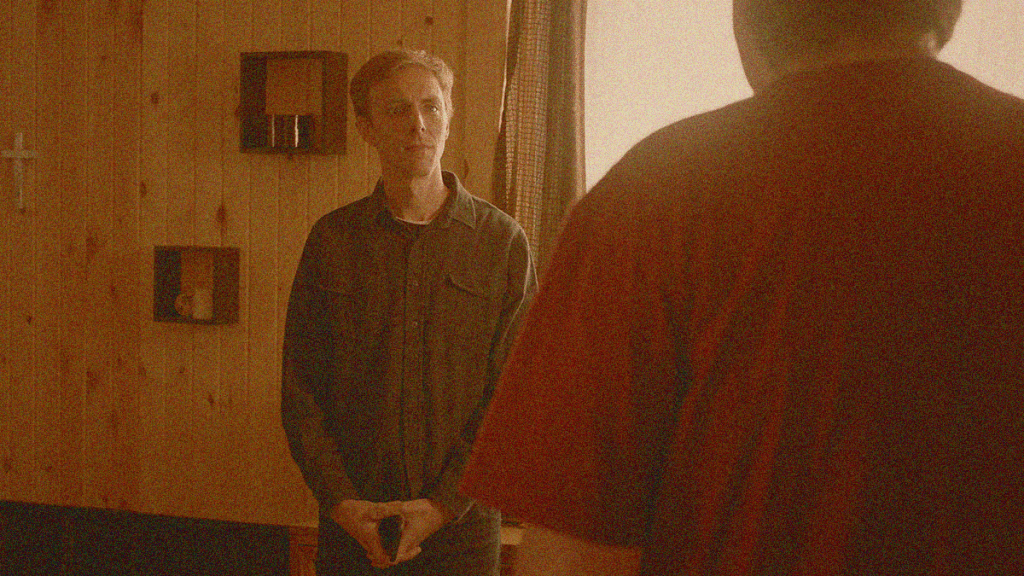
At one point during Quinn Armstrong’s The Exorcism of Saint Patrick, seventeen-year-old Trick (Michael J. Cline) asks Pastor Pat (Steve Pinder) why the church can’t simply accept him for who he is. The latter—hired by the former’s parents to conduct a one-on-one conversion therapy retreat with the boy—starts spouting vagaries about how the “Book” says so. When Trick pushes back, however, Pat finally gets to real reason: Because the more concessions Catholicism makes, the less uniquely special those who belong become. His religion (all religions, for that matter) isn’t therefore about salvation. It’s about control.
Trick’s parents want control over his identity. The church wants control over humanity. Pat wants control over his life. And in order for all those entities to achieve that power, they must destroy whoever stands in the way … even if they know it’s wrong. Because Pat does know that things aren’t like they used to be in the past. Some lines aren’t supposed to be crossed anymore—not because of morality or decency, but because the church has changed course in a bid for self-preservation. This institution still wants to “save” young gay boys and girls from damnation, but they don’t want to be sued in the process.
Armstrong does well to portray the generational history of this barbaric act by opening the film with a character (Maya Jeyam’s Alana) we won’t really get to know until the end. We watch her get kidnapped during the night before being forced to watch a video from her parents explaining why they’ve allowed it to happen as a means to save her soul. Her pain and tears are enough to guess the result of her conversion. She becomes a glimpse at the pattern continuing today with Trick. And while the rest of the film progresses from the vantage point of his “therapy” with Pat, we never fully escape the pull of the past.
The supernatural underpinnings of this horror are subverted as a result. Whereas we’d usually be watching ghosts frighten people with malicious intent, the shadows Trick sees are instead offering help. Why? Because they know what he’s feeling. They know that his greatest fear isn’t death, but the eternal realm in which he’s destined to reside in its aftermath. That’s the power the church holds over him. Homosexuals and suicides burn in Hell. So, if Trick can’t be “fixed,” what alternative is there? What escape has God provided? Can those ghosts be a sign that it’s actually okay to die? That he won’t suffer alone?
It’s an intriguing tale that can get a bit too unwieldy once we inch closer to the end. Armstrong is perhaps giving us too much credit insofar as realizing there’s more than one ghost in the distance. Talk about Alan (Alan Tyson) and an appearance by Meredith (Caitlin McWethy) also do more to distract than enhance until the denouement finally supplies the context with which to understand how they fit. The whole is thus better upon reflection than it might seem in the moment. I think that eventual clarity does ultimately redeem it from my initial indifference, but I understand if it won’t be enough for others.
A scene from THE EXORCISM OF SAINT PATRICK; courtesy of Cranked Up Films.



 jaredmobarak.com
Leave a comment