
Rating: R | Runtime: 97 minutes
Release Date: August 23rd, 2024 (USA)
Studio: Magenta Light Studios
Director(s): JT Mollner
Writer(s): JT Mollner
Are you a serial killer?
Nothing is as it seems in JT Mollner’s Strange Darling. Except, of course, that being told as much means everything is exactly as it seems. The problem with marketing your film as unpredictable is that audiences inherently stop thinking about where things should go and start hypothesizing where they will instead. Suddenly everything we see as one thing automatically becomes its opposite because we know that pitch means the filmmaker must make us believe the bait in order to activate the switch. It’s why many such works fail.
The fact that this one doesn’t is meaningful as a result. Yes, it’s easy to guess the broad-stroke red herrings Mollner uses. His job is therefore to ensure where he takes us in response to their unveiling is worth the trip. Considering I haven’t heard a single bad thing about it (straight down to Ed Begley Jr. tweeting “I haven’t been in a film this great in decades.”), he objectively succeeds in that pursuit. Because Mollner knows it’s not enough to simply pull the rug. He must make the rug entertaining as well. So, he can give us the role reversal we expect and then provide another (or more) for good measure.
It helps that the script itself does the same. First it tells us that this is going to be a story told in six chapters. Then it commences out of order. The assumption is then that what we seeing is real because enough time has passed off-screen to make it so. That’s why there needs to be so many false bottoms. The middle is a result of the beginning just as much as the end is a result of the middle yet cause and effect don’t always align with good versus evil. Victims can sometimes become killers seeking revenge. Killers can sometimes become victims if things go south.
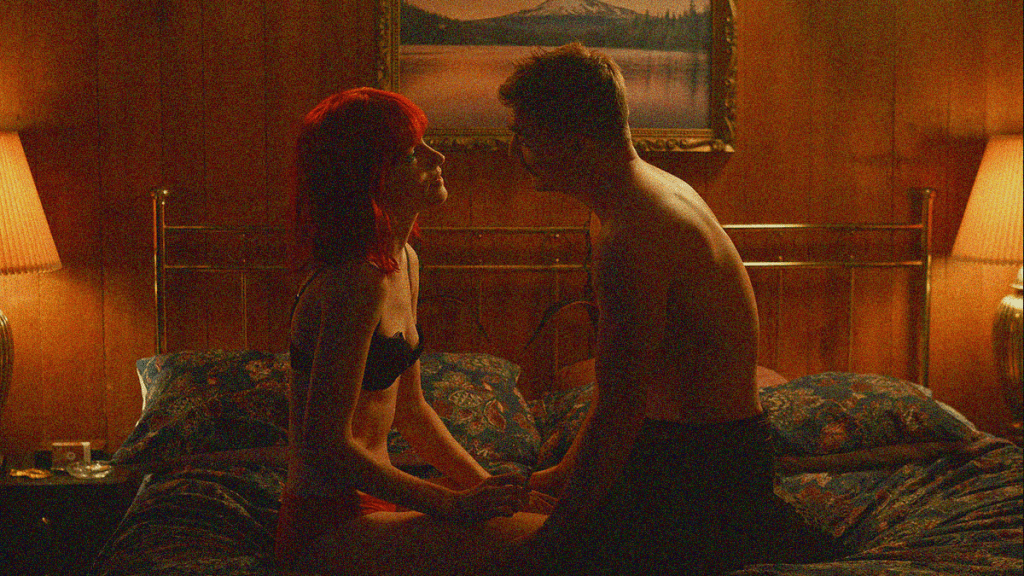
Add notions of role play, gender norms, and desperation to the equation and the actual pitch becomes “nothing is as it seems precisely because what we see is all real.” The Lady (Willa Fitzgerald) is being pursued by The Demon (Kyle Gallner) and his rifle. She’s also asking him to rough her up in bed. One does not negate the other and how they play out together differs depending on which happens first. Shuffle that progression around and how we perceive the dynamic becomes blurred even more. It’s not that Mollner is manipulating his characters to hide the truth. He’s manipulating our preconceptions to heighten it.
As you can tell from my getting this far without supplying more than two lines of plot (he chases her, she seduces him), going in blind is paramount. Let Mollner’s machinations unfold in real-time and, if you’re able, stop yourself from trying to guess what’s next despite the marketing begging you to do so by making its twisted strings a selling point. Because this is ultimately a film about two people pushed to the edge of self-preservation. He must kill her. She must kill him. They must survive each other. And those in their path (Begley Jr., Barbara Hershey, Steven Michael Quezada, etc.) are destined to suffer being in the wrong place at the very wrong time.
Do the ends justify the means? My initially thought was “not as much as it wants.” The serial killer angle is kind of shoehorned in despite it being one of the few truths we’re given in the synopsis (leaving the justification for killing less interesting than it should be on paper) and the “Mountain People have guns” angle is perhaps too comical not to derail some of the tension (regardless of Mollner saying the absurdity is intentional). But neither truly impacts the result. There are enough twists and turns in Fitzgerald’s performance alone for those aspects to never become more than blips amongst the whole. I was never bored. I was always invested in the pursuit(s). And the underlying desperation breeds mess. So why not embrace it?
Willa Fitzgerald and Kyle Gallner in STRANGE DARLING; courtesy of Magenta Light Studios.


 jaredmobarak.com
Leave a comment