
Rating: TV-MA | Episodes: 10 | Runtime: 60 minutes
Release Date: February 27th, 2024 (USA)
Studio: FX Network / Hulu
Creator(s): Justin Marks & Rachel Kondo / James Clavell (novel)
Why is it that only those who have never fought in a battle are so eager to be in one?
Despite the title, Yoshii Toranaga (Hiroyuki Sanada) is adamant about not seeking sole rule of Japan throughout Rachel Kondo and Justin Marks’ adaptation of James Clavell’s novel “Shōgun”. His every move is instead in service of ensuring the young heir of the realm’s late leader will take control when he comes of age. The main threat from doing so doesn’t come from outside the empire, though. It comes from those who do wish for that power themselves. That’s why Toranaga refused an offer to be sole regent. He knew others, like Ishido Kazunari (Takehiro Hira), would simply kill him and the heir. By helping to steer the ship with Ishido and three other Lords together, however, decorum might keep them alive.
Those versed in the history of Japan at the end of the Azuchi–Momoyama period will know that a shogunate is coming. This story doesn’t necessarily deny that fact despite its protagonist’s protestations, it merely refuses to pretend like that can ever truly be a thought now considering how much is stacked against Toranaga. Regardless of his desires, the drama that unfolds puts his very life at stake. He’s done his best to steward the heir and cultivate peace, but Ishido has consolidated power via promises to his fellow regents (and their Catholic backers lining pockets) in exchange for their votes to impeach Toranaga from the council. Doing so would prove a death sentence.
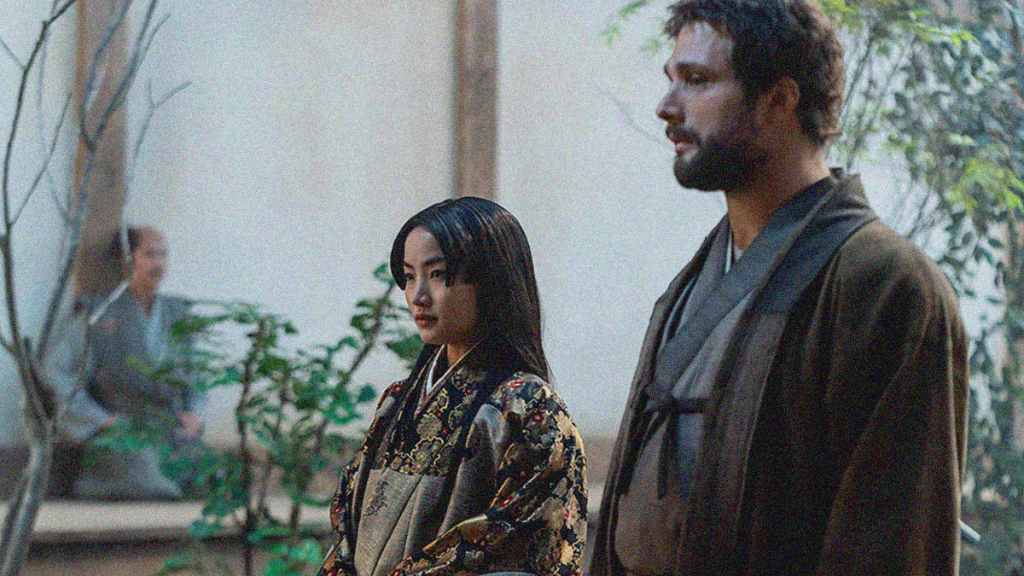
Enter John Blackthorne (Cosmo Jarvis), a Protestant English pilot on a Dutch ship that has been sailing toward the Pacific with the sole goal of taking over the Portuguese Catholics’ trade monopoly in the region. Unfortunately for him (whether he is willing to accept his failure or not), there are barely enough sailors to man the ship when it washes ashore let alone anyone with the strength to fight. The only reason he isn’t killed as a “barbarian” is the fact that he speaks Portuguese. That skill gives him a voice—one he’s all too willing to use to hang himself anyway, but also one that piques Toranaga’s interest as a distraction. The more issues for the council to juggle, the more time he has to hatch a plan.
And that’s pretty much the entire crux of the ten-episode miniseries—one that has been lauded for its faithfulness to Clavell’s source material while also currently being retrofitted into a “season one” as Marks and Kondo have earned the ability to expand its finite story into a trilogy post-success. “What is Toranaga’s game?” becomes a question that everyone on-screen asks. Ishido to know what it is he must do to defeat him. Blackthorne to know what it is he must promise to stay useful and perhaps curry favor into a quid pro quo. And Kashigi Yabushige (Tadanobu Asano), a lord who both pledges allegiance to Toranaga and deceives him, to know which councilman provides him the best chance to keep his head.
There’s obvious drama in this. Especially since circumstances are constantly changing courtesy of betrayals, incompetence, and pride. The real suspense is thus in the underlying theme of loyalty and the difference in its meaning between Japan and Europe. Here it is everything. So much so that men are committing seppuku to maintain their honor and fealty in the face of something as seemingly small as talking out of turn. There are women whose lives have been spared despite their families being sentenced to death who want nothing more than to join them if not for their duty to oblige their master’s request to live. Blackthorne, while admiring their courage, considers them all a series of pointless deaths.
One could say the lesson of the tale is therefore teaching this foreigner that is certainly not the case. And there are many examples with which to do so during the show’s unflinching success at serving the narrative above all else. A lot of characters die in service of that message. Sometimes their deaths are as symbols of the culture’s heavy weight. Sometimes they are evidence of fate’s guiding hand to knock sense into those too stubborn to find it themselves. No one is off-limits (theoretically speaking since both Toranaga and Blackthorne are too crucial to the proceedings not to at least make it to the finale) and most of these demises become somber notes with which to sit with at the end of an episode.
The meaning behind each is only augmented by the three-dimensional performances delivered by a cast that knows they might be next. Nobody can afford to mail it in. Sanada and Jarvis are great at the top, carrying everything with the emotional heft of always having everyone’s eyes upon them. My favorites, though, are Asano’s Yabushige and Anna Sawai’s Toda Mariko. Both roles live with a duality between duty and desire. Yabushige wants fame and fortune, but he’s willing to die by Toranaga’s side so as not to tarnish his name in that pursuit (unless he can do so without that risk). Mariko wants to escape a punishing life she believes was stripped of meaning, but she’ll accept purpose through Toranaga’s need for her assistance.
Shinnosuke Abe’s Buntaro (an unequivocal hero and Mariko’s abusive husband), Tommy Bastow’s Father Martin Alvito (aligned with the Catholic Church’s mission yet keenly aware of the human cost it sometimes shouldn’t pay), Moeka Hoshi’s Usami Fuji (Blackthorne’s reluctant consort), and Tokuma Nishioka’s Toda Hiromatsu (Toranaga oldest and most trusted friend) are each fantastic in their own way too. They all have a role to play in the larger picture, but each is allowed agency in choosing how they fulfill it. The best drama on-screen comes when characters stand their ground and call each other out. Sometimes they sway the other to their side. Sometimes they don’t.
Filmed mostly in Japanese (and when English is spoken, it’s actually a stand-in for Portuguese being it’s the only European language Japan knows at this time), the vibe and production value seems steeped in the nation’s historical and cultural meaning. Sanada is a producer and there seems to have been a conscious effort to get as many Japanese and Asian voices in the room as possible to maintain legitimacy and keep things from becoming a “white savior” trope—something this is very much not. By centering Blackthorne, the script is able to educate us through him about the beauty of this land and its customs. It’s not about him saving Japan or the Church saving souls. It’s about Japan saving itself from the corruption those external forces brought to its shores. It’s the violent struggle to remember that life and death mean more than wealth and power.

Anna Sawai and Cosmo Jarvis in SHŌGUN; courtesy of FX.



 jaredmobarak.com
Leave a comment