

Rating: NR | Runtime: 91 minutes
Release Date: October 25th, 2023 (France) / June 28th, 2024 (USA)
Studio: The Jokers / Oscilloscope
Director(s): Adrien Beau
Writer(s): Adrien Beau & Hadrien Bouvier / Aleksei Tolstoy (short story “La famille du Vourdalak”)
Wait six days for me.
Not sure I’ve heard a worse sound than the sucking/chewing of shrouds in Adrien Beau’s The Vourdalak. Give me the breaking of skulls at the bottom of a chasm instead—a sound Sdenka (Ariane Labed) describes when putting Marquis Jacques Antoine Saturnin d’Urfé (Kacey Mottet Klein) in his place. We never actually hear that one, though, because we don’t need to hear its crunch to know it happened upon seeing something disappear over the edge of the cliff. The inevitability is enough horror itself. Those wet mouth sounds are conversely a precursor to nightmare. A warning that it may already be too late.
Adapted by Beau and Hadrien Bouvier from Aleksei Tolstoy’s “La famille du Vourdalak” (a story that predates Bram Stoker’s Dracula), the film centers on a haunted peasant family in the forest of Serbia that the aforementioned Marquis stumbles upon while fleeing for his life from an attack. A long way from his royal court, d’Urfé follows the instructions of a gruff man refusing to give him sanctuary himself. He says to find shelter from the night and run straight down a western path to the house of Gorcha (Beau) for help. But he warns not to stop along the way for “evil seethes” in these woods.
So, what does the hapless d’Urfé do? He quickly gets distracted. First by Sdenka. Then by her brother Piotr (Vassili Schneider). Luckily for him, they’re merely eccentric rather than dangerous. And, in fact, two of Gorcha’s three children (rounded out by Grégoire Colin’s elder statesman Jegor). Unfortunately for them all, however, Gorcha is presently missing. He’s gone to fight the Turks so as not to be labeled a coward (despite his old age) and told his family to await his return for six days. If he doesn’t come back before then, they should mourn his death. If he arrives after then, they should know it isn’t him who’s returned.
The myth of the Vourdalak intrigues with its proto-vampire description of a blood-sucking monster that feeds on those its human form loved. You know it’s not your relative because of how it chews on its death shroud, but sense has never had a great track record besting desire. Should Jegor truly assume his father is now an undead creature? Should Piotr truly attempt to put a stake through his heart to hold him in place and burn him to ash? Should d’Urfé believe any of the craziness he’s stumbled into on his search for a horse to return home? He should have run away the second things got weird.
But d’Urfé is falling for Sdenka and, despite appearances, might have a bit of hero’s blood in him after all when Jegor’s young son Vlad (Gabriel Pavie) is threatened in the night. So, he stays. He becomes a watcher (much like us) as Gorcha seeks to feed on his family—since love is what makes the blood sweeter and he has no connection to d’Urfé … yet. The film is thus a series of unfortunate events wherein doing the right thing is always undermined by the fear of being wrong. Because even though Gorcha looks like a puppet to us, he still resembles their patriarch. He still commands their respect and loyalty.
Despite Gorcha obviously being a puppet, he looks great. A creepy skull with wooden teeth staring daggers at the other characters, daring them to make a move while he holds a musket in his hands. There are some truly unforgettable moments, including a scene that mimics the poster (albeit with a different victim) and a few bloody kills shot in 16mm. And while the somber tone mixed with dark humor is great and the ending proves sufficiently bittersweet and damning (a stark difference from the novella if the plot summary I read is correct), that slurping of bloody cotton is still what sticks with me most. What a horrific sense memory to be burned onto my brain … but well worth it.
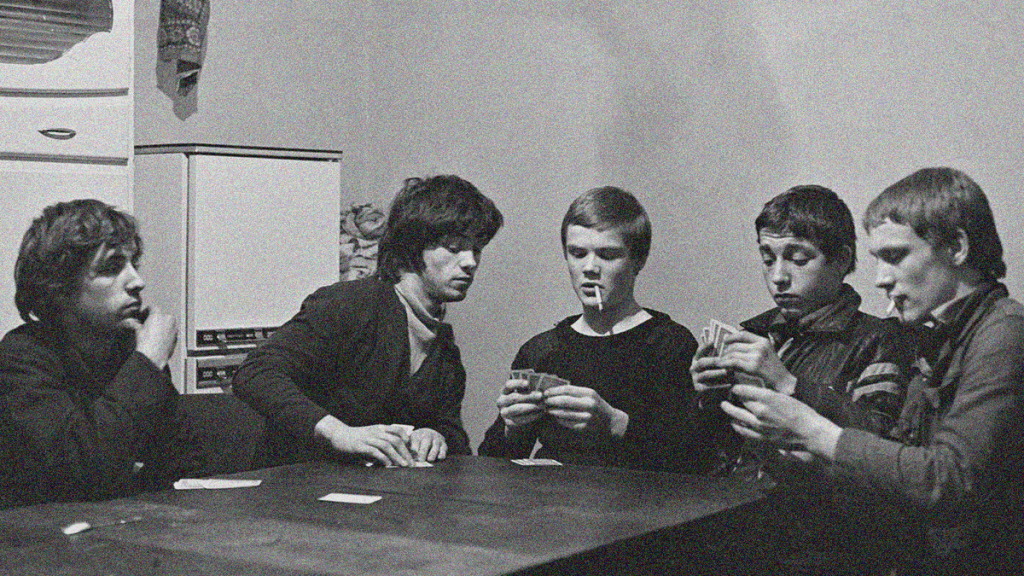
Kacey Mottet Klein and Ariane Labed in THE VOURDALAK; courtesy of Oscilloscope.


 jaredmobarak.com
Leave a comment