
Rating: R | Runtime: 88 minutes
Release Date: February 9th, 2024 (USA) / February 23rd, 2024 (UK)
Studio: Protagonist Pictures / Bleecker Street Media
Director(s): Andrew Cumming
Writer(s): Ruth Greenberg / Andrew Cumming, Ruth Greenberg & Oliver Kassman (story)
It’s punishing us.
Director Andrew Cumming and screenwriter Ruth Greenberg’s Out of Darkness delivers timely subject matter in its depiction of a group of Stone Age humans searching for a new home. There were four different types roaming the Earth at that moment, and, as we know, only one of them inevitably made it out to evolve into us: Homo sapiens. Why did they survive? How did they survive? What monsters may have lurked in the shadows for them to defeat so they could ultimately persevere? Or was salvation won by becoming the monsters?
It’s all about that age old fear of the “other” and how history is written by the victor. How we dehumanize another race or culture’s differences instead of taking the time to learn and understand the similarities. How labels like “monster” and “demon” arise so we may indoctrinate ourselves with the notion of an enemy that must be trying to kill us if we are trying to kill them. It’s the origin of genocide like the one currently unfolding in Palestine. A lack of empathy and compassion courtesy of an unfounded and irrational terror born from one’s own sins.
So, when Adem (Chuku Modu) breaks free from his clan to find paradise, he steels himself to the reality that he’ll need to fight his way through. Whatever might stand between him and prosperity must be unceremoniously cut down. Does that hubris lead to their discovery of barren land instead? Is God punishing him as Odal (Arno Lüning) muses? Or must they simply continue forward despite a lack of food and Adem’s new wife (Iola Evans’ Ave) needing nourishment to save the baby growing inside her?
Add Adem’s younger brother (Kit Young’s Geirr), his other child (Luna Mwezi’s Heron), and the stray they’ve picked up along the way (Safia Oakley-Green’s Beyah) and the potential for conflict only increases the longer things refuse to go right. They start blaming each other for their troubles. Their circumstances start forcing them to make bad decisions. And, with a howl in the night, they start being hunted as prey. One of them is taken and another killed. Where should the rest turn? To their faith, wits, or growing futility?
Out of Darkness intrigues by showing how genetic evolution never quite helped evolve our species psychologically. We still suffer from superiority complexes. We still give credence to superstition. We still ignore what our eyes see by choosing violence rather than support. We create villains out of our victims so as not to confront the reality that we are to blame. It’s all there on-screen as Geirr and Beyah are backed into a corner opposite the known (their traveling partners) and unknown (the beasts in the forest) and also in today’s news as more and more children are senselessly murdered.
It’s a tense affair with fantastic sound design that keeps the horror alive. Moments of gore are few but effective with the whole spoken in a made-up language (Tola) loosely based upon Basque. Yes, it’s another “we were the monsters all along” narrative, but it arrives in a unique package that embraces the nihilism of the concept instead of the hope that might remain despite it. Because we can still believe humans are “good at heart” despite doing “bad things” when watching this tale unfold in the present day. To see it set 45,000 years ago, however, demands we consider the opposite might be closer to the truth.
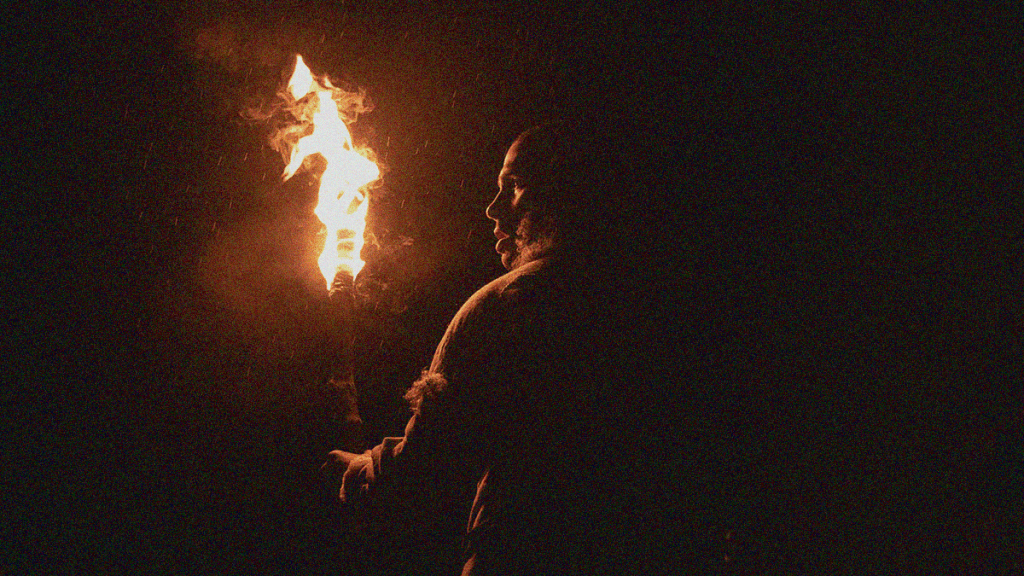
Chuku Modu in OUT OF DARKNESS; courtesy of Bleecker Street.


 jaredmobarak.com
Leave a comment