
Rating: PG-13 | Runtime: 135 minutes
Release Date: November 8th, 2023 (France) / December 13th, 2023 (USA)
Studio: Gaumont / IFC Films / Sapan Studios
Director(s): Anh Hung Tran
Writer(s): Anh Hung Tran / Marcel Rouff (novel La vie et la passion de Dodin-Bouffant)
How many times will you ask me?
Adapted as a prequel to Marcel Rouff’s source novel, Anh Hung Tran’s The Taste of Things is a wonderfully sweet and tragic tale of the life and love shared by two souls only interested in their art. Does that mean they can’t also have a romantic relationship? No. As long as it doesn’t affect the product of their culinary partnership in the kitchen—he as gourmet and she as cook. For twenty years they’ve worked side-by-side to create meals fit for royalty. The food they serve is their labor of love.
Not that Dodin Bouffant (Benoît Magimel) hasn’t asked for Eugénie’s (Juliette Binoche) hand in marriage multiple times. But why ruin a great thing? Why force a label and thus risk altering an equilibrium based on a level of independence and separation outside the kitchen that married couples in the 1800s didn’t often have? Because to watch them cook that first meal—a lengthy opening sequence that eats up most of the first hour—is to see an unwavering level of respect for one another, but also a clear division of duties.
He gets to eat with their guests while she keeps the food cooking in the kitchen. Despite their closeness, a gulf still exists … or it seems that way at least. Thankfully, one of those guests goes behind the scenes to chastise Eugénie for not eating with them before hearing how she “did” through the art of making that which they ate. She therefore chooses to be in the background. It’s a necessary detail to learn because the inherent politics of a man and woman as “equals” at that time forces us to presume the opposite. That they truly are equals is crucial.
From that point on we can bask in the joy they share. It’s as though they are of one mind at times, a fact brought to life by a story about a dream Eugénie had wherein Dodin appeared as though she willed it. Theirs is one life regardless of the labels society might project upon them. They wake-up in separate rooms (whether or not they shared one the previous night) and begin their day behind the stoves. They contemplate a new apprentice (Bonnie Chagneau-Ravoire), visit their esteemed neighbors, and consider a menu for the Prince of Eurasia.
Anyone who knows how Rouff’s book starts, however, knows how Tran’s film must eventually end. As such, conflict arrives in the form of potential tragedy via an unknown illness. It colors the whole (especially Dodin’s ability to remain as happy as he is when he believed everything was okay) by adding a sense of urgency that two decades of routine can easily gloss over if you aren’t careful. That isn’t to say resentments exist. But there are perhaps some regrets. So, while the opening meal is Eugénie orchestrating a masterpiece for guests, the final meal is Dodin conducting one solely for her.
There’s beauty to the gesture and a warmth to their reactions (perhaps helped in part by Binoche and Magimel’s history together) that renders The Taste of Things a gorgeous love story marked by the smiles and stares shared in the background of what proves a 19th century dramatic symphony of food porn. I felt like I was watching Frederick Wiseman’s Menus-Plaisirs – Les Troisgros again, that’s how in-depth and process-driven the kitchen scenes are. So, of course it all culminates in one final overlap where memory’s grief becomes momentarily erased by the excitement and potential of food worthy of conjuring nostalgia instead.
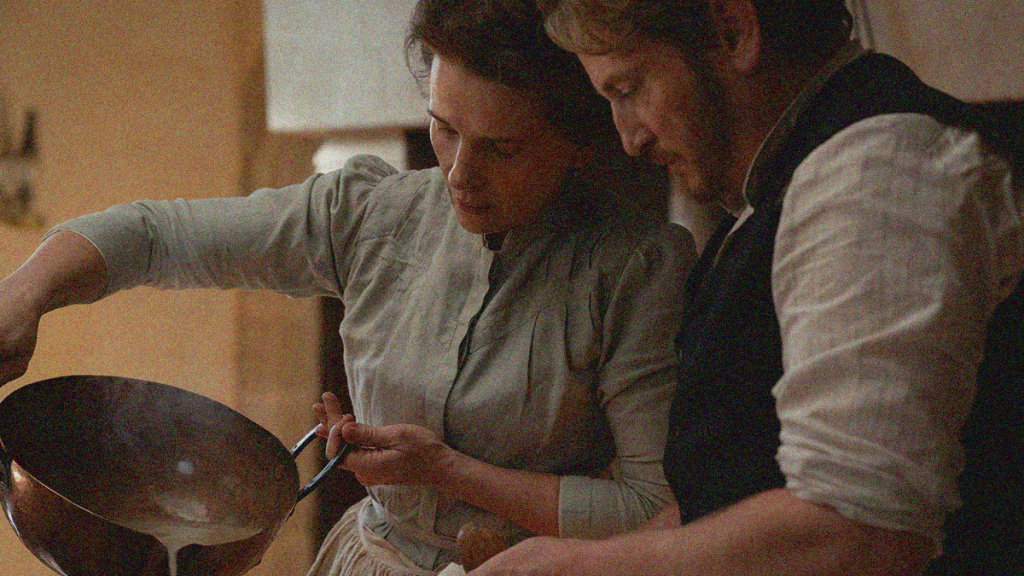
Juliette Binoche as “Eugénie” and Benoît Magimel as “Dodin” in Tran Anh Hung’s THE TASTE OF THINGS. Courtesy of Stéphanie Branchu. An IFC Films Release.



 jaredmobarak.com
Leave a comment