
Rating: R | Runtime: 113 minutes
Release Date: October 27th, 2023 (USA)
Studio: A24
Director(s): Sofia Coppola
Writer(s): Sofia Coppola / Priscilla Presley & Sandra Harmon (book Elvis and Me)
I’m just afraid you’ll forget me.
It’s not just that Sofia Coppola’s Priscilla is based on the book Elvis and Me by Priscilla Presley and Sandra Harmon. Priscilla Presley is also an executive producer. So, what you see on-screen is presumably what really happened. The love and the abuse. This story is a trial by fire in many respects as a result—the eye-opening experience of becoming an adult under an oppressive spotlight alongside someone who never could himself. It’s about control. Acquiescence. Revolt. It’s an ivory prison of co-dependency wherein the doll becomes real and ultimately discovers that fantasy is often better kept to the imagination.
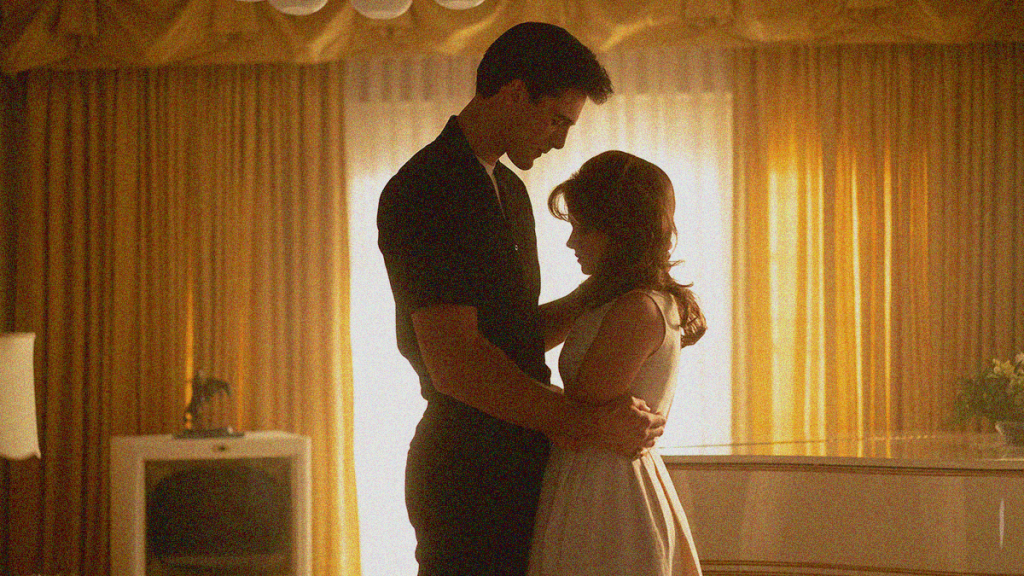
Cailee Spaeny is fantastic as Priscilla. Between wardrobe/make-up and performance, you really do get the sense that she’s a fourteen-year-old girl at the start who cannot contain the excitement of meeting the most famous man on the planet in Elvis Presley (Jacob Elordi). And then the twenty-five-year-old actor gradually matures as the years go by, waking to the fact that her every movement since that fateful night in Germany has been dictated by him. Elvis lures her in with vulnerability and keeps her with delayed attention and gratification. He uses her as a stand-in for home—something to return to without needing to commit.
To watch these events unfold is to realize Priscilla is being groomed as a surrogate mother right when Elvis lost his. Not in a maternal sense, but in the sense of unconditional love. In his eyes, he can mold this child to be the woman he needs. Someone to “keep the fire going at home” while he’s away doing drugs and having affairs. Someone who will forgive his every indiscretion with but a smile because it is in her DNA to give him everything regardless of whether she receives anything in return. And when she dares to remind him that she in fact has no obligation, that’s when the rage flies. That’s when we see he was the real child all along.
It’s a captivating vantage point. Less about Priscilla herself (until the final fifteen or so minutes when she’s finally able to break loose, call him on his BS, and evolve through montage rather than extended bouts of Stockholm syndrome) than an uncensored look at Elvis through her eyes—the only ones able to truly experience that which Colonel Tom Parker meticulously kept from the public’s view. This is about surviving his magnetic charisma and mercurial temper. It’s about being trapped by the promise of happily ever after only to slowly realize the impossibility of that dream if everything revolves around his happiness alone.
Maybe Elvis wasn’t a monster (Elordi does a great job toeing the line with sweet nothings alternating between red hot anger and manipulative gaslighting), but he was a predator. And maybe Priscilla wasn’t a victim, but she was exploited. This isn’t a “usual” situation. There can exist complexity wherein Priscilla can look back with fondness for the good times and hindsight for the bad. I think Coppola does well balancing that duality, never shying from the violence or the romance. If anything, she employs that convergence to deliver a compelling biopic that seeks to dismantle the illusion by recreating its inescapable allure.
(L-R) Jacob Elordi, Cailee Spaeny in PRISCILLA; Credit: Sabrina Lantos.


 jaredmobarak.com
Leave a comment