
Rating: TV-MA | Episodes: 8 | Runtime: 60 minutes
Release Date: October 12th, 2023 (USA)
Studio: Netflix
Creator(s): Mike Flanagan
Your family is a collection of stunted hearts whose time has come.
I’m not that familiar with the works of Edgar Allen Poe. I’ve read some. Watched a movie or two. I even finished Kevin Bacon and James Purefoy’s “The Following”. So, I know the gist of the stories. I’m simply not some superfan with any thoughts on whether Mike Flanagan adapted the poet “correctly” via “The Fall of the House of Usher”. I’d guess the answer is “Yes, he did” considering I could see Poe’s plots, spirit, and themes shining through this Sackler family fanfiction amalgamation. But I’d also propose that it doesn’t matter. The only question should be whether it works on its own.
That’s the sign of a truly successful adaptation. Not whether it got every detail correct, but that it found a voice of its own from within the original’s inspiration. (I always use Ron Howard’s mediocre Dan Brown movies as an example of how filming the book is never the correct choice. You must turn the book into a movie and then film that.) I think this one works so well that it might be my second favorite of Flanagan’s Netflix miniseries projects behind “The Haunting of Hill House”. I liked “Bly Manor” a lot, respect “Midnight Mass” despite it faltering somewhat, and have an affinity for “The Midnight Club” due in large part to nostalgia, but “Usher” really puts everything together like that first foray.
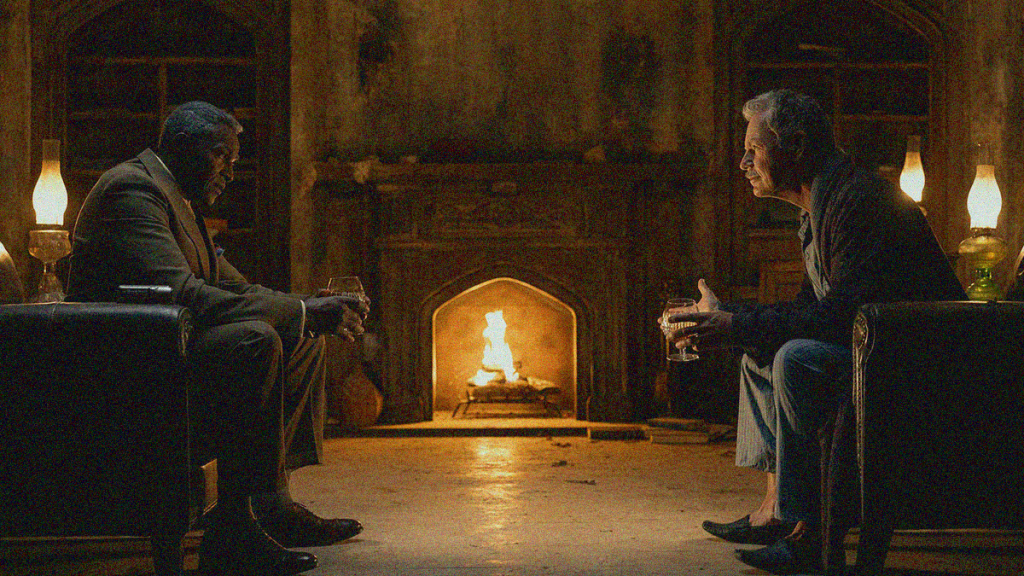
Similar to how he handled Henry James’ and Christopher Pike’s work, Flanagan takes one Poe story as his scaffolding (Usher) and weaves the others into its tapestry to tell tales of each character’s inevitable demise. The title is thus about siblings Roderick (Bruce Greenwood, who took over the role from Frank Langella after he was fired for inappropriate behavior) and Madeline Usher (Mary McDonnell). They are the last surviving members of their bloodline and the end is nigh. He invites the short story’s “narrator” (Carl Lumbly’s C. Auguste Dupin) to see it, but also to explain what “really” happened to the others: six children given an episode each to fall themselves.
Episode One (“Midnight Dreary”) isn’t all exposition, however. It houses a murder too—the murder that starts everything that follows over half a century later. Then it’s debauchery in “Masque of the Red Death”. Carnage in “Rue Morgue”. Insanity (“Black Cat”), guilt (“Tell-Tale Heart”), jealousy (“Goldbug”), and hubris (“Pit and the Pendulum”) all en route to the finale’s returned focus onto Roderick himself (“The Raven”). And while she takes many names and personas throughout the entire proceedings, it’s that last story where the name Verna (Carla Gugino) arrives. Not because anyone ever calls her by it, but because that name is an anagram of her Corvus form.
She’s as important to this tale as Roderick and both Gugino and Greenwood prove as much by giving everything they have to the roles. There’s an obvious severity to the overall macabre tone, but also a wealth of humor. These are two characters (matched by McDonnell’s Madeline) who know who they are and suffer zero fools as far as wasting time pretending anything different—that confidence inherently breeds comedy. This attitude is crucial too since everyone else does pretend in some respect. The children have been pitted against each other for so long that they all wear façades to survive their own insecurities, let alone the pressures of a very public existence to go along with any private ambitions they may still harbor.
Most of the kids are caricatures as result—funny in their own right too. Frederick (Henry Thomas), Tamerlane (Samantha Sloyan), and Camille (Kate Siegel) are the biggest with Leo (Rahul Kohli) and Perry (Sauriyan Sapkota) following closely behind. Victorine (T’Nia Miller) is the outlier. Her ambition is to do good in this world and she has a significant other (Paola Núñez) who’s kind-hearted and altruistic enough to almost keep the evil of the Usher name from corrupting her soul. As we know from the start, though, even Victorine must die. Almost isn’t quite enough. But it does provide a memorable parallel to Roderick’s own.
That “almost” isn’t his current wife Juno (Ruth Codd), but his first Annabel Lee (Katie Parker). Seen in flashbacks (with Zach Gilford, Willa Fitzgerald, and Malcolm Goodwin playing younger versions of Roderick, Madeline, and Auguste), we catch a glimpse of what this family might have been had money, pride, and revenge not taken hold. It’s the basis to one of the overall themes being the true definition of “rich” too. Is wealth an infinite bank account or a family who loves you? One of my favorite parts of the whole series is when the answer gets warped by Madeline when she wields the pain of its truth onto another so that she might escape the sting felt upon being its target first.
The production value is fantastic throughout—not an easy thing considering how much special effects work is needed to constantly haunt Roderick with the ghosts of those killed as a result of his actions. No matter how good the aesthetic or even the writing, though, the calling card of a Flanagan film/television series is the stellar work of his regular troupe of actors. The synergy and talent of this obviously close-knit group is so solid that it’s no surprise he punted Langella despite the numerous reshoots that would become necessary as a result. You cannot let an outsider—no matter how famous—taint the safe and collaborative space you’ve cultivated for over a decade.
That said, it’s great when outsiders do fit like a glove. McDonnell is great. So is Mark Hamill as the Ushers’ fixer/attorney (enough to earn another of my favorite scenes opposite Gugino in the finale). And you can’t diminish the role Lumbly plays as the straight man to this circus—our surrogate “non-believer” bearing witness to truths that cannot fully be explained by rare diseases or emotional trauma. As fantastic as Greenwood is delivering his “lemon” monologue, Lumbly’s reactions that both spark it and respond to it are equally necessary. Gerald’s Game alums Greenwood and Gugino might steal the show, but it’s definitely not because the others can’t keep up.

(L to R) Carl Lumbly as C. Auguste Dupin, Bruce Greenwood as Roderick Usher in episode 101 of THE FALL OF THE HOUSE OF USHER. Cr. Eike Schroter/Netflix © 2023



 jaredmobarak.com
Leave a comment