
Rating: NR | Runtime: 99 minutes
Release Date: July 20th, 2023 (USA)
Studio: Dark Sky Films
Director(s): Laurence Vannicelli
Writer(s): Laurence Vannicelli
You ever trip with somebody and they start acting like another person?
This one did not turn out like I expected. And that’s a huge compliment.
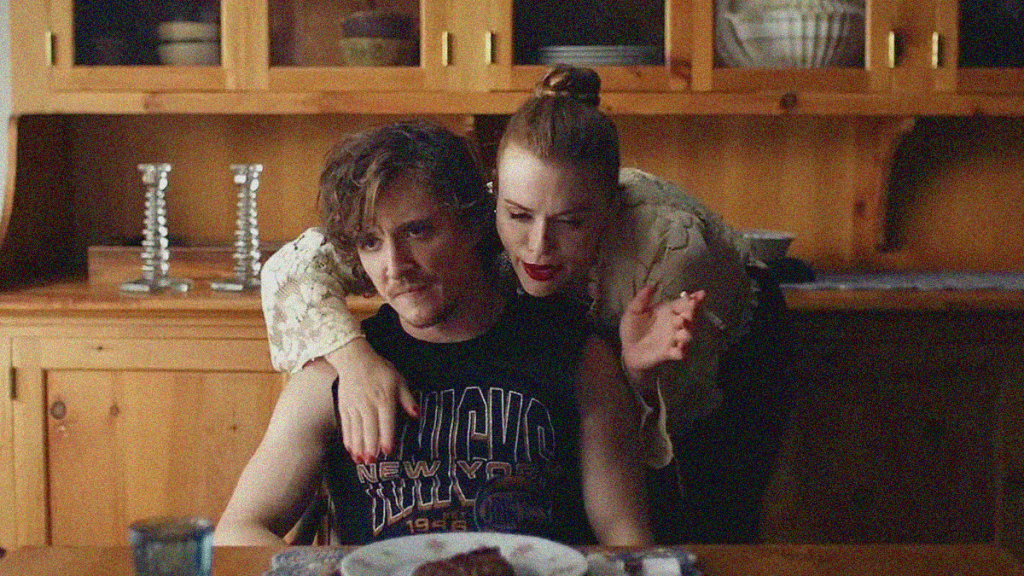
Following the death of his estranged mother, Emmett (Kyle Gallner) and his fiancé Anya (Holland Roden) travel upstate from NYC to claim her ashes and the house she’s willed him despite not having seen each other in decades. The goal is to clean things up, put the property on the market, and better situate themselves financially for getting a bigger place to start their own family. The longer Emmett stays within those walls, however, the more memories flood back.
In order to try quelling flashbacks that are obviously exacerbating his depression and anxiety, Anya suggests psychedelics. Neither could expect the mushrooms to turn a generally productive psycho-analysis game the couple often plays into a full-on psychotic break. It’s not just that Anya subsequently lives as Tracy for three days, though. She becomes Emmett’s mother. Cooking. Cleaning. Dancing. Swimming. Things that Anya never did and literally couldn’t do are effortlessly achieved. You can’t therefore blame him for questioning reality once she wakes up.
Laurence Vannicelli’s Mother, May I? initially seems to be solely about Emmett. His “mommy issues.” The repressed events of his childhood. The fear of repeating his mother’s parental mistakes. The script that Vannicelli and his partner Daisy Long developed unfolds via Emmett’s perspective with Anya being both a figure for support and provocation before all that changes around the halfway point after she reclaims consciousness from whatever fugue state possessed her. After three days of the impossible, Emmett is now the one who’s changed.
There’s a reason then that Roden is top-billed. Not only is she given the meatier, dual role of Anya and Tracy, but she also becomes the unwitting victim to an unexplainable phenomenon tied to a shared history of ghosts. She didn’t ask to lose herself to whatever power is inside that house and within Emmett’s soul. She did, however, ask to meet who Emmett used to be. He admits he remembered nothing of that life, believing he was abandoned as a baby when the truth reveals he lived there much longer. So, just as Tracy inhabits Anya, that child inhabits Emmett.
Rather than the usual supernatural jump scares, Mother, May I? leans into its psychological thriller underpinnings by letting Tracy (whether her presence is “real” or not) be a catalyst for Emmett and Anya to exorcise the demons that have taken hold of them. Both are keeping secrets—intentionally or not. Both are starting to wonder if their actions are less a product of desire and more about patching over a void within themselves that they’re too afraid to admit exists. The idea that they are a perfect pair quickly takes on new meaning as a result.
Roden and Gallner are very good in complex roles. At times so confident in their identities (regardless of which identity is in control) and at others a mess of insecurities and terror. Because the scariest part of what’s happening isn’t that they might lose themselves to that dread. It’s that they will recognize who it is they are becoming is who they actually need to be. These are broken souls pretending they’ve conquered their issues to find clarity together when the opposite is true. Their respective damage is what makes the other whole.
Kyle Gallner and Holland Roden in MOTHER, MAY I?; courtesy of Dark Sky Films.



 jaredmobarak.com
Leave a comment