
Rating: NR | Runtime: 104 minutes
Release Date: March 13th, 2024 (USA)
Studio: Dark Sky Films
Director(s): Larry Fessenden
Writer(s): Larry Fessenden
I was separating from myself.
Much like with Depraved, writer/director Larry Fessenden returns to the world of classic Universal-inspired monsters with Blackout. Whereas that title brought the mythos of Frankenstein’s monster (and its ample room for social commentary) into the present-day, this latest update shifts focus towards the so-called “wolfman.”
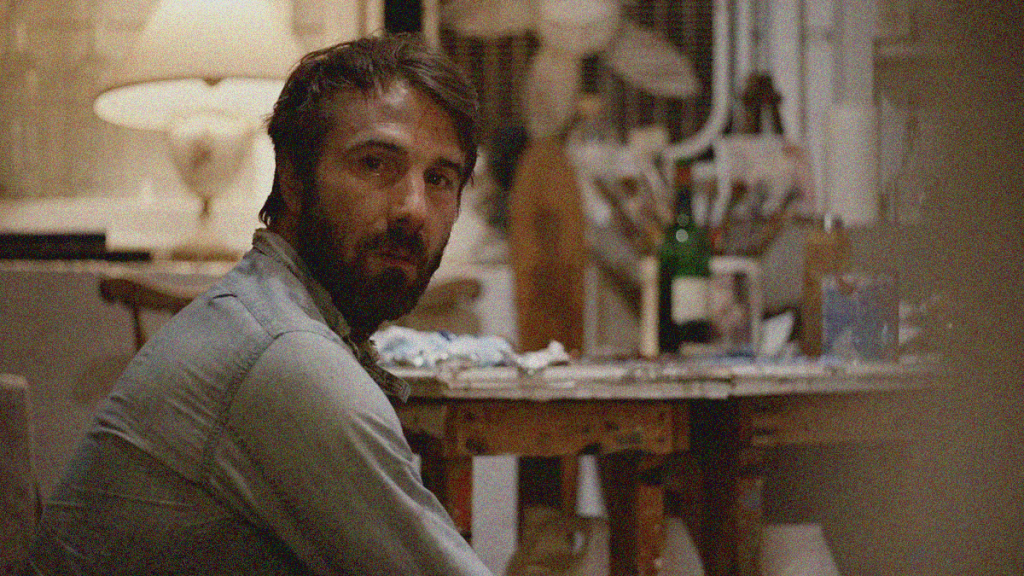
How does knowing he potentially killed innocent people affect Charley (Alex Hurt)? How can he keep pretending his life is simple and his love (with Addison Timlin’s Sharon) pure when a cloud of uncertain violence looms above the three-day nightly windows he cannot remember each month? Because while his actually being a werewolf is presented with enough ambiguity to make the truth part of the intrigue, Fessenden pulls no punches insofar as making certain we know Charley is at fault. He sees glimpses of his victims’ faces and, as an artist, paints them to try severing their hold. So, while he might not be a “monster” in the literal sense, he is a haunted soul guilty of unspeakable horror.
That’s why he runs. He cannot risk harming Sharon or the town of people who all know him by name. It’s also why he’s resigned himself to putting an end to the bloodshed. Because it’s not just about the lives he’s already destroyed, but also those being targeted as perpetrators of the carnage in his absence. So, while Charley’s ordeal carries a good helping of emotional drama as he attempts to reconcile the complexities of his father’s (seen in photos as Alex’s real-life dad, William Hurt) complicity in empowering a power-hungry millionaire (Sharon’s father, Marshall Bell’s Hammond) and his own conflicted nature as a man who has thus far avoided confronting the consequences of his own actions, Blackout is strongest when it turns towards those external reverberations.
When a man like Hammond starts passing out good will and money to one section of the populace while sowing seeds of hatred for the other, his sway with public opinion can’t help but create monsters in his image. Because the citizens of this town want answers. They want whoever is brutally maiming folks to rot behind bars. And who better to target than the leader of the community’s Mexican contingent—a group that put down roots at Hammond’s behest so he could exploit their labor before inevitably tossing them aside? Miguel (Rigo Garay) was at the scene of the crime, after all. He’s the one who called the police to report a gruesome murder at the hands of an “hombre lobo.”
It’s therefore easy for the white population to interpret that implausible declaration as evidence of guilt. Werewolves don’t exist. Miguel was there. So, Hammond riles his faithful up into a witch hunt that serves his own purposes. It becomes the final straw for Charley. He will not hurt anyone else whether literally or as a product of his actions. Unfortunately, stopping himself won’t be easy. And turning himself in without knowing his full strength might even make matters worse.
Give Fessenden credit for really jam-packing this low-budget affair with as much political and social commentary as possible—even if a lot of it might come across as somewhat half-baked and reductive (see Motell Gyn Foster’s Earl as a means to messily relay how cops will always shoot a Black man with a gun first and never ask any questions later). The topics are broad (Mexicans as “killers” hot on the heels of Trump’s presidency, quick reaction shots involuntarily othering a gay couple rather than simply including them, and an untouchable tyrant of wealth acting as though his “charity” entitles him to demagogic rule over those benefiting), but they’re also relevant and keep to the theme of mirroring Charley’s inner struggle with that of the town itself.
Fessenden talks about how he wanted to keep the production fast and loose while letting spontaneity rule the day. Doing so might create some really interesting tonal shifts (I loved the hard-boiled nature of Officers Luis and Alice’s dialogue delivery, played by Joseph Castillo-Midyett and Ella Rae Peck, that’s fully incongruous yet welcoming just the same), but it also leaves some narrative loose ends. The experience is worth those hiccups, though.
Hurt delivers an effectively introspective performance that does at times remind us of his father’s soulful depth. The creature effects are top-notch too (Fessenden also states that his desire to keep costs down by hiring friends and offering “relationships” never meant skimping on what the film needed to be a success) with both the transformation scenes and murders leaving no question that the eyes we’re watching through wholeheartedly believe Charley to be that monster.
Maybe some things could be tightened narratively, but you always get the gist of what Fessenden is going for while knowing those moments that might be lacking aren’t a product of intent. And if you somehow find yourself unable to get past them, it’s impossible not to enjoy the stellar cast of supporting players. Barbara Crampton, Joe Swanberg, James Le Gros, Kevin Corrigan, Jeremy Holm, and others all make appearances to lend their one or two scenes the weight they deserve while leaving the whole better off for it.
Alex Hurt in BLACKOUT, courtesy of Glass Eye Pix.




 jaredmobarak.com
Leave a comment