
Rating: NR | Runtime: 102 minutes
Release Date: April 20th, 2023 (Germany) / July 14th, 2023 (USA)
Studio: Piffl Medien / Sideshow / Janus Films
Director(s): Christian Petzold
Writer(s): Christian Petzold
Work won’t allow it.
The words are barely out of Leon’s (Thomas Schubert) mouth before he begins regretting the pretentiousness and self-martyrdom of the statement. This is a man who has been self-absorbed in his own needs and desires from the moment we meet him at the start of Christian Petzold’s Afire while sitting in his best friend Felix’s (Langston Uibel) car, a photographer giving him more than we can even assume considering developments still on the horizon.
Leon agreed to a quiet vacation to finish his book. He agreed to let Felix drive him, house him, and entertain him for free—not to be forced to feign humanity by sharing the space with a stranger (Paula Beer’s Nadja) that Felix’s mother double-booked into the family’s summer home without warning. It’s one thing if the work truly didn’t “allow it,” but Leon spends more time falling asleep in the sun than proving he has any work to do at all.
That’s the insular nature of many artists, though. Especially insecure ones on a deadline who know in their hearts that their latest piece isn’t very good. So, rather than accept that reality, Leon lies to himself about its importance. He frets about “distractions” that are really just the normal actions of people his age living by the sea for the summer. He shirks any and all responsibilities of cohabitation, leaving Felix in the lurch when asked to help fix a leaky roof and simply allowing Nadja to make him dinner without ever once offering to repay the favor.
Everything surrounds him. Leon is the sun. The genius. The serious soul who understands the importance of art. And yet he can’t even bring himself to acknowledge the same when confronted with Felix’s new direction for his portfolio. We witness the pause. The loss for words when gazing upon the new portraits. But all Leon gives his friend is a scowl of indifference and faux confusion. Why? Because the photography’s success reminds him just how insufficient his manuscript is.
Petzold has a wonderful knack for tapping into the emotional tumult of his characters and the humor that exists beneath the drama. He writes Leon in a way that ensures we know he knows how foolish he’s being despite having no control over stopping himself from continuing down that path. This is a man who’s so lost in his own head that he refuses to see the life and excitement around him. If anyone dares to have fun, it becomes a personal attack. If anyone dares to feel hurt, it’s from a lack of caring about his feelings.
Most films like this would therefore work towards showing their audience that this flawed character has the room to grow, but Petzold piles on instead. He does so by constantly adding to Leon’s troubles with another (better looking) stranger (Enno Trebs’ Devid) to whom Felix and Nadja take a shine, the potentially devastating news that his publisher (Matthias Brandt’s Helmut) wants to meet in-person to talk about the latest draft, and the ever-looming opportunity for tragedy with forest fires raging nearby.
The most cutting trouble, though, is the reality that everyone else actually has it worse than him—not that he could ever open his eyes wide enough to recognize it. He doesn’t ask Felix what he can do to earn his stay. He doesn’t ask Nadja anything about her life or aspirations. He literally attacks Devid for something as innocuous as telling a fictionalized story as if doing so was pointed commentary on how easy Leon’s profession was.
And it’s all compounded by the fact that artists actually improve by experiencing what’s happening around them. By asking for advice (Felix finds a fresh avenue towards creativity simply from his willingness to meet new people and listen to them) or putting aside the work for a while to enjoy yourself and return to it later. It’s no coincidence then that this week quickly becomes more energetic and interesting than anything written in the pages he’s squirreled away from being read by anyone. Or that the winds might change to show just how privileged he is to be able to create something from nothing.
Afire is beautifully orchestrated with so many glimpses of joy and laughter from afar as Leon angrily watches, too embarrassed to ask to join and too prideful to admit the error of his way. It also finds itself moving from a breezy sense of low stakes (beyond Leon’s delusions of grandeur) to a really dark place of melancholic introspection and self-realization—the sort of rug-pull fans of Petzold should always expect considering how emotionally heavy his dramas ultimately prove.
The shift is so impactful that a final moment of possible hope can’t help but make you think its smile will soon disappear too. Because Leon doesn’t really do anything to warrant the number of people who truly want to be his friend. The sheer lack of redeemable qualities exposed by the steady unraveling of his own self-prescribed mythos shows us he deserves pity more than love. But that would also diminish just how brilliant Felix, Nadja, and Devid are. They don’t need to be brought down to his level to prove anything. Because he’s not their sun. They’re simply providing him stars.

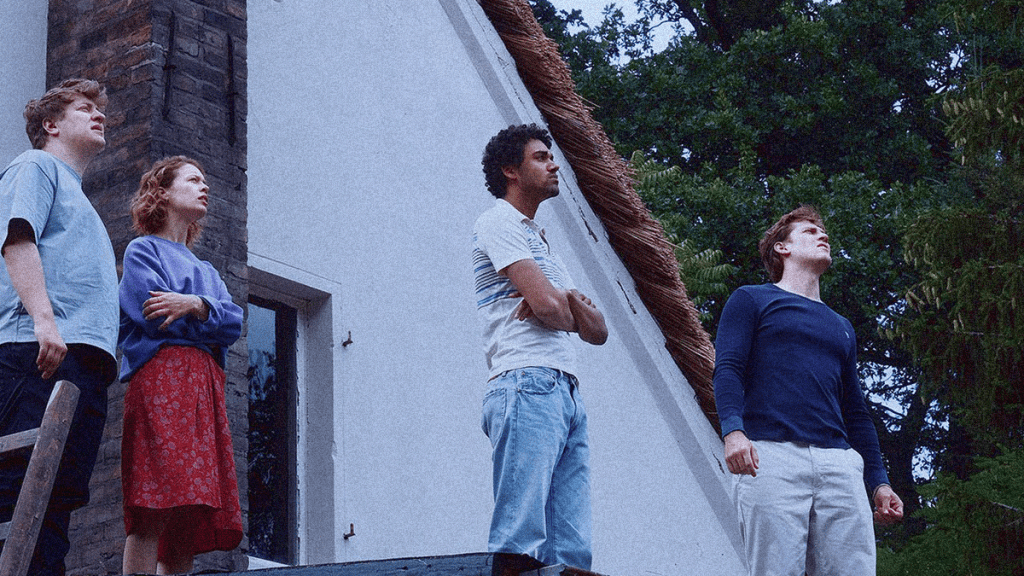
Thomas Schubert, Paula Beer, Langston Uibel, and Enno Trebs in AFIRE; courtesy of Sideshow and Janus Films.




 jaredmobarak.com
Leave a comment