
Rating: NR | Runtime: 115 minutes
Release Date: July 13th, 2022 (France) / May 19th, 2023 (USA)
Studio: Haut et Court / Film Movement
Director(s): Dominik Moll
Writer(s): Gilles Marchand & Dominik Moll / Pauline Guéna (book 18.3 – Une année à la PJ)
Something’s amiss between men and women.
Director Dominik Moll and co-writer Gilles Marchand lay it out right at the beginning of their seven-time César-winning film The Night of the 12th. The text on-screen explains that out of approximately eight hundred murder cases opened by French police a year, nearly twenty percent remain unsolved. And rather than simply provide a dire statistic, they quickly contextualize it by saying this film, (based on a story within Pauline Guéna’s novel 18.3 – A Year With the Crime Squad), is one of that twenty percent.
So, we instantly know that newly minted captain Yohan Vivès (Bastien Bouillon) is never going to capture his man. The figure in a ski mask who says Clara’s (Lula Cotton-Frapier) name before dousing her with accelerant and lighting her on fire will never be identified. This police procedural isn’t therefore about justice or heroism or even violence. At least not any of them isolated from the others. It’s a look at the human condition and its tragic flirtation with futility.
All the potential suspects become provocations as a result. Fate laughing in the faces of Yohan, Marceau (Bouli Lanners), and the other officers in their precinct. They want to crack this case so badly that they’ll float the notion of false alibis to put away known abusers for the crime. They’ll even go so far as to lose sight of their purpose by projecting blame upon the victim due to having no perpetrator to carry the load.
It leads to many introspective and important conversations wherein vulnerability is laid bare. Sometimes they are wholly relevant to the case (Clara’s best friend, Pauline Serieys’ Nanie, calling out the destructiveness of Yohan’s line of questioning despite his intentions being pure) and sometimes completely removed from it (Marceau pouring out his soul about love and loss). Every new lead becomes a trigger flipping emotional and psychological switches alike that push these detectives into the dark corners of their own inadequacies.
Moll’s film is thus composed of unanswerable questions. It’s populated by short vignettes of men and women finding themselves thrust into awkward situations wherein artifice and conditioning disappear. Marceau knows he can’t jeopardize the case with his own unchecked violence, but he does so anyway. Jules Leroy (Jules Porier) knows he’s a suspect in the investigation and yet he cannot stop himself from bursting out laughing during his interrogation.
You have Yohan constantly trying to burn off his anxieties and frustrations by biking on a velodrome—a literal loop without an exit. Rookies talk about marriage while the grizzled veterans relay cynical outlooks about the fallacy of romance. And it’s always the women (Nanie at the beginning and Mouna Soualem’s Nadia and Anouk Grinberg’s judge at the end) reminding the men that their newfound confusion about the breakdown between men and women isn’t new to them since they’re generally the ones left dead.
While proving to be a downer in many respects due to its characters spinning their wheels without getting anywhere, The Night of the 12th is not without its subtle inspirations. Because eliminating suspects is just as important as finding them.
Not letting oneself buckle under the pressure of such nightmarish realities only to become a part of their horror also can’t be undervalued—especially when you consider how meaningless a Venn diagram of policemen and criminals is in America (Nadia’s question about it being “weird that most crimes are committed by men yet society sends mostly men to solve them” hits home considering that dynamic is a function here rather than a flaw so US cops can get themselves out of trouble).
There’s a reason Yohan is both a Boy Scout and alone. Some lose their compass to uphold the law. Others lose the ability to shut it off and live. All are fallible. All are haunted by the mistakes they don’t even know they’re making. It’s unavoidable since the alternative’s indifference is unacceptable.
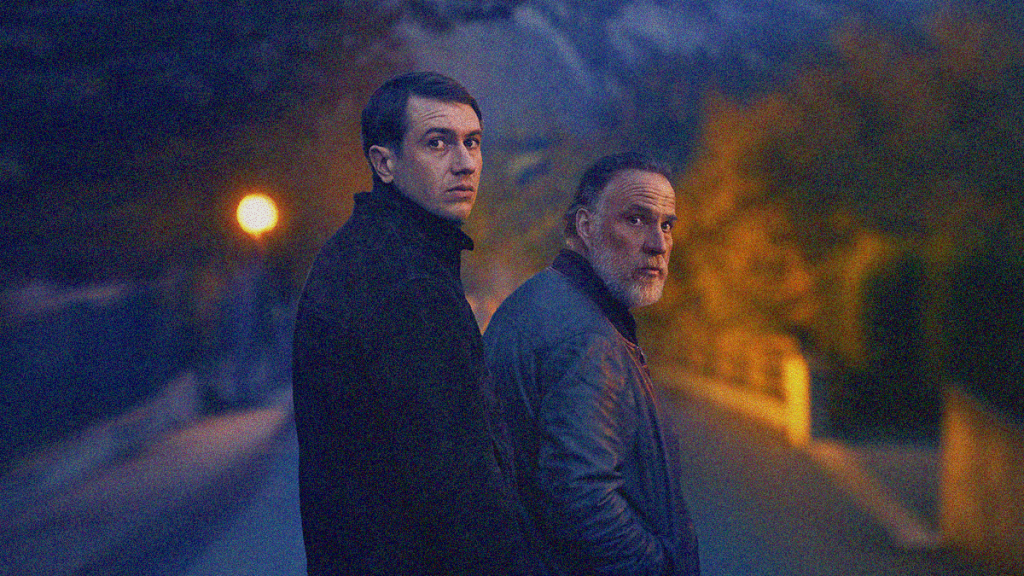
Bastien Bouillon and Bouli Lanners in THE NIGHT OF THE 12TH; courtesy of Film Movement.



 jaredmobarak.com
Leave a comment