
Rating: NR | Runtime: 113 minutes
Release Date: June 17th, 2022 / May 5th, 2022 (USA)
Studio: Happinet / Kimstim Films
Director(s): Chie Hayakawa
Writer(s): Chie Hayakawa / Jason Gray & Chie Hayakawa (story)
We’re all alone in life.
Chie Hayakawa’s Plan 75 imagines a present-day Japan that’s pretty much the reverse of what’s happening in present-day America. Whereas our politicians are passing laws that force women to carry their pregnancies to term while also denying any legislation necessary to provide those mothers assistance in raising those babies, this not so far-fetched sci-fi premise sees the Japanese government enacting laws that allow any senior seventy-five or older to receive one thousand dollars in exchange for agreeing to be euthanized so that the nation’s own social services aren’t over-tasked to the point of bankruptcy. What Hayakawa imagines is the effect this new initiative would have on Japan’s society: those facilitating the endeavor, those participating in it, and those profiting.
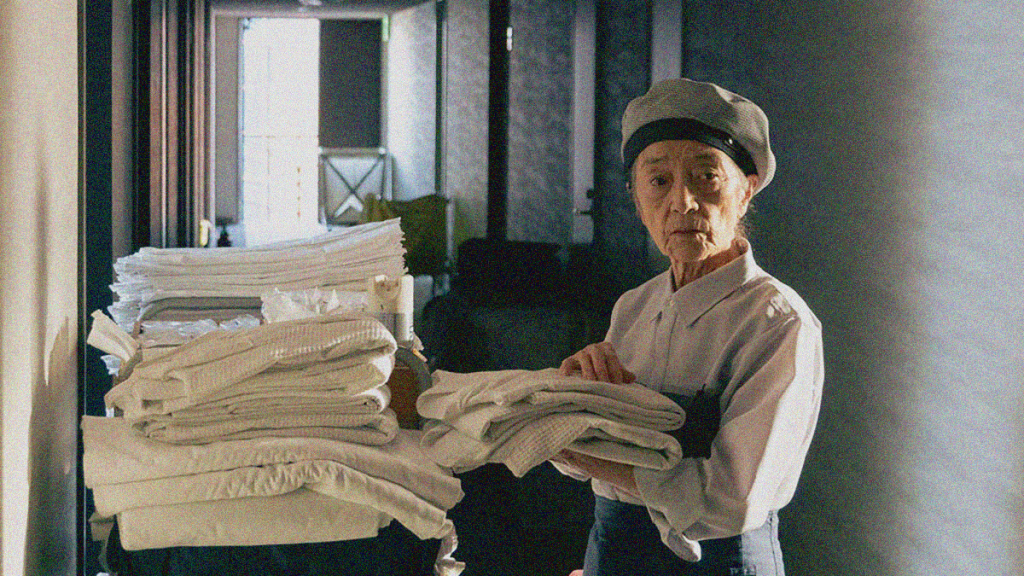
It’s a three-pronged narrative following Chieko Baisho’s Michi, Hayato Isomura’s Hiromu, and Stefanie Arianne’s Maria. Michi is a spry seventy-eight-year-old without family who enjoys working as cleaning staff at a hotel. Hiromu is an up-and-comer at the government Plan 75 program, setting up contracts with potential senior clients and helping on the backend with outreach and budget allocations. Maria is a Filipino immigrant trying to find employment that will pay enough to bring her young daughter over too.
All three start out content until the inevitable repercussions (or benefits depending on who you ask) of Plan 75 rear their head. Michi is laid off right when she finds out her apartment is set for demolition and no one will hire or rent to her because of her age. Hiromu meets a customer he cannot simply treat like a statistic: his uncle (Taka Takao). And Maria discovers it pays more to help kill senior citizens than it does to keep them active and alive.
Their plot progressions are sobering since each is a moral and empathetic soul discovering they’re caught in a system that’s anything but. As Michi’s friends begin dying around her, she sees that accepting Plan 75’s services is the only way she can find human connection despite it ultimately leading towards her demise.
It reminds her of the preciousness of life in the face death—of realizing that younger generations don’t get to dictate what she can and can’t do (much like the older generation of American politicians suppressing the voice of the nation’s youth here). This idea that Japan has always been built on sacrifice shouldn’t render the elderly obsolete. Because you know the septuagenarians pocketing the spoils of the law’s for-profit sector’s multi-million-dollar boon (so much so that the government begins to anticipate lowering the age to 65 in ten years) aren’t submitting to the program themselves. Such sacrifices are always left to the poor.
The result is a well-acted and structured journey towards oblivion that retains a glimmer of hope thanks to characters caught within. You’d like to believe that experiencing the cost of a Plan 75 will wake the masses to the error of its way, but sometimes prosperity is too much to ignore. And don’t forget that some of those participating want to die. Hiromu’s uncle literally goes to a Plan 75 center on his seventy-fifth birthday.
Don’t therefore assume Hayakawa is anti-euthanasia or that her film is vociferously admonishing those who would partake. Her criticism and commentary are objectively drawn to both question the idea’s legitimacy and execution. Because maybe it is a solution. That doesn’t, however, mean it should be sold with lies. Hiromu and Maria are helping themselves in service of their clientele only to realize the machine serves their bosses instead. So, where’s the line and how’s it drawn? For health purposes or financial incentive?
Chieko Baisho in PLAN 75; courtesy of KimStim.



 jaredmobarak.com
Leave a comment