
Rating: TV-14 | Episodes: 10 | Runtime: 30 minutes
Release Date: April 6th, 2023 (USA)
Studio: A24 / Netflix
Creator(s): Lee Sung Jin
It is selfish for broken people to spread their brokenness.
It’s around halfway through Lee Sung Jin’s “Beef” that things start to really come into focus. Whereas the opening few episodes were about escalating rage from pettiness to destruction, it’s here that the camera begins to turn away from Amy (Ali Wong) and Danny (Steven Yeun) to get a glimpse of the people around them. Because the whole concept of the show hinges on loneliness and how we all suffer from it regardless of our economic, social, or cultural station. Amy and Danny are pretty much the same person besides the fact that she’s been able to cultivate a persona that’s provided success while his façade always seems to turn everything he touches into garbage. And it is exactly when we realize this feud could end by them just talking to each other and realizing this similarity that the others’ struggles rise to the surface.
Amy’s husband George (Joseph Lee) isn’t the perfect, innocent soul she believes him to be. His mother (Patti Yasutake’s Fumi) isn’t the put-together success her composed presence and flowery art-speak assume. Danny’s brother Paul (Young Mazino) isn’t lazy as much as unmotivated due to a life of invisibility. And while Amy’s neighbor (Ashley Park’s Naomi) might be everything she strives for, it’s one thing to admire and crave something and another to actually live it. So, what starts out as a war between two angry and depressed black holes sucking in collateral damage with every new act of revenge becomes much more external. Jealousy and ignorance and desire push those on the periphery to become main players, raising the stakes to the point where Amy and Danny couldn’t stop if they wanted.
With no end in sight, things snowball to some dark and violent places I’ll admit I didn’t see coming. I should have, though, considering the first work that came to mind while watching was Catfight. Onur Tukel’s wild farce goes to some extremes too, but it also presents an atmosphere of heightened reality and fantasy that “Beef” doesn’t until casual mentions of crows talking to each other receives a humorous payoff. We instead feel as if Amy and Danny’s moves are happening in a world with consequences and sense—like they’ll eventually wake up and see that their actions are destroying their own lives worse than their nemesis. As I explained above, though, they cross a point of no return that renders any ceasefire temporary. The truth of how far they went will ultimately push the other to see so much red that they will unintentionally risk the lives of those they love too.
That’s a captivating and important pivot—one that appears to skew more towards the profoundly emotional scene of Danny crying in his return to church than the chaotic uncertainty of his cousin Isaac’s (David Choe) criminal proclivities. Maybe it’s because I looked forward to that shift to heavier subject matter and weightier cause and effect that the choice to go towards comic horror in “The Great Fabricator” got me sighing despite some legitimate gasps. The humor had been augmenting the tragedy before that episode and suddenly it started to subvert it in ways that didn’t quite mesh with the experience I had been enjoying up until that point. “The Drama of Original Choice” is so good that following it with a climactic penultimate chapter playing as fast and loose as the Vegas escapades in “Just Not All at the Same Time” gave me whiplash.
Thankfully, “Figures of Light” re-grounds things. Even with the fun visual treatment of drug/poison effects, we finally get Amy and Danny speaking truth without the games, deception, and self-delusion they hide behind with George and Paul respectively. It’s a brilliant finale with a keen desire to retain the mess of what these characters wrought while also providing them an avenue towards self-acceptance. Jin and company never pretending that the stakes can be avoided is my favorite part of the show. He makes them feel the pain of their actions and fall prey to the anguished prison of their minds that forces them to always choose war. Wong and Yeun are phenomenal—especially in those moments of clarity about their own wretchedness. Add a killer soundtrack (I’m a child born in the 80s like their characters) and it was easy to get swept up into the emotional insanity.

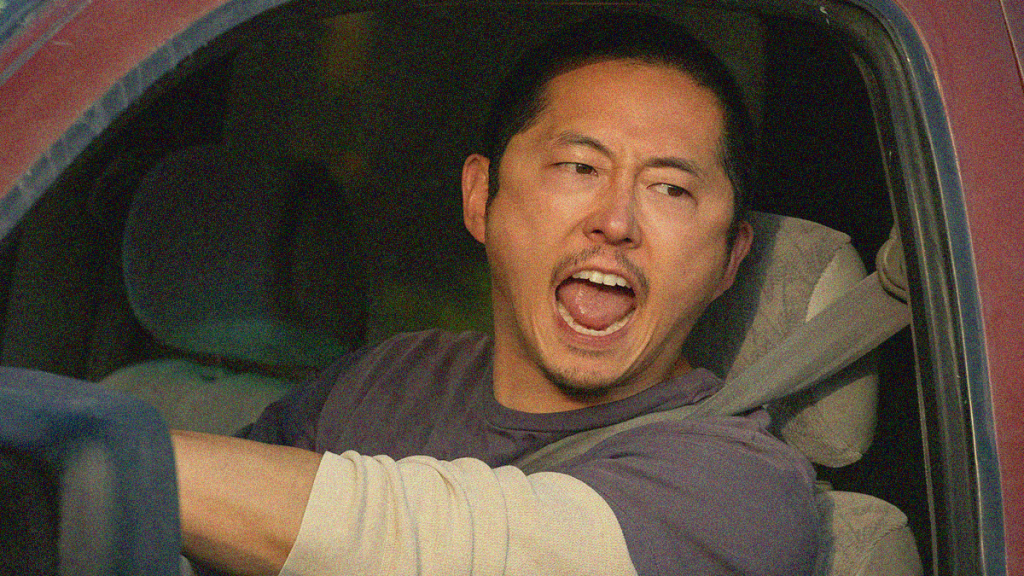
Steven Yeun in BEEF; courtesy of Netflix.




 jaredmobarak.com
Leave a comment