
Rating: TV-MA | Runtime: 96 minutes (Part One) / 113 minutes (Part Two)
Release Date: April 7th, 2023 (USA)
Studio: Apple TV+
Director(s): Alex Gibney
Writer(s): Alex Gibney
I just did it.
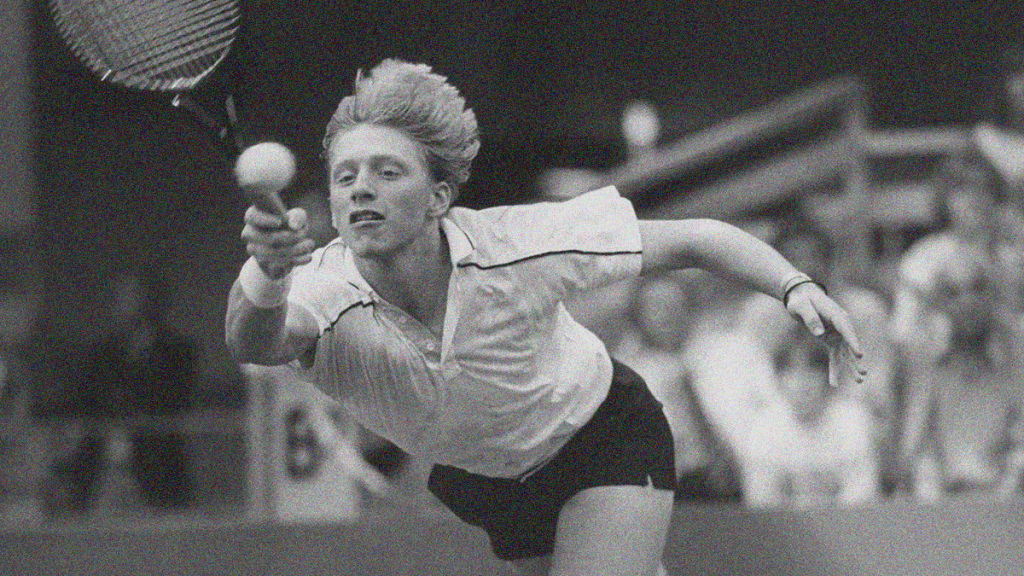
I was three years old when Boris Becker won Wimbledon at seventeen, so I never really got to see him play during his heyday. Tennis eventually became a sport I religiously watched in the 1990s, so I wasn’t too late to catch his comeback. I saw him win that second Australian Open and watched some of those matches against Pete Sampras and Andre Agassi.
You still saw his mental intensity on the court and his charming demeanor with the press regardless of the time that passed. And you appreciated his decision to retire upon hitting thirty like everyone else (but Agassi) did back then. That’s why it’s so weird seeing my generation continue to play. Serena Williams and Roger Federer are my age (forty). Rafa Nadal and Novak Djokovic aren’t much younger. It’s a different era of athlete and world of sport.
Maybe that’s why Alex Gibney’s Boom! Boom! The World vs Boris Becker feels somewhat superficial now. I have a mindset where professional athletes in all sports come at their careers from a completely different place than those of generations past. You don’t see as many getting caught in scandals, partying their money away, or skating by on talent alone once dedication to the craft wanes in the wake of celebrity.
So, hearing Becker say he wasn’t mature enough or ready enough to adjust a teenage millionaire’s lifestyle to an adulthood devoid of a revenue stream rings somewhat hollow. Yes, it can be rocky and people will take advantage of you, but at a certain point you must learn from previous mistakes. You must buckle down and take responsibility.
To hear Becker talk, he has … to a point. He blames himself. He admits he wronged many of the people who became adversarial to him. But I don’t think he’s ever learned anything from it. As his former manager Ion Tiriac describes him, Boris truly is a kid constantly grabbing for a lit flame to see how close he can get to having it all even when every finger on both hands have already been burned.
He’s relentless. He craves the challenge. He agrees that he perhaps threw some sets to put his back against the wall and come out stronger while on the tennis court. That edge sustained him to the point where he’s on-camera saying it would be impossible to find another exciting job post-retirement because nothing would ever match the excitement of Wimbledon’s Centre Court. Well, messy divorces, bankruptcies, secret children, fraud charges, and jail prove exciting too.
Gibney presents his two-part film (“Triumph” is around one-hundred minutes and “Disaster” just under two hours) as a means towards understanding all the personal problems Becker has faced via the lens of his playing career. I think there are obvious parallels, but I’m not so certain there’s much insight when everything pretty much plays out like you’d expect from a once heroic figure of fame and fortune crashing back down to earth.
There’s nothing therefore unique insofar as the human element to Boris’ drama. He attached himself to shady people, spent and consumed in excess of his means, and ultimately paid the price. This renders the second half much less captivating for me. Solid storytelling, but straightforward and unsurprising save some anecdotes from the court.
That’s why I enjoyed the first half a lot: it’s pretty much all tennis anecdotes. Björn Borg, John McEnroe, Nick Bollettieri, Michael Stich—they have the insight into who their competitor / friend / student was. So too does Becker’s first wife Barbara. To be able to focus on just Boris, Barbara, and a couple other people while dipping our toes into this tumultuous life and drive to be independent makes everything hit harder.
And that includes the tease of jail time and chaos before meeting the other women, business partners, and Novak Djokovic (who Boris coached for a couple years, potentially being the voice that finally got him over the psychological hump to now be tied for the most Grand Slam victories in men’s tennis history). Becker is never more lucid and engaging then when speaking on his career.
The rest is for show. Even Gibney admits it with narration cutting in to mention how the words Boris just spoke aren’t entirely true. And that’s okay. That side of this story—when Becker is often lying to himself—is really fascinating. I’m just not sure Gibney ever digs deep enough to get something out of it. Not that he necessarily must considering “Triumph” succeeds on entertainment value alone with its biography approach.
Maybe it’s the fact that we’re led to believe more is coming in “Disaster” that’s the issue because it too is just biography. Details in chronological order with no real commentary beyond Boris saying he’ll “accept whatever happens” regardless of “fairness.” But that tone of taking his woe-is-me punches “like a man” never gets called out either. Boom! Boom! proves an enjoyable puff piece as a result. It touches on the messier points of the tennis great’s life, but only to admit they occurred.

Boris Becker in BOOM! BOOM! THE WORLD VS. BORIS BECKER, premiering April 7, 2023 on Apple TV+.



 jaredmobarak.com
Leave a comment