
Rating: NR | Runtime: 96 minutes
Release Date: January 13th, 2023 (UK) / March 31st, 2023 (USA)
Studio: British Film Institute (BFI) / Neon
Director(s): Mark Jenkin
Writer(s): Mark Jenkin
And now descends the Night of Sin!
What if The Lighthouse, but with Skinamarink vibes? And not with Robert Eggers at the helm, but Ben Wheatley. Those are the touchstones that kept coming up while watching Mark Jenkin’s deliberately paced folk horror Enys Men. It therefore made sense to learn the whole was shot without an interest in sound before being reconstituted in post with new voices, folly, and score.
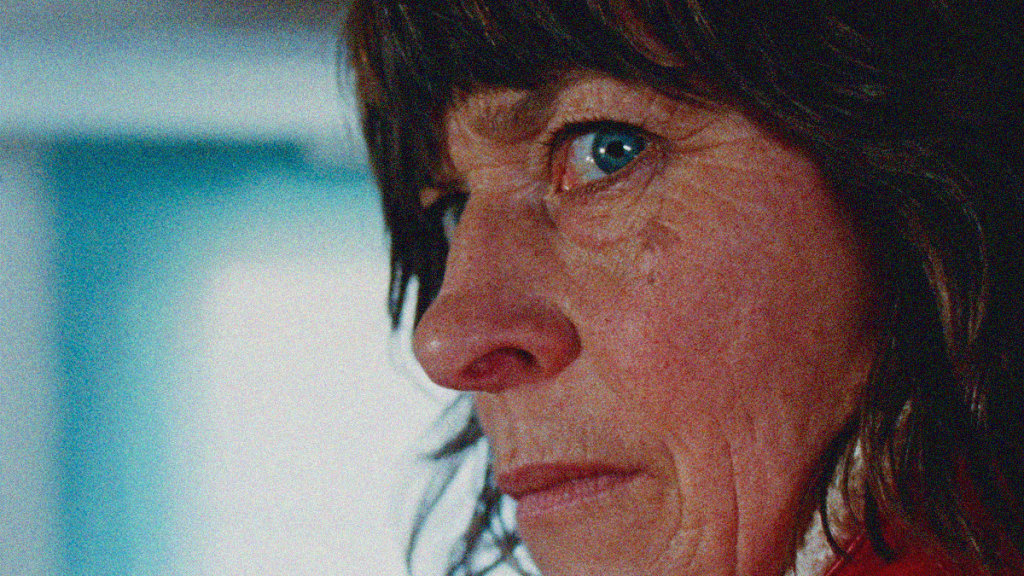
The deafening static and auditory scramble becomes an aesthetic choice much like Kyle Edward Bell’s child height abstraction of sight. Jenkin is putting us into a headspace steeped in uncertain reality wherein we can never trust what it is we’re seeing. Just like the repeated close-up of Mary Woodvine on a flattened stone “step” causing me to anticipate a slip and fall, the whole unfolds with an intense trepidation … that ultimately lacks release.
Woodvine is “The Volunteer”: a wildlife scientist on an isolated Cornish island who’s documenting a particular flower growing on a cliff. She puts on her red slicker each morning and goes down to take soil temperature and write her observations (“no change”) before walking back with a detour past an old mining shaft to drop a rock and head home.
Her movements are like a ritual without deviation—until we see a young woman standing on the cabin’s roof (Flo Crowe), a man rising from the toilet (Edward Rowe), and a preacher under the darkened sky (John Woodvine). And yet even they don’t read as changes. They don’t shock her. If anything she talks to them like they were always there. Because in many respects they were. Memories reverberating through the ether.
Jenkin will eventually tease answers by way of a dedication and later provide a glimpse back at the truth of who these people are and what fates have befallen them. Even then, however, the answers are incomplete with more cryptic imagery dripping in culturally specific folklore from the region and the filmmaker’s own childhood interpretations of iconography and mythology.
It’s all more about the mood than anything else. The sharp crescendo of sounds supplying contrast to the familiar pattern of events, willing us to find intrigue in the staid sights that threatened me with sleep more than once. That’s unfortunately the case with these sorts of singular visions. You’re either on their wavelength or being lulled into a state of unconscious indifference. I seem to regularly experience the second.
That’s not to say there aren’t some truly captivating moments. The Bal Maidens leaving their kitchen label to manifest on the cliffs. The May Children singing with disembodied voices and jarringly direct eye contact. The lichen growing, the symbols of death and destruction, the screams of “Mayday!” This island has seen so much tragedy that it couldn’t exist without a few ghosts lingering.
And yet they aren’t haunting “The Volunteer”. They’re haunting us. Not to frighten or provoke, but to be remembered. Smiling. If there’s anything I can take from the experience, it’s this undefined historical aspect existing between the lines of the inert images overtly presented atop it. Because while striking, the film itself feels as superficial as its spirits. The rocks might be watching, but they mean no harm.
Mary Woodvine in ENYS MEN; courtesy of Neon.


 jaredmobarak.com
Leave a comment