
Rating: R | Runtime: 105 minutes
Release Date: March 17th, 2023 (USA)
Studio: Momentum Pictures
Director(s): Matt Smukler
Writer(s): Jana Savage / Jana Savage & Matt Smukler (story)
Our family is harder to kill than cockroaches.
Matt Smukler’s Wildflower is a case where context is key. It’s one thing to tell the coming-of-age story of a teenager growing up as the child of developmentally disabled parents because you think the subject matter is ripe for comedy and another to know it is because you lived it.
The result may still feel exploitative (although good on them for casting disabled artist Samantha Hyde in the role of Bea Johnson’s mother even if Dash Mihok plays her father—the former character being born disabled and the latter a victim of head trauma at age twelve), but the heart still shines through if the purpose is love. Smukler’s niece Christina lived this experience. What’s on-screen is inspired by her truth and based on a documentary he made to showcase her journey. He and co-writer Jana Savage simply decided to also use fiction as a means of bringing that story to a wider audience.
They do a good job smoothing over some problem areas. Like when Bea (Kiernan Shipka) realizes she can use the same tactics for training her dog to train her parents. Getting her mother into the bathroom with Oreos isn’t the payoff. So, while it feels very wrong in-the-moment, the punch line of Bea using those cookies to also “train” her cousins helps acknowledge that the humor lies in these familial relationships rather than the disability itself.
Is that enough to justify it? I don’t know. You’ll have to read a review from a disabled person since they are the only ones who can truly judge when something has crossed a line. Because perception still matters whether what’s depicted really happened or not. It’s a fine line with comedy since intent isn’t more important than impact.
That said, it’s easy to get won over by the humor because of that aforementioned heart. Things can get wild since Bea’s extended family is hyperbolically eccentric (Alexandra Daddario and Reid Scott as her aunt and uncle are so “normal” that their normalcy becomes a joke while her grandmothers, Jean Smart and Jacki Weaver, are never without an opinion or action that doesn’t embarrass the group more than anything her parents might do), but they would do anything for each other.
Even to their own detriment—a truth that becomes the film’s core message. Because when you’ve grown up as the parent of adults who are supposed to be yours, it can be hard to step back and consider the opposite. Bea doesn’t have to sacrifice her future because of who her mom and dad are, martyr complex or not. She should still be allowed to be a kid.
Smukler and Savage realize this and ensure the narrative deals with the fact that many of the problems Bea faces are self-inflicted. That’s not to say circumstances outside her control didn’t force them upon her, though. Just that she does have a choice. She can go to college. She can have a boyfriend (Charlie Plummer). She can lose the chip on her shoulder and have fun.
The script gets a bit cavalier at times with its own choices concerning subject matter (the film is told from Bea’s perspective while lying in a coma, the cause of which, alongside an ongoing pedophilia “gag” when selling school raffle tickets on the Vegas strip, is brushed aside way too easily), but that shouldn’t be surprising since effect being positioned above cause is its modus operandi. Wildflower is playing to its audience. Its first goal is to entertain and that inherently undercuts its dramatic potency.
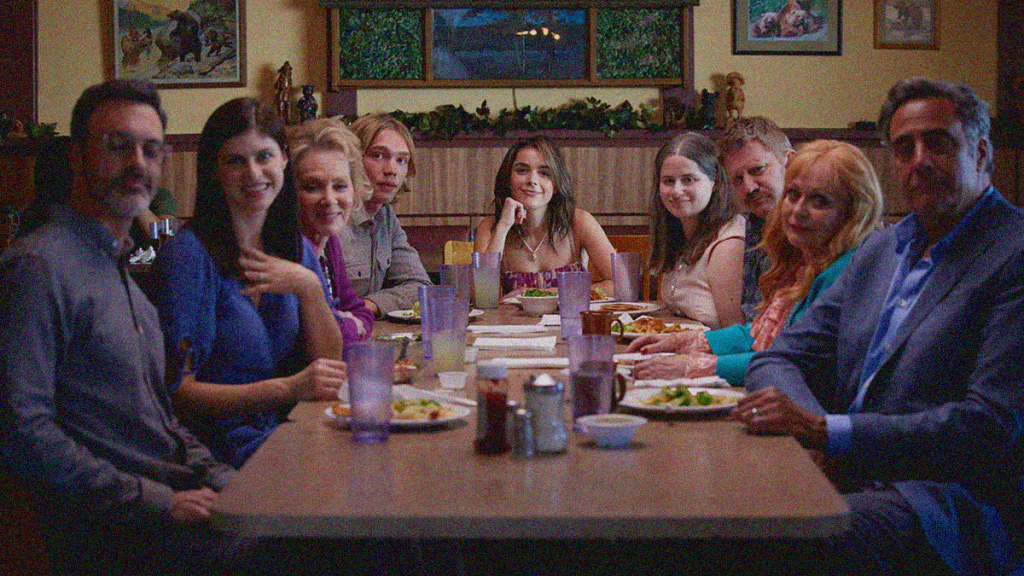
[L-R] Reid Scott as “Ben,” Alexandra Daddario as “Joy,” Jean Smart as “Peg,” Charlie Plummer as “Ethan,” Kiernan Shipka as “Bea,” Samantha Hyde as “Sharon,” Dash Mihok as “Derek,” Jacki Weaver as “Loretta,” and Brad Garrett as “Earl,” in the comedy, drama film, WILDFLOWER, a Momentum Pictures release. Photo courtesy of Momentum Pictures.


 jaredmobarak.com
Leave a comment