
Rating: NR | Runtime: 106 minutes
Release Date: January 19th, 2024 (Taiwan) / May 16th, 2024 (Singapore)
Studio: Anticipate Pictures
Director(s): Jow Zhi Wei
Writer(s): Jow Zhi Wei
The rain is ruthless.
Writer/director Jow Zhi Wei’s director’s statement reveals the crux of his film Tomorrow is a Long Time to be the immigrant experience. It’s an easy one to parse from the first half’s issues concerning illegal residents, insane working hours, and Burmese subtitles every so often, but there’s more to it than just those surface aspects.
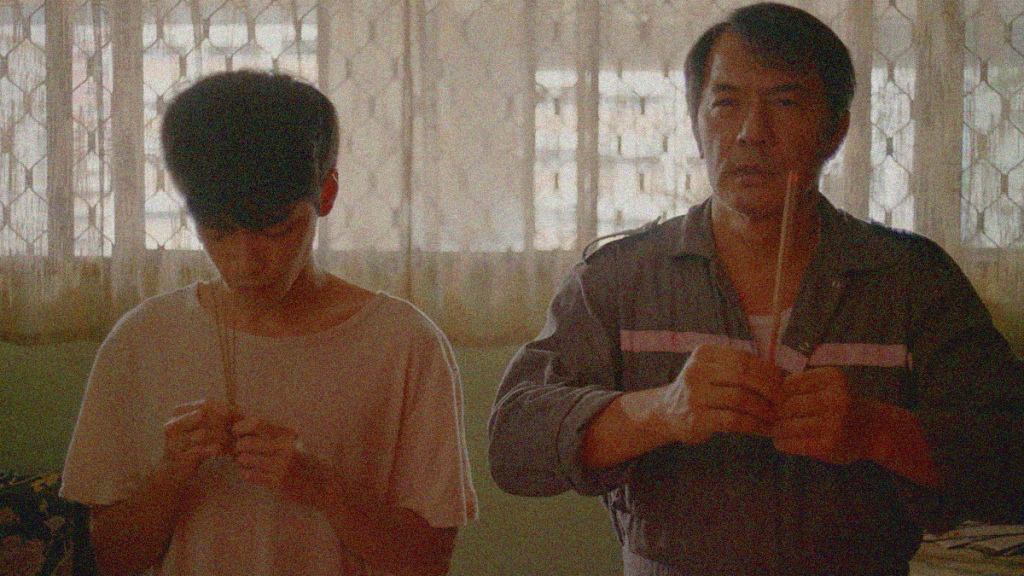
He talks about their being an “indelible, almost metaphysical link between parent and child in the Asian family” and how he sought to juxtapose that reality against the “backdrop of a contemporary, economically driven society.” So, there’s more to Meng (Edward Tan) wanting to know about his grandfather and wondering if his ailing grandmother can live with them. There’s a desire to connect that Chua (Leon Dai) is simply too exhausted to facilitate.
We’re talking about a widower grieving the loss of his father and wife. A man who cannot sleep and thus takes whatever extra shifts he can working as a fumigator. It’s a dangerous job for his health, yet he cannot say no with a teenage son to support at home. That’s a lie, of course, but it’s one he accepts because the work’s distraction is the only thing keeping him going when Meng’s curiosity brings up sad memories that make him want to leave as soon as he arrives.
It’s therefore no wonder the boy seeks inclusion elsewhere, joining a gang of bullies for which he doesn’t belong except for the sole purpose to belong. Both men are forced to choose paths that betray their natures, life effortlessly beating them down as they willingly walk towards oblivion with tears in their eyes and guilt in their hearts.
The film proves quite intriguing for those first forty-five or so minutes as a result. We see the strain of this relationship and watch the hurt these men inflict upon others out of a necessity for survival despite their suppressed morality. And we anticipate a collision course that will presumably dictate where they go afterwards and whether it will be together or apart.
While Jow does deliver that collision, however, it’s not as you might expect. His plot ultimately forces Meng’s hand to take over the story himself with a trek through the jungle while fulfilling his mandatory two-years of military service—much earlier than usual. What follows is a lot slower than what came before (and that was very slow too), unfolding in such a way that allows Meng to finally makes choices that are all his own.
He can fear for the safety of others rather than his own. He can seek to help his fellow man rather than hurt. And he can bask in the freedom of nature’s splendor, sleeping in without the responsibilities of society (school) or family (religious rituals). He can finally breathe.
It’s a beautiful message rendered with gorgeous cinematography and two memorably potent performances, but I’d be lying if I said it wasn’t a bit of a slog built upon convenient plot points (gunshots, a soldier’s disappearance, etc.) that make us expect a heavily dramatic climax that simply never comes. The back half is instead lyrically open-ended with diminished stakes. It’s a blank canvas that allows Meng to decide his next steps. It’s an epiphany of relief for him that may leave you wanting more.

Edward Tan and Leon Dai in TOMORROW IS A LONG TIME.




 jaredmobarak.com
Leave a comment