
Rating: R | Runtime: 117 minutes
Release Date: May 12th, 2023 (USA)
Studio: Bleecker Street Media
Director(s): Laurel Parmet
Writer(s): Laurel Parmet
When God asks you to give something up, it’s just so you got more room for Him.
Between Jem Starling’s (Eliza Scanlen) parents (Jimmi Simpson’s Paul and Wrenn Schmidt’s Heidi) coaxing their daughter to talk to their pastor’s (Kyle Secor) son (Austin Abrams’ Ben) in a way that screams “arranged marriage” and another parishioner taking her aside to tell her everyone can see her bra-line through her blouse, it’s not difficult to comprehend the world writer/director Laurel Parmet has led us into with her debut feature The Starling Girl.
This is a Christian Fundamentalist community hinged upon male dominance and female shame—one where the cost of adolescent lust is seen by all from the physical and mental scars left by rehabilitation camps. As Paul explains, rejecting pleasure in order to avoid sin is worth the pain because it opens more space up for God.
Simpson’s performance is a crucial one because those words are as much a reminder for himself as they are a lesson for Jem. He wasn’t born in this world like her. He was “saved” after losing himself to alcohol. Everything he has now with Heidi and their five children is therefore a product of God. Paul cherishes it, but nothing will ever fully expunge his appetite to go back.
And whether he’d shown this truth previously or not, Jem is at an age where it’s unavoidable to see his suffering and relate it to her own as an increased drive to express sexuality and autonomy craves that space her indoctrination by society and religion had cordoned off for faith alone. She doesn’t want to live according to her elders’ rules if those rules cause so much grief. She wants to follow her heart.
That’s where things get complicated since her heart has always led her towards the pastor’s other son—a much older and married Owen (Lewis Pullman). He’s just returned from a missionary stint in Puerto Rico to find that he may have outgrown “home’s” rigidity. So, he’s open to Jem’s advances and ultimately willing to exploit her naivete to spark an affair. But it’s not about victimization.
Parmet spoke after the screening about needing to center Jem’s desires throughout because she wrote from experience as far as the complexity of this sort of relationship being more than black and white statutory rape. Her agency in its creation can’t simply be dismissed as a byproduct of the law. Owen’s abuse doesn’t erase her yearning.
It’s not an easy film as result. It exists in the gray area of allowing Jem to find her footing in a quest for independence from numerous oppressive systems. She’s gaslit by those around her in the name of God to the point where she often gaslights herself considering this life is all she’s ever known. This romance becomes her escape regardless of whether age and immaturity guarantee the road leading her away from this existential prison is paved with abuse.
Credit Scanlen and Pullman for portraying the nuance inherent to this dynamic and Parmet’s deft handling of the material to ensure these three-dimensional circumstances aren’t flattened to accommodate any one agenda. Jem is confronting a minefield of compromising positions with church, sex, and so-called “respectability” demanding her subservience. It’s time to see about making them a means to her own end.

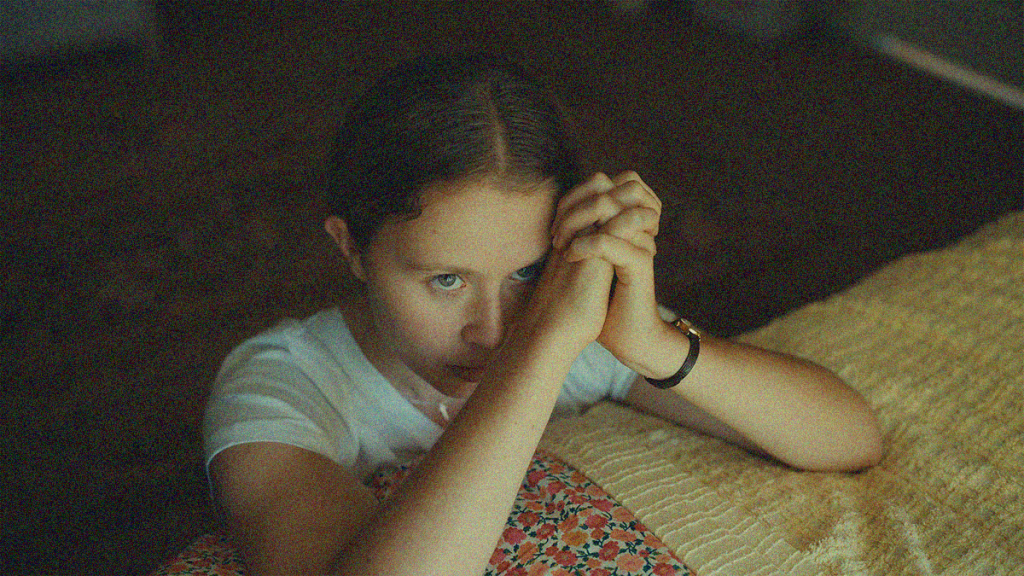
Eliza Scanlen in THE STARLING GIRL; courtesy of Sundance.



 jaredmobarak.com
Leave a comment