
Rating: PG-13 | Runtime: 104 minutes
Release Date: December 23rd, 2022 (USA)
Studio: United Artists Releasing
Director(s): Sarah Polley
Writer(s): Sarah Polley / Miriam Toews (book)
And in that gaping silence was the real horror.
What a line. It’s spoken via narration towards the beginning of Sarah Polley’s adaptation of Miriam Toews’ novel Women Talking—words born from hindsight by one of the young girls residing in the strict Mennonite colony where it is set. She’s providing context for the meeting that’s being held in a hayloft between the women of three families attempting to decide the fate of all women in their community. The “silence” is their lack of language, education, and privilege to fight back. The “horror” is their subsequent inability to band together and stop the atrocities committed upon them by their men while also allowing themselves to become involuntarily complicit to that violence. It’s the product of a power void those same men created and continue to enforce to maintain their control. And the time has come to fill it with righteous fury.
While the events on-screen are fictional (and described as such by a clarifying caption), don’t be fooled into believing its exercise isn’t based in truth. I’m certain there will be some viewers who discover that it takes place in 2010 and scoff, ignorant to the fact that Toews loosely based the scenario on real events that occurred in Bolivia circa 2011. There, like here, saw the rampant and unchecked domestic abuse and rape by men from the community against their wives, sisters, daughters, and neighbors with the assistance of animal tranquilizers. The women in the film were told they were hallucinating. Lying for attention. Victims of ghosts or demons. Only when one caught her attacker and forced him to name names were they finally arrested. So, the colony leaders did the only thing they could do: threaten the women to forgive their abusers or lose their place in Heaven.
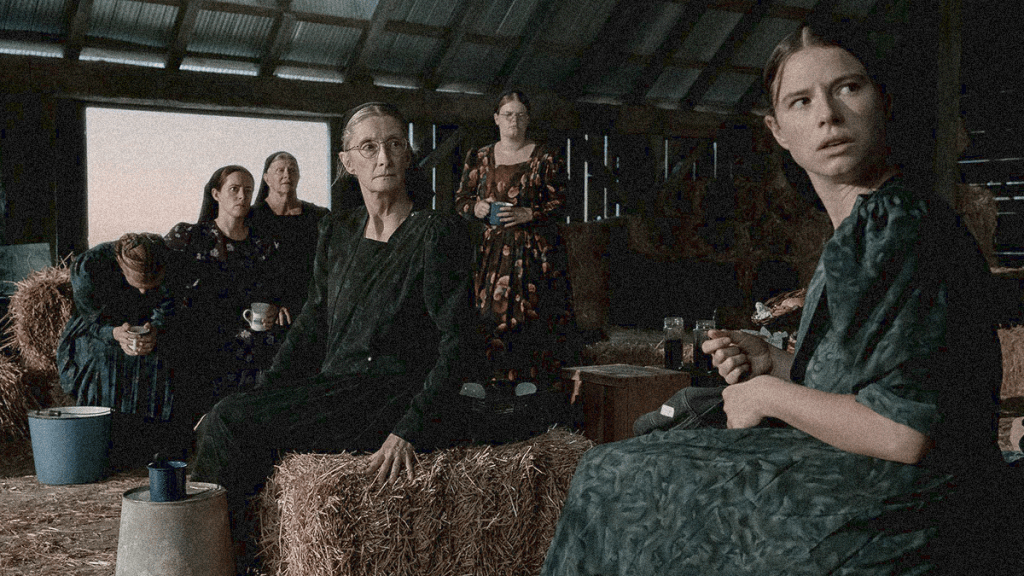
In another of many brilliant lines of dialogue, it’s explained that these women who cannot read or write quickly teach themselves how to vote. There are three choices to decide between while all the men are in town trying to bail out their brethren. Stay and forgive. Stay and fight. Or leave and never return. The narrative premise is that the democratic process ends in a three-way tie pitting three of the most well-respected families against each other to hold a debate. Frances McDormand’s domineering and scarred Janz won’t be swayed from forgiveness. Salome (Claire Foy), daughter of Agata (Judith Ivey), wants blood. Her sister Ona (Rooney Mara), impregnated by her rapist, sees leaving as the freedom to witness a world that’s been kept from them.
Add Greta’s (Sheila McCarthy) desire to at least try finding consensus despite her daughter Mariche (Jessie Buckley) angrily interrupting and refuting the others’ points and the stage is set for a rousing dialogue that moves between indignation, introspection, pragmatism, unbridled emotion, and even a few well-placed hints of humor. We hear their respective cases, watch as they alter minds and change their own, and get transported back to their individual traumas with effectively rendered flashbacks that always prove contextually relevant to the current topic of conversation. Faith. Pacifism. Education. Love. Autonomy. It may just be eight women and their minutes-taker (Ben Whishaw’s recently returned August) arguing in one room for the duration, but it’s the most dynamic and tense film I’ve seen all year.
Because you don’t know how things will shake out. The narration teases that some of these women leave, but says nothing about the nightmarish drama that could potentially occur beforehand—whether by the men’s early return or the women passionately defending their right to not back down. Foy is a force of nature. Buckley is heartbreaking in her nihilism. Ivey and McCarthy deliver steadying maternal hands of wisdom earned from decades of knowing what “forgiveness” has already wrought. And Whishaw, along with August Winter’s Melvin, devastates as a masculine counterpoint that strengthens the women’s resolve. We’re witnessing a reckoning—a rebellious cry to erase that silence once and for all with tears of sadness for what’s left behind and joy for what’s to come. And above all else: relief.

Winner:
Adapted Screenplay
Nominee:
Motion Picture
(l-r.) Rooney Mara stars as Ona, Claire Foy as Salome, Judith Ivey as Agata, Sheila McCarthy as Greta, Michelle McLeod as Mejal and Jessie Buckley as Mariche in director Sarah Polley’s film WOMEN TALKING. An Orion Pictures Release. Photo Credit Michael Gibson. Copyright © 2022 Orion Releasing LLC. All Rights Reserved.


 jaredmobarak.com
Leave a comment