
Rating: PG-13 | Runtime: 129 minutes
Release Date: October 15th, 2010 (USA)
Studio: Warner Bros.
Director(s): Clint Eastwood
Writer(s): Peter Morgan
Cooking is for all the senses.
Right before sitting down for a screening of Hereafter, my friend told me she had read that it was Clint Eastwood’s ‘French film’. Once the end credits rolled, I realized there isn’t a more succinct description for it. Showing again how the marketing machine loves to manipulate audiences into seeing something they might not want to see if they knew exactly what it was, the trailer used to advertise this nuanced, heavy work doesn’t come close to doing it justice.
This isn’t a spooky tale of a psychic speaking to the dead. Nor is it a disaster film where God has become vengeful, making it seem Matt Damon’s George Lonegan is the only vessel capable of stopping the carnage. Damon might not even be the lead of this endeavor, but instead one piece of a triptyched canvas constructed of three lost souls desperately trying to cope with death. The first has been followed by it most of his life, cursed with the ability to hear those who passed with the touch of his hand. The second is reconciling the fact that his twin, the outgoing half of their whole, is gone and never to return. And the third is wrapping her head around what she glimpsed in the minutes between the here and the after.
It begins with a tsunami leaving billions of dollars in damage and hundreds of thousands of lives lost. Whether fate, bad luck, or perhaps divine intervention—depending on how one looks at it—French television anchor Marie LeLay (Cécile De France) finds herself in the path of the tide, washed up in it, and lost to the weightless darkness of what happens before being pulled back to life by two good Samaritans giving CPR. What she experienced was real and cannot be shaken, especially when one clear visage from her memory is the little girl she tried in vain to save from the demise she somehow beat.
Her trajectory then shifts from one of fame and fortune to an internal need to find answers to the questions she has about what happened. It’s a spiritual journey of faith as she loses everything she held dear before this tenuous idea of existence became known to her. Marie becomes a woman embracing death as a new chapter to no longer be afraid just as Damon’s George sees it as a burden separating him from ever living a normal life. Where she looks to learn more, he only desires an escape from his ability. An escape from the ‘duty’ and ‘money machine’ his brother (Jay Mohr) tempts and the parlor trick people like Bryce Dallas Howard’s Melanie presumes.
But these two adults are merely grappling with what they see of the afterlife. Neither has a need to speak to someone who has actually crossed over. They’re just looking to understand. It’s that third fork—the trio unfolding in an A-B-C format, repeating in order so you never lose your bearings—pertaining to young Marcus that deals with the brunt of death ravaging one’s soul. The son of a junkie mother that he and twin brother Jason have been taking care of and keeping from child services despite their extreme youth, (played by Frankie and George McLaren), he is lost once an automobile accident takes his better half away.
Always the quiet, contemplative follower of his more extroverted and successful sibling, losing Jason causes Marcus to burrow further down into himself, the prospect of talking to him again proving the only drive he has left. His mother has gone to a rehabilitation clinic, his foster parents are confused as to what they can do to help, and the multitude of psychics he visits are simply frauds stealing his money—which he stole from the couple looking after him. The pain and sorrow in his eyes is ever-present and his isolation seeming more heart-breaking than Damon’s and De France’s.
All three characters are expertly portrayed through the quiet moments of contemplation and emotion to express so much in moments devoid of sound or action. Hereafter is a thinking man’s film built with tonal weight piling higher and higher until the inevitable collision at its end that culminates in a universal acceptance. I wanted to say release, but, when death and unshakeable memories are concerned, you really can’t ever let go. You can, however, accept your life for what it is and fearlessly look towards the future with optimism that things may actually turn out positively.
This is where the ‘French’ comment enters the equation. It’s not just because a third of the film is literally spoken in the language. Much like Marie seeking to compose a political novel on François Mitterrand before switching to write about her near-death experience and the true science discovered that proves it, screenwriter Peter Morgan, known for his own political scripts such as The Queen and The Last King of Scotland, has instead chosen to speak on the metaphysical and unavoidable reality that all humanity needs to eventually face death. This is a film of introspection that unravels in its own time without the pandering of Hollywood conventions.
Unfortunately, while I believe this is its strength, the general movie-going public (like my friend) will probably check out early from boredom due to America’s conditioning for faster pacing and easy answers. Eastwood and Morgan thankfully have the clout to take their time and craft a work that’s different and unafraid of being so. Whether you believe in God, the afterlife, purgatory, or a blackness of nothing when your end arrives, this story doesn’t want to sway you in one direction or another.
If anything, it sparks conversation—one based on a person’s unwavering beliefs and philosophies—to no longer ignore the fact our lives are finite. We can either embrace that finality as our inevitable finish or a reason to live each second as the precious moments they are. Our lives exist with the capacity for forgiveness, retrospect, and passion. No matter what your personal demons hold or what you must fight to stay alive and sane, the one common factor is that no one you lose is ever truly gone if you keep them close to your heart.

Nominee:
Visual Effects
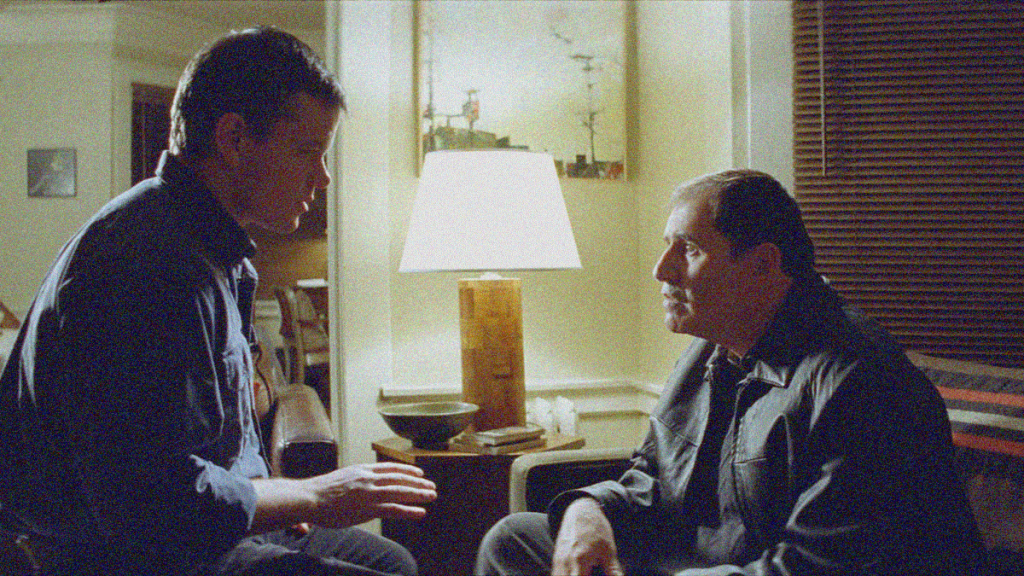
MATT DAMON as George Lonegan and RICHARD KIND as Christos in Warner Bros. Pictures’ drama “HEREAFTER,” a Warner Bros. Pictures release. Photo courtesy of Warner Bros. Pictures.




 jaredmobarak.com
Leave a comment