
Just Buffalo Literary Center’s Babel series began in 2007.
It’s a service I perform.
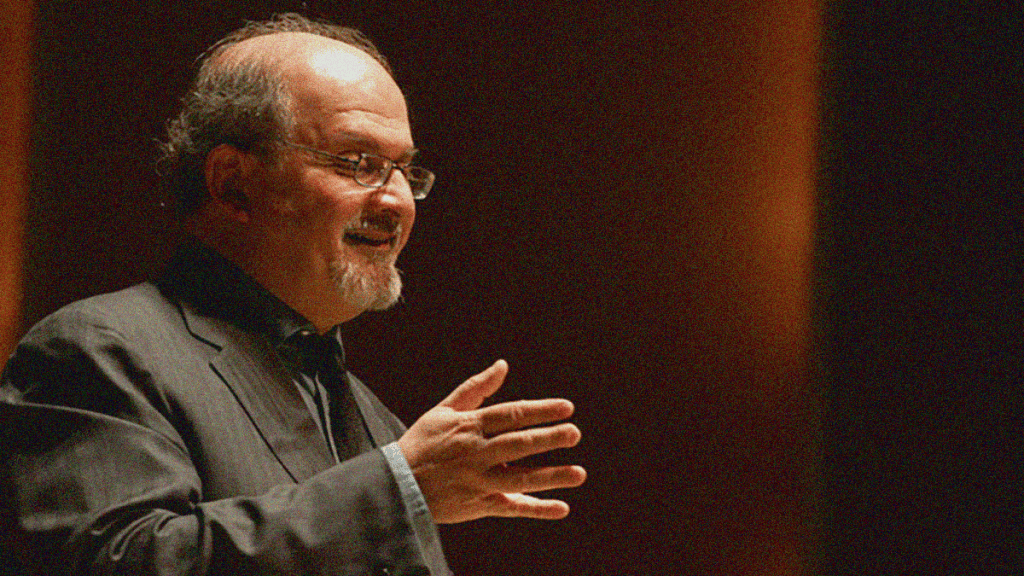
And that’s why you leave to get in line for an autograph before Mike Kelleher finishes saying “final question” when a guy like Salman Rushdie is doing the signing. The guy is a rockstar that not only brought the biggest crowd to a Just Buffalo Literary Center Babel event yet, but also attracted the largest group to take advantage of the signature session.
It all began with Rushdie relaying how we can all thank Charles Dickens for making authors feel like they were allowed to do ‘the strange thing’ and speak in front of people. The Brit’s arduous second tour of America might have been a direct cause of his death, but he did it anyway—a fun fact that segued the first of many jokes along the line of some being better at speaking tours than others … but it kills them.
With everyone in the audience fully aware of the fatwa Ayatollah Ruhollah Khomeini issued for what many Muslims believe to be controversial views on Islam via his novel The Satanic Verses, making light of authors getting killed held a much deeper meaning. If I took anything from Rushdie this evening, however, it’s that, if you aren’t confident enough to speak freely with passion, you shouldn’t speak at all.
He writes to spark argument in the belief that anyone can cause real change in the world. For some reason, though, if you are a totalitarian government head of state, you don’t last long after publicly denouncing his work. Three died shortly afterwards, including Khomeini. It is dictator annihilation and, as Rushdie says, “A service I perform.” Quips like this one sparkled throughout the talk, enrapturing the crowd and truly epitomizing what this series can provide.
Rather than go into the motivations or meanings behind his novel Midnight’s Children alone, he spoke about the changing job of the novel instead. Trained as an historian, the usage of books as a means of facilitating news is not lost on him. We have always read in order to learn about other people’s cultures and past. So, with the world at a place now where the media is more concerned with entertainment than fact—at the behest and enjoyment of the public—this truth becomes even more prevalent.
Art is at its best when it opens the world to those previously in the dark. Storytelling is central to our nature and we pass our history on through it, whether via private familial tales or broader accounts of a nation.
A large portion of Rushdie’s talk focused on how the public sphere of existence is no longer separate from the private world. While things that happened in the past like wars and politics didn’t necessarily have any bearing on your own life, (he speaks about how Jane Austen wrote throughout the Napoleonic Wars but never included them in her novels while still capturing the essence of the people from that era), one cannot avoid it today.
We were once thought to live our lives based on our character (who we are as the basis of what we do), yet the activities of people we may never meet or even know exist eventually started to impact our lives. When incidents like 9/11 occur and change thousands of people as disparate from one another as can be into victims of the same crime without having done anything to deserve it, the unknown becomes more relevant than ever.
Yet Rushdie refuses to believe outside forces shape our identities completely. It’s too narrow a viewpoint. By explaining how such an incident can have the same impact on two people while forcing one to pick up a gun and the other to abstain, he shows how a person’s character still brings meaning to a situation.
Rushdie is as interesting a human as you can encounter. Toiling for twelve years before finding his first success in his field, this British-educated Indian has done all he can to speak his mind and create conversation. While he wrote The Satanic Verses to spark intellectual discourse, he never thought someone would take a civilized debate and change it into the question of whether one should be able to kill an author for his words. The only thing worse, he says, than the Ayatollah hating his work would have been if he liked it.
From this attitude, I’d gather Rushdie wouldn’t change a thing if he had the opportunity to do so. He’s proud of his role in that conversation as well as seeing how ordinary people won the battle—bookstore owners, translators, publishers, and readers—by refusing to be told what they can or can’t do. His answer to whether a writer should be killed was “No,” followed by a soft chuckle and the mention of Dan Brown’s name. But he shakes his head and says that he doesn’t actually think Brown should be killed … only that he should no longer be allowed to write.
To conclude with a few Babel tidbits: Season Four is set and ready to go come October. With a new $25,000 grant from HSBC Premier, it appears that the monetary goal will be reached so Just Buffalo can feasibly put the show on for many years to come.
It’s all getting bigger and more user-friendly with the continued use of sign language for the hearing impaired and an addition of instant closed captioning. The system is flawed (while supplying a fun, ancillary bit of entertainment to see what strange word combinations appear on-screen), and Mike Kelleher really tested the typist in his opening speech’s breathless description of Midnight’s Children‘s lead character, but it’s a valuable new tool to show the event’s progression towards accommodating all who want to attend.
Babel 2010/2011 Season:
- V.S. Naipaul (Trinidad and Tobago) – October 19
- Maxine Hong Kingston (United States) – December 1
- Edwidge Danticat (Haiti) – March 25
- Chris Abani (Nigeria) – April 15
Photo of Azar Nafisi by Bruce Jackson.






Leave a Reply