

Rating: NR | Runtime: 138 minutes
Release Date: February 16th, 1963 (Italy) / June 24th, 1963 (USA)
Studio: Cineriz / Embassy Pictures
Director(s): Federico Fellini
Writer(s): Ennio Flaiano, Tullio Pinelli, Federico Fellini & Brunello Rondi / Federico Fellini & Ennio Flaiano (story)
Because he doesn’t know how to love.
With the soon to be released Nine on its way, I had to finally dust off my Criterion DVD of Federico Fellini’s 8½ for a viewing (that musical is based on it). Besides all the praise lauded, I really had no idea what to expect. It only took about ten minutes or so to discover that we wouldn’t have Charlie Kaufman if it were not for this film interpreting Fellini’s inner thoughts, both creatively and personally road-blocked.
Synecdoche, New York borrows a lot from this opus and Adaptation takes the rest. I say this not to demean anything Kaufman has made—I love both of those films—but instead to praise this Italian master for doing it almost fifty years earlier as well or better. The movie soon causes you to be disoriented in regards to what is real and what is imagined. Inventive transitions are connected by actions or thoughts in the scene, leading us through the mind of Guido Anselmi as he seeks answers to the chaos.
Marcello Mastroianni’s Guido is a stand-in for Fellini, at a crossroads in his life and desperately trying to discover what it is he needs to do next. So many people have come and gone in his life (connections that he could have reached out and loved unconditionally), but all of whom he pushed away to create the isolated loneliness he despises. He can tell each of his actresses, producers, and mistresses exactly what he feels, causing them to hate him and leave without a second thought. However, the one woman he truly cares for—his wife Luisa—is left in the dark.
Throughout the film we see Guido whisper to himself about how much she means to him, but all he can do is lie or act disinterested when in her company. He’s lost in life. Unable to find true happiness and feeling bored by those around him. It’s a self-imposed torture he can no longer run from. Who else would invite both his mistress and wife to the city he’s filming in? Only a man looking to be cleansed of his demons would play with that fire. Guido might just not be strong enough to do it, deciding instead to sit back and watch every opportunity pass him by.
Even the script doctor he hires to make some sense of the incoherently abstract film he’s written can’t get through. His notes attempt to drive out the symbolism and personal moments that make no sense to an audience unknowing of his past, commenting on memories that play for us as though we’re watching the film he’s about to shoot. I wonder if the notes he makes are real notes made on 8½. And that’s the genius of the movie—what we’re watching is the film the character refuses to make.
While Guido drags his feet by bringing every woman who’s ever crossed his path back into his consciousness, we get to watch it take place in his head. His memories are what have been put on paper (although I’m still not sure where the spaceship comes into play besides as an escape hatch to leave his true self behind), and they’re shown as he remembers them.
We see his mother and nanny giving him a bath. His first brush with sexuality courtesy of La Saraghina’s Rumba. There are the chorus girls he bedded, his wife of which he’s taken for granted, the mistresses he’s used and thrown aside, and the actresses he has forced to perform for his films … and possibly himself. This is a man who’s forever treated women as objects at his disposal and the unfilmable movie he wrote is a way to air that dirty laundry.
What becomes even more profound is that, despite Guido’s inability to stand tall and make the film (although he does let his wife view the screen tests as a way to tell her what’s happening without actually opening his mouth), Fellini himself did. The real director of 8½ has made himself emotionally naked here, sharing with the world his mistakes and insecurities. Talk about catharsis as art form: the underlying meaning to the film only makes the finished piece that much more astounding.
It opens with our “hero” trapped in a glass box for all to see. A celebrity held up to immense scrutiny without secrets attempting to break free only to find his foot tethered to the Earth and his producers paying for his survival. This vicious system is its own predatory circle of life that’s made him subservient to powerful people—a pawn in their game much like the women in his. Life is a system of power struggles and I believe that’s at the forefront of this cautionary tale of ego. Even the actors, excited to work with a prolific auteur like Guido, become impatient to learn what their parts and motivations signify. They use their agents to threaten him for more information, yet must still wait until he’s ready to let them into the loop.
It all culminates in an extended dream sequence of a world consisting of all the women he’s loved and the hierarchy to which they must adhere. He’s their master, whipping them when they’re insubordinate, and they love him unconditionally despite his own feelings for them being fickle. Once you’re too old, you’re sent to the upstairs never to be seen again except as a memory of younger times.
It’s a world created for his own comfort. A world he thought he constructed in real life until recently realizing it never existed anywhere besides in his head. Even the muse he imagined at the start—a shining face of youth amongst the cattle-driven lines of elderly folk at a day spa he’s seeking treatments at—isn’t enough. Claudia Cardinale’s Claudia is sent to be this angelic new beginning, but her arrival in reality isn’t as he imagined. Instead of the jumpstart to a new life, her youth and vitality only serve as a mirror to how broken and unloving he’s truly become. She is the catalyst to finally end his lament and accept that the people in his life are more than chess pieces to move and discard on a whim.
The inventive camerawork is stunning in its dream-like quality creating distinct divisions of place between reality, Guido’s mind, and fantasy worlds. Compositionally precise, every frame is meticulously drawn complete with editing tricks seamlessly replacing actors and transitioning scenes through a common focal point. I was impressed early on upon seeing an out-of-place woman washing nonexistent windows inside a hotel room soon becoming the static detail that remains as the windows of our new locale manifest.
The acting is fantastic too, especially Mastroianni carrying every single scene. The women are beautiful and talented with Anouk Aimée’s Luisa morphing from quiet victim to stunningly happy homemaker in his visions and Sandra Milo’s Carla flaunting her body like an archetypal mistress despite being married herself. Everyone plays his/her role to continue Guido’s progression towards his enlightenment. And the final scene’s destruction of the scaffolding built to bolster the lie courtesy of his loved ones re-entering for a farewell parade is the perfect footnote to a complex and intricate tale.



Winner:
Foreign Language Film, Costume Design (Black-and-White)
Nominee:
Director, Original Screenplay, Art/Set Decoration (Black-and-White)
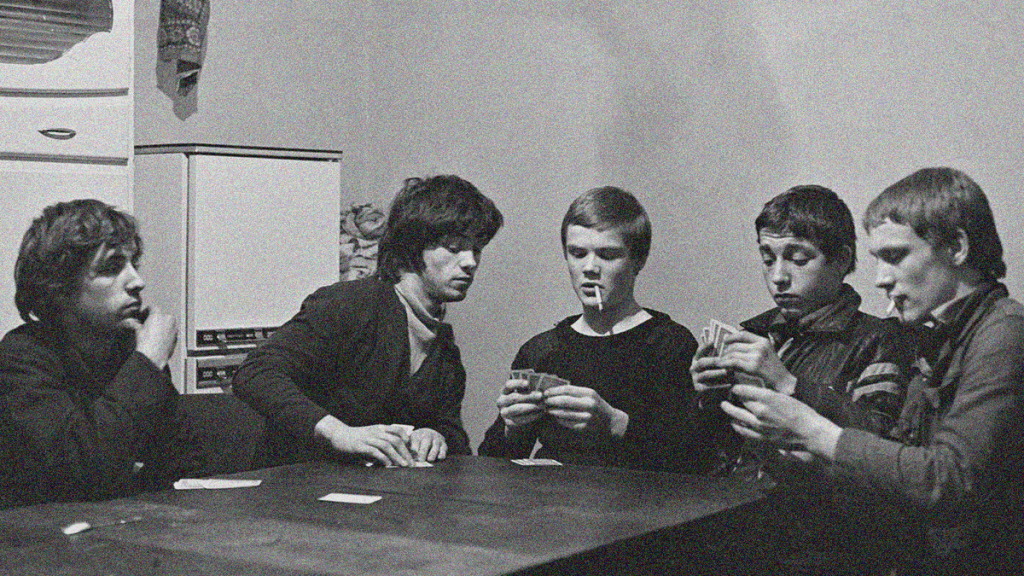
Marcello Mastroianni in 8½; courtesy of Janus Films.


 jaredmobarak.com
Leave a comment