
Rating: PG | Runtime: 100 minutes
Release Date: February 6th, 2009 (USA)
Studio: Laika Studios / Focus Features
Director(s): Henry Selick
Writer(s): Henry Selick / Neil Gaiman (novella)
Great. The village stalker.
Ok, America. Before you go blindly into an animated film with your young children, why don’t you do a little research on what they’re about to witness? Because a PG rating and stop-motion animated aesthetic do not always make a child-friendly adventure. Based upon the horror novella by acclaimed author Neil Gaiman, Henry Selick’s Coraline is chockfull of heavy material, dark story threads, and bleak possibilities.
For a guy like me, those things equal undivided success. For a ten-year-old child, those things might equal nightmare-filled evenings and parents writing angry letters to Focus Features for subjecting their children to lewd and horrific imagery. Well guess what parents? No one is to blame but you! I’m not saying keep your youngsters away, but do use some discretion about whether your son or daughter can handle the fantastical elements.
This is very much Alice in Wonderland displayed in all its non-Disney possibilities. A cautionary tale about being careful with what you wish for, our heroine must discover the difference between a world of people neglecting her and one of people doing all they can so that they may give her all she could ever want in the future. Life is not about getting it all right now, but instead a slow and steady climb built on love and trust. One whose benefits far outweigh the whirlwind romance that’s never truly as it seems.
Remember folks, this is a story that won the 2002 Bram Stoker Award for Best Work for Young Readers. It’s not all singsongy like Selick’s masterpiece The Nightmare Before Christmas. With that said, however, it is very, very good in a very, very different way. Be prepared for a methodically and deliberately paced story. More psychological terror than jump scares, the tale of Coraline escaping into a parallel world that perfectly mirrors her own besides it being inhabited by animated dolls, is one of enlightenment and discovery of what love truly means.
Do we all want parents that dote on us? Guardians that will do what we want and when we want it? Of course. But that idyllic utopia doesn’t exist, especially in the times for which we live today. Children need to be raised and supported, and that takes money and a lot of hard work. What may seem like neglect in the eyes of a child is really two people doing all they can—sacrificing their time in order to give you a chance at success. Only when Coraline sees the manipulation and truth behind the “kindness” her Other-Mother gives her does she realize what she had back at home.
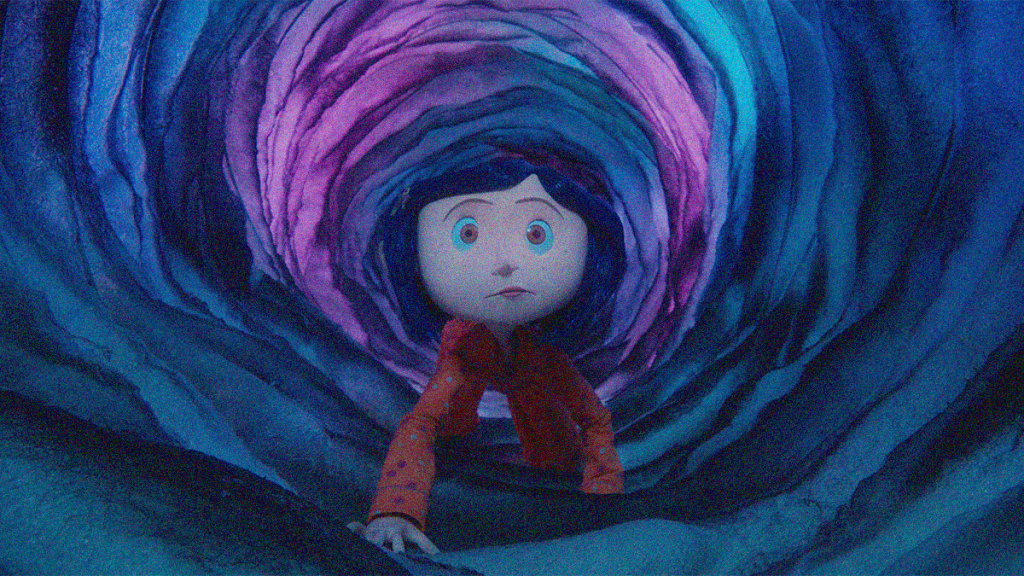
What we are shown is a world through a tiny door in the wall of an old triple-segmented home. There are stories about this door used to explain the disappearances of some local children, including the sister of loud-mouthed and shy Wybie Lovat’s grandmother. Only a weathered black cat appears to know what is going on—what the too good to be true farce beyond the door is actually masking. This cat can travel between worlds (I’ve always though cats were on a totally different dimensional plane that us) and therefore knows it all, allowing him to warn Coraline by orchestrating events via those she encounters.
A disgruntled child is easily malleable and fooled when doted upon and given sweets and a smile. The mantra “never talk to strangers” is never more applicable than it is here. With something a tad off-kilter in the fantasy world, Coraline finds herself shaking it off and relishing the opportunity to experience all that she had dreamed of, not knowing that those dreams would also be fulfilled in reality if her parents succeed with their new gardening catalog. Patience is a virtue and youngsters unfortunately don’t learn that until they’re grown, finding ways to apologize to their parents for being such confused and naïve monsters.
With some very nice voice work—Dakota Fanning as our titular heroine, Keith David’s baritone bringing the cat’s mixture of foreboding and help to life, Robert Bailey Jr.’s nervous tick and stammer for Wybie (short for WhyBorn, a name you hope your parents never considered), and Ian McShane and Mr. PC himself, John Hodgman—you do find yourself enveloped in this world. A rare thing for an animated film to begin with a cast, it thankfully doesn’t detract from the escapism by making you think of the actor rather than the character. This fact works best with the mother, played by Teri Hatcher. I would never have been able to pick her voice out, but that just enhances it more to breathe life into the stop-motion clay on-screen becoming its crucial wolf in sheep’s clothing villain.
The real success, however, is Selick’s use of the technology to create stunning visuals. And I’ll say it now—you must experience the 3D spectacle. He never makes it a gimmick by throwing things at you or sticking sharp objects out (well, not too much), but instead uses it for atmosphere and depth. When outside, there is always a branch or other obstruction used to frame our focal point as well as create space. The shining achievement comes in the Jones’ kitchen when Coraline lines up seed packets on the windowsill. The way you feel as though a pane of glass is between you and her with rain beading down is spectacular.
Soak in the aesthetic and intelligent storytelling since Coraline is for a thoughtful audience willing to delve into its metaphors and hidden meaning. There’s no “approved for your Attention Deficit Disorder child” stamp of approval, though. One the contrary, don’t be surprised if your child hates you for making them sit through it. That said, it will surely resonate for a large portion of the public by hitting upon their own feelings of selfishness in wanting the spoils without work.
When your child is mature enough to handle a rich and deep story, you will know. It’s ultimately a film for all ages—one that shows adults how it all will get better due to junior one day understanding the sacrifices you’ve made and exposes children to a fantastical world with consequences that will shake you into appreciating what you already have at home.

Nominee:
Animated Feature
Coraline (voiced by Dakota Fanning) travels through a portal between worlds in Henry Selick’s stop-motion animated 3-D adventure CORALINE, from LAIKA Entertainment for release by Focus Features. © 2008 Laika, Inc. All rights reserved.





Leave a Reply