
Rating: NR | Runtime: 134 minutes
Release Date: September 5th, 2008 (Spain) / December 12th, 2008 (USA)
Studio: Morena Films / IFC Films
Director(s): Steven Soderbergh
Writer(s): Peter Buchman / Ernesto ‘Che’ Guevara (memoir Reminiscences of the Cuban Revolutionary War)
Homeland or death.
You walk around college campuses, attend concerts, or visut any other place young people congregate and probably see someone in a t-shirt proudly displaying a famous Latin American’s mug. Who is that guy and why is he so important? Director Steven Soderbergh has taken it upon himself to open the world’s eyes to the legend that is Ernesto “Che” Guevara, an Argentine revolutionary who helped bring freedom to the Cuban people under the leadership of Fidel Castro.
It all sounds so wonderful until you remember the Communist regime Castro installed and the people who ultimately died by his and Guevara’s hand. Did they give the people freedom? Is this really a Cuba for the Cubans? I’m not informed enough on the state of that country’s politics to answer, but what I can say from watching this film is that the people united under their stewardship. No matter how many westerners picketed and protested Che’s visit to the UN in the mid-60s, he’s a larger than life figure and deserving of his own film.
Does Soderbergh’s epic tale do the job? That’s a tough question to answer. The Argentine, being part one in the two-part epic, definitely tries to show the definitive account of how Castro seized power from Fulgencio Batista. Che is there for the duration, leading the men and helping the peasants as they soldier on while also letting us know a bit about that t-shirt’s origin. So, you’ll either become proud of the man whose likeness you’re wearing or possibly realize that you shouldn’t have bought it in the first place.
Portraying the years spanning his fateful first encounter with the Castro brothers in Mexico to the end of the revolution, The Argentine helps show how a young doctor became a “comandante” respected and loved by a nation that was not even his. This was a man with ideals who believed in the love of humanity, justice, and truth. He was a man of medicine above all else, patching up troops and making sure the people in every village they passed through got care and attention. He was also not afraid to lead the charge and stand on the frontlines. If one lives as though they’ve already died, the fear dissolved and you can do whatever is necessary for the cause. The country becomes more important than survival. His idealized communist beliefs had him fighting for Cuba with only outcomes being victory or death.
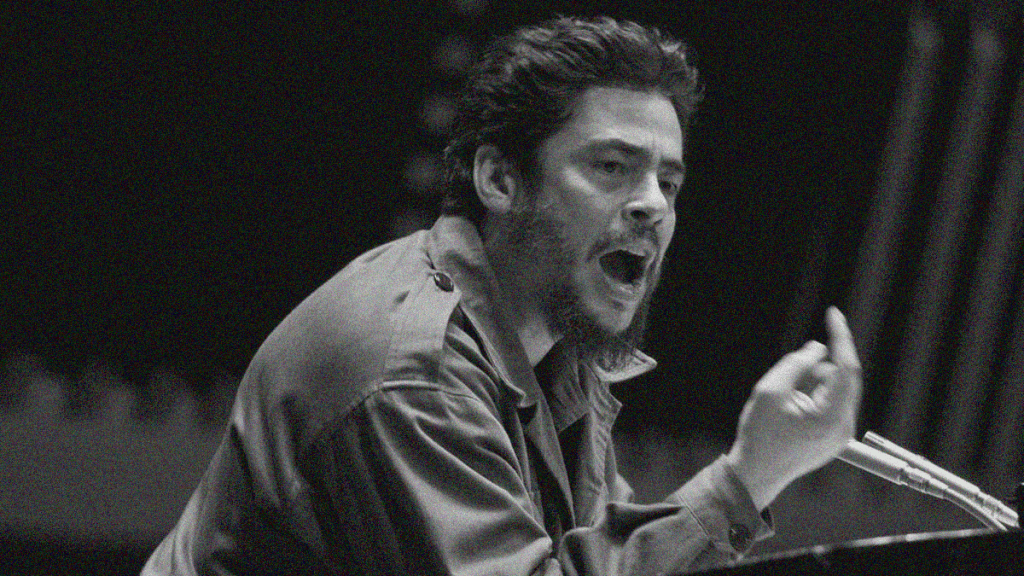
Soderbergh’s ambitions are evident from the start. Although the film mainly concerns itself with the years between 1955-1962, he splices in events happening later during a UN visit. Shot in black and white to help juxtapose against the main action’s colors, these future scenes comment on what’s happening during the war to enhance the tale. There’s a lot of structural jumping between the years, each shift labeled by a date and place to orient viewers. The technique lends a more modern artistic scope to what would otherwise be a linear narrative and I believe helps tell the story more coherently.
He’s edited the film for the most efficient portrayal of its facts—a somewhat cause and effect relationship to better let us understand the situation. And it’s also beautifully shot to lend a fly on the wall type feel as we follow revolutionaries or watch UN debates. It’s an account of what happened based on Guevara’s memoirs. All the battles and the victories from his own uphill advancement through the ranks to his evolution from doctor to right-hand man to his job instructing new recruits eventually seeing him lead an army.
If this film is to be believed, however, Che never wanted to maintain that power after completing the job. Once Cuba was freed, he sought to take the revolution to all of Latin America and share his experiences and political viewpoints. This is an intelligent man who fought for his beliefs and knew that meant being unafraid to kill. Does a man like that deserve to be glorified? That’s in the eye of the beholder since every conflict in history ensures one side’s heroes and patriots are the other’s villains.
The Argentine makes you think about the power of ideas that can bring a country together to revolt against its government. With a charismatic and understated performance from Benicio Del Toro as Che, one can’t help but see why. Always smiling and sharing a kind word, he rules with respect and never compromises his beliefs. The fact that he leads intellectually only makes those moments of emotional outburst more effective. The role should garner praise as Del Toro embodies the man completely and sheds any preconceptions of the actor himself.
Demotions and promotions don’t apply during his tenure in the army as he does what Castro needs him to do. Che follows his leader and expects the same from those under his own command. He’s portrayed as someone to be listened to and taken seriously. Castro himself holds council with him and values his ideas to the point where one might say Fidel was the face of the revolt pulling strings while Che was the muscle allowing it to happen.
The rest of the cast is a who’s who of familiar Latin American actors. If I were to single out any it would be Demián Bichir, Victor Rasuk, and Unax Ugalde. Bichir embodies Castro as a man with purpose and reason. Without any real insight into the dictator he would become, Soderbergh allows the character to be shown as a leader looking out for his people. Ugalde might be my favorite, playing “Little Cowboy”. Something about his performance struck me as authentic to stand out above the other soldiers. Rasuk plays Rogelio, a young volunteer whose enthusiasm leads to confrontations with Che. He’s the impetus behind a great scene towards the end after driving a stolen luxury car to Havana. It’s a moment that shows Guevara won’t bend his ideals and politics even in victory.
While the visuals are gorgeous and the acting superb, it’s the story that leaves something to be desired. Structurally interesting and easier to follow than one might think due to the time jumps, we’re not shown all the details. We’re often thrown directly into the action without knowledge of why we’re there or what’s happening for what reason. Events occur and we’re only shown flashes, sometimes learning details after the fact or never at all. An example: Che suddenly needs a cast for his arm. A character asks him the cause for us, but we jump to another scene just as the answer is about to be given.
Soderbergh has crafted this tale with only those pieces he deems important and leaves the rest by the wayside. He paints Guevara in a kind light as a warrior with purpose who never puts himself above mission or country. The film truly is just about his Argentine. Why is Batista bad? Why is Castro good? None of that matters. This isn’t a history lesson showing reasoning or rationale. You’ll need a book for that. So, while you can’t deny the scale or ambition, the lack of context may make it hard to decipher. Or worse, hard to care.

Benicio Del Toro in CHE: PART ONE; courtesy of TIFF.




Leave a Reply