
Rating: R | Runtime: 114 minutes
Release Date: December 14th, 2006 (China) / December 21st, 2006 (USA)
Studio: Edko Films / Sony Pictures Classic
Director(s): Zhang Yimou
Writer(s): Zhang Yimou, Wu Nan & Bian Zhihong / Cao Yu (play Thunderstorm)
Family dysfunction.
My introduction to writer/director Zhang Yimou was his first foray into epic territory Hero. The film took the beauty of Ang Lee’s Crouching Tiger, Hidden Dragon and infused it with inventive and powerful storytelling a la Kurosawa’s Rashômon. As a result, the film proved an amazing feat of technical and emotional brilliance.
With his latest film, Curse of the Golden Flower, the trailer had me thinking that Yimou was once again focusing on a solid story he could enhance through visceral flourish. I enjoy tales of imploding nobility and family fracturing to see how people will betray blood against blood. Also, it looked stunning—set pieces and cinematography alike.
I could now call it a masterpiece of style with a lush environment so detailed that one can understand why it’s become the new leader for Chinese film budgets. As a whole, however, the movie proves a nice shiny wrapper with little to offer on the inside. We are given a simple morality tale injected with so much fluff and ritual that you almost get faked into thinking you have seen something more profound than you actually have.
China is led by the Tang dynasty and an emperor with three heirs to take his mantle upon his death. The eldest was born by his first wife who has since died. Remarried to the daughter of another king—more for political purposes than love—he is given two more sons. We are therefore thrust into the lives of this royal family at an important moment in their history. All together for the first time in three years, they’re about to celebrate the Chrysanthemum Festival in honor of family and duty.
Under the surface, however, brews many secrets and tests that each member must face to decide on a path for the future. The emperor must choose which son to crown, the empress discovers she’s being poisoned into insanity, the eldest prince (Wan) realizes he doesn’t want to rule, the middle son (Jai) reveals himself to be a deserving warrior whose love for his mother always wins against the king, and the youngest (Yu) is treated like a lap dog without regard or consideration for any real power. In true Greek tragedy form, the family falls apart as each character picks who they love more: father, mother, or themselves.
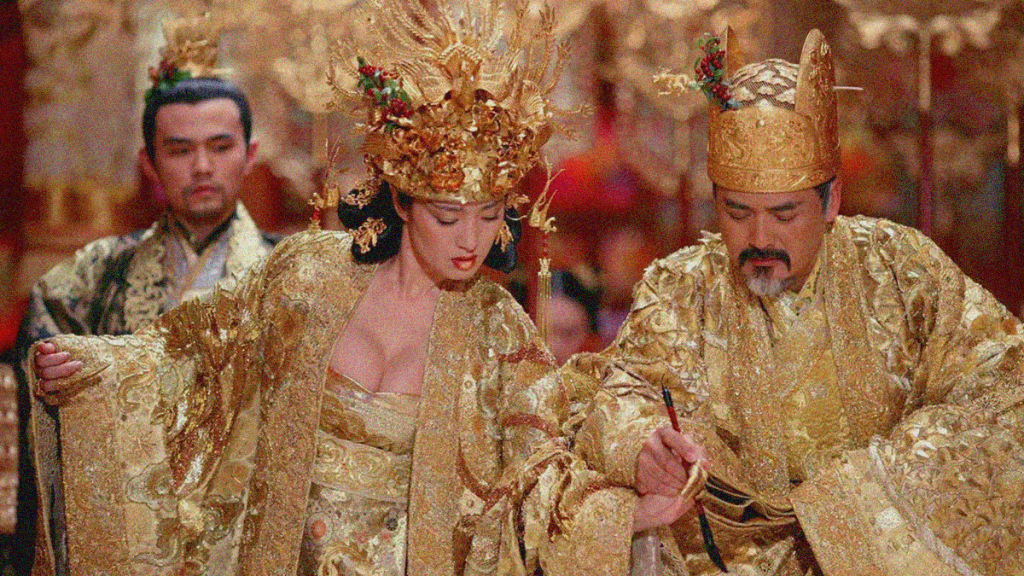
As far as acting and aesthetic go, Curse of the Golden Flower is amazing. The authenticity is unimaginable and so vibrant that it’s tough to see everything in each frame. There’s so much to look at, yet, at almost every opportunity, your eyes will go to the enthralling cast first. Gong Li is great as the matriarch slowly slipping deeper into dementia while attempting her revenge. Her utter devastation upon learning the price her ill-thought coup comes with is heartfelt and real.
Chow Yun-Fat is his usual steady self. His emperor is one who leads with a strong fist where duty and obligation always trump the emotional ties of family that can cloud a weaker man’s judgment. By the end of the film we will see just how each atrocity could be attributed to him as well as what might be some sick test of loyalty.
All the other characters play their roles nicely, staying true to their positions in the Chinese feudal food chain. Thankfully, each son is very different to allow for unique story threads. Liu Ye plays the eldest with the kind of trepidation and nervousness of someone unsure with how their life will progress. Jay Chou is conversely great as the son caught between his parents to the point where he no longer fights for the crown. He lets his love, which will never penetrate his father, take over his actions.
Everything built up eventually leads to a successful climatic battle sequence for which Yimou thankfully pulls no punches as the characters finish their respective arcs how they have been trending. No one comes out where they do not belong. Sadly, the progression there is long and tiresome. I understand Yimou and the artistic director wanting to show the era in all its glory, but the detail can get very tedious since this isn’t an historical epic. It’s a fictional drama.
The continual use of extreme close-ups and showcase of everyday servant activities gets old fast. Also, the over-saturation of little superfluous things like the continual scraping and sparks when swords collide (show me the fight not the friction of the metal), overshadow the moments when the artifice works (like the chase scene with Wan as we see streaks of color through the stained glass hallways).
The story itself has moments of artificiality too with many plot points proving too crazy. Between the abundance of incest, the youngest brother Yu’s odd smile that makes him seem not all there, creepy close-ups while eavesdropping around the palace, and the many convenient twists, the story is so convoluted for no reason.
At its core, this is a simple tale of loyalty and betrayal tearing a family apart at the seams. Unfortunately, Yimou tried to beef it up with trivialities that hinder its success. Cut a good 30 minutes (including the romance between Wan and the royal doctor’s daughter that serves no purpose when you think a jealous subplot will develop with his mother) and you might have one of the year’s best films.

Nominee:
Costume Design
Left to Right: Jay Chow as Prince Jie, Gong Li as the Empress, Chow Yun Fat as the Emperor in CURSE OF THE GOLDEN FLOWER. Photo by: Ms. Bai Xiaoyan © Film Partner International Inc. Courtesy of Sony Pictures Classics, all right reserved.


 jaredmobarak.com
Leave a comment