
Rating: R | Runtime: 128 minutes
Release Date: August 20th, 2025 (France) / March 27th, 2026 (USA)
Studio: Diaphana Distribution / Neon
Director(s): Julia Ducournau
Writer(s): Julia Ducournau
I may not be mentioned, but I do exist.
**Potential spoilers**
It’s weird to say considering Julia Ducournau’s previous films, but her latest is a lot. Of course it is. That’s what she does. But it’s not “a lot” in the same sense. It’s not as much about the genre trappings and metaphorical transmutations as the sensory and emotional experience unfolding. With loud music (including almost full Portishead and Nick Cave tracks), gorgeous marble-skinned special effects, and extreme anguish, Alpha isn’t for the faint of heart.
I therefore wonder if it’s proving to be a The Village type situation as far as the response being so varied with many critics hailing it an irrefutable misfire. How much of that backlash is a product of what people expected from Ducournau rather than what she actually delivers? How much of their discomfort is about the subject matter skewing closely to a real-world tragedy rather than the way in which she uses it? Because I think it works very well at face value.
But I also wasn’t as high on Titane as those same critics were. Much like with that M. Night Shyamalan film (as well as its follow-up Lady in the Water), perhaps I’m simply on a different wavelength wherein my tastes for Ducournau skew the opposite direction from original consensus. Because Alpha is not an AIDS movie. Maybe she could have moved away from all similarities to that epidemic completely, but I do think that familiarity is necessary for its full potency.
This is a fictional world ravaged by an incurable communicable disease that gradually turns its victims into marbleized stone. How it transmits is exactly how HIV transmits—bodily fluids. So, when thirteen-year-old Alpha (Mélissa Boros) returns home drunk after a party in which a stranger used an unsanitary needle to tattoo her arm, her mother (Golshifteh Farahani) is justifiably scared and enraged. What if her daughter just signed her own death warrant?
Not only is Mom (the character is nameless) a doctor well-versed in the disease considering she and her nurse (Emma Mackey) are the only two people willing to treat the infected, but she’s also experienced its effects first-hand via her brother Amin (Tahar Rahim). Our assumption from the opening prologue is that he passed away years ago, so it’s strange when Mom appears to talk to him after cleaning Alpha’s wound. It’s stranger still when he starts living with them.
Ducournau begins playing with time here to explain the discrepancy between what we assumed and what we’re seeing. She does this via flashbacks that are easily distinguished by Mom’s hair (curly in the 80s and straight in the present-day 90s). We watch how her love for her junkie brother kept him alive even when he obviously wanted to die. We learn about the “Red Wind” their mother believes infected him. And we understand the origins of Mom’s fear for Alpha.
In many ways, the teen is discovering these same things with us. How Mom interacts with Amin. How she treats Alpha. While the film is very much from Alpha’s perspective (especially in the ways she’s treated as a pariah at school due to the uncertainty of her blood test), this is very much Mom’s story. She is the constant. She is the protector. She is the jailor. She is the one desperate to save those who cannot be saved. Alpha might be next. So, the trauma floods back.
I don’t want to ruin anything, but it’s not difficult to understand what’s going on beyond what seems to be a straightforward narrative taken at face value. If you’re not asking yourself why Amin seems to be showing no signs of the disease despite how much time has passed, you might as well stop watching because you’re obviously not invested in what Ducournau is showing you. I personally thought I was going crazy when he keeps disappearing from frame at Eid.
What makes that unspoken truth tough to accept, however, is that the film maintains Alpha’s perspective. If what we assume is happening is happening, the film should be from Mom’s instead. So, we presume we’re wrong. Otherwise, it appears like Ducournau has made a grave error. What we cannot fully grasp until the climactic overlap reveal is that this was all done with intent. Yes, this is Mom’s trauma, but its intense influence has ensured it becomes Alpha’s too.
This reality leads to some unforgettably powerful moments. The climax is at the top because it’s when everything clicks into place, but there are many beforehand too—even if you aren’t yet aware of why. Some if it is merely a result of Ducournau’s directorial prowess (the pool scene) and some the dynamic between subject matter and cast (the waiting room scene). Some is a byproduct of the AIDS mirror reminding us how easy it is for mankind to lose its humanity.
Regardless of whether you think it all works in the end, you cannot deny the effects, sound (and song selection), production, or performances. Boros (nineteen playing thirteen) is impeccable as our entry point into this world’s paranoia and grief. Finnegan Oldfield (as Alpha’s English teacher) does a lot with very little screen time. And Farahani is fantastic as the mother and sister who refuses to let go—not because of love, but her fear of losing it.
But it’s Rahim who proves the best of them all. Even without the weight loss, he embodies Amin’s plight with the empathy and authenticity necessary to ensure the character never becomes a one-dimensional pawn of burden. He’s so much more as a representation of the suffering endured by countless victims to countless diseases that we as a society are so quick to sweep under the rug and the face of strength in one’s acceptance of that fate.
Alpha had an Oscars-qualifying run on October 17th, 2025.
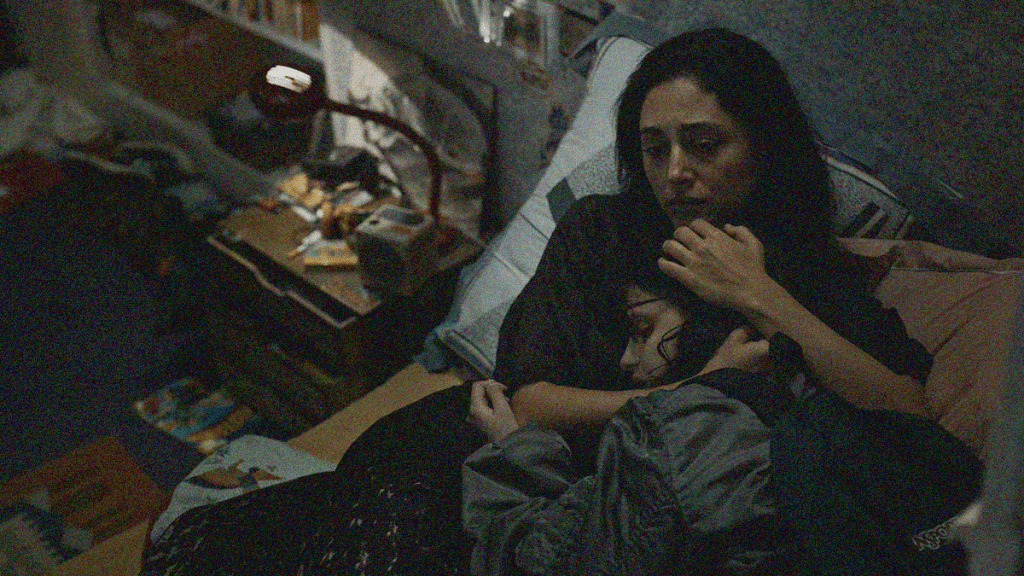
Golshifteh Farahani and Mélissa Boros in ALPHA; courtesy of Neon ©MANDARIN & COMPAGNIE KALLOUCHE CINEMA FRAKAS PRODUCTIONS FRANCE 3 CINEMA.



 jaredmobarak.com
Leave a comment