
Rating: NR | Runtime: 109 minutes
Release Date: June 20th, 2025 (Romania) / March 27th, 2026 (USA)
Studio: 1-2 Special
Director(s): Radu Jude
Writer(s): Radu Jude
Life is full of unforeseen stuff.
The themes behind Radu Jude’s latest film Kontinental ’25 find clearest focus during a phone call between Orsolya (Eszter Tompa) and her former student Fred (Adonis Tanta). She’s asking him to meet for a drink in Cluj and hoping he’s still there since she, despite working in the city, lives in the suburbs. More than that, however, Orsolya lives in the “poor” suburbs. A place where cheap housing and an explosion of new residents have caused its name to conjure sneers.
Orsolya is badmouthing the place she lives because of its influx of impoverished Romanians yet cannot help throwing pity parties every chance she gets for the guilt felt from being an indirect cause of an unhoused man’s (Gabriel Spahiu’s Ion) death (take a drink each time she explains the cause). She sees herself as empathetic and charitable when it suits her despite constantly reverting to the same sense of superiority as that of her friends, mother, and online trolls.
Because there’s more at play here than just socio-economic disparity. There’s also the rampant capitalistic corruption of corporations strong-arming their way into permits and contracts. There’s the ethnic-based bigotry that sees Romanians slandering her in the press for being Hungarian (even though the city she works in, Transylvania, was stolen from Hungary) and the hollow nationalism of Hungarians who look down upon Romanians as lazy peasants.
Everything we see and hear is thus predicated on the conditions placed upon them by the people doing the seeing and hearing. Orsolya’s mother bleeds Hungary regardless of never leaving her Romanian home for it since words are easier than actions. Orsolya isn’t innocent from holding Romanians to the same racist standards as her mother even as she lambasts Hungary for being a fascist state in Putin’s pocket. Jude exposes their hypocrisy via their selfishness.
And he does it as he always does with characters quick to name-drop and heavily quote sources as varied as the Bible and Wim Wenders’ Perfect Days. Besides opening scenes of Ion mumbling to himself on the streets picking up recyclables and asking for work/money before ultimately killing himself when Orsolya evicts him after already brokering a one-month extension, the film follows her as she confronts her complicity while others absolve her.
They all have their own reasons since none want to think about their own shame. Orsolya’s husband wants her to forget it all so they can have a nice holiday in Greece. Dorina (Oana Mardare) wants her to buy back her innocence by donating to a non-profit like she does to buy back her own after calling the police on an unhoused man in her neighborhood. And Fred just wants to spew the Zen axioms that remain unused in his brain from college.
Even Father Serban (Serban Pavlu) has an agenda when comforting Orsolya’s uncertainty. He interprets scripture to suit his needs in the moment and goes out of his way to explain why her own caution with certain passages is incorrect. God isn’t punishing those with nothing by creating a world where they can never hope to rise from the gutter. God is merely using their helplessness as an example to lead His sermons. Because that’s so much better.
Fans of Jude will enjoy the comedic philosophizing and contradictory actions on-screen just as detractors will discover one more example of why they can’t understand his appeal. The filmmaker is nothing if not consistent in his ambitions and style to present long-takes of clunky dialogue meant for us to begin conversations with ourselves. (I’ve just realized that Jude and Onur Tükel would probably be best friends … if they aren’t already.)
I once again land in the middle with an appreciation of what he’s doing despite not quite getting on his level to find it successful beyond reproach. His point is always clearly elucidated (I love that Orsolya ultimately visits all the same places Ion did in the prologue) and the actors embrace the dialogue and emotions to lean into the tragedy of our current world and the absurdity of it getting worse. Soon it will just be empty buildings and unmarked graves.
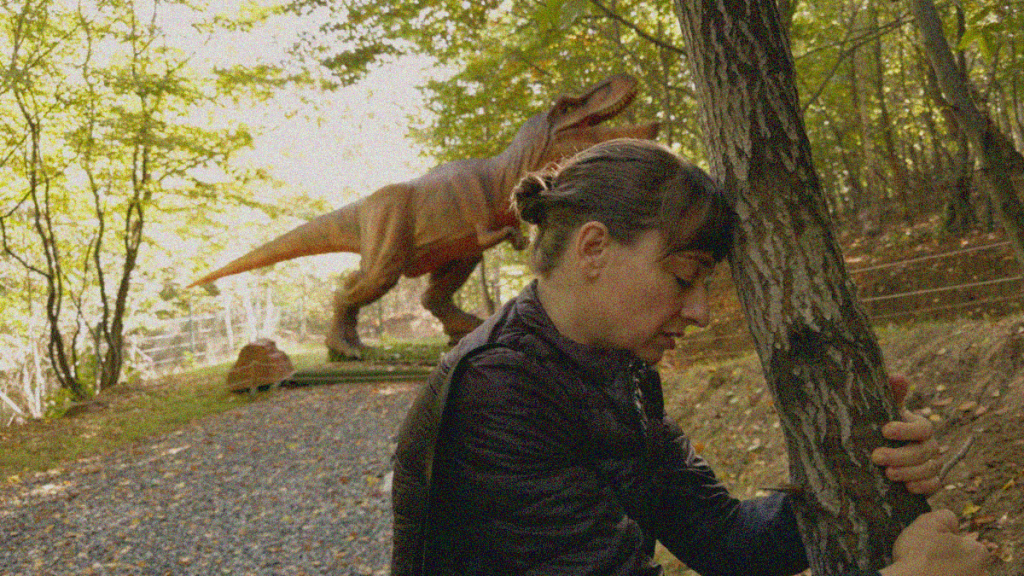
Eszter Tompa in KONTINENTAL ’25; courtesy of 1-2 Special.




 jaredmobarak.com
Leave a comment