
Rating: NR | Runtime: 83 minutes
Release Date: March 27th, 2026 (USA)
Studio: Dark Star Pictures
Director(s): Alice Maio Mackay
Writer(s): Alice Maio Mackay & Benjamin Pahl Robinson
Only now matters.
The latest self-styled “transgender film” from Alice Maio Mackay begins as Anna (Alexandra McVicker) flees her transphobic hometown to live in the city with older sister Dakota (Charlotte Chimes). It’s there, during an attempted robbery on the first day of her new job at a record store, that Anna experiences her unfiltered supernatural powers. She’s always known she was different and able to feel and do things, but only now does she realize just how dangerous she is.
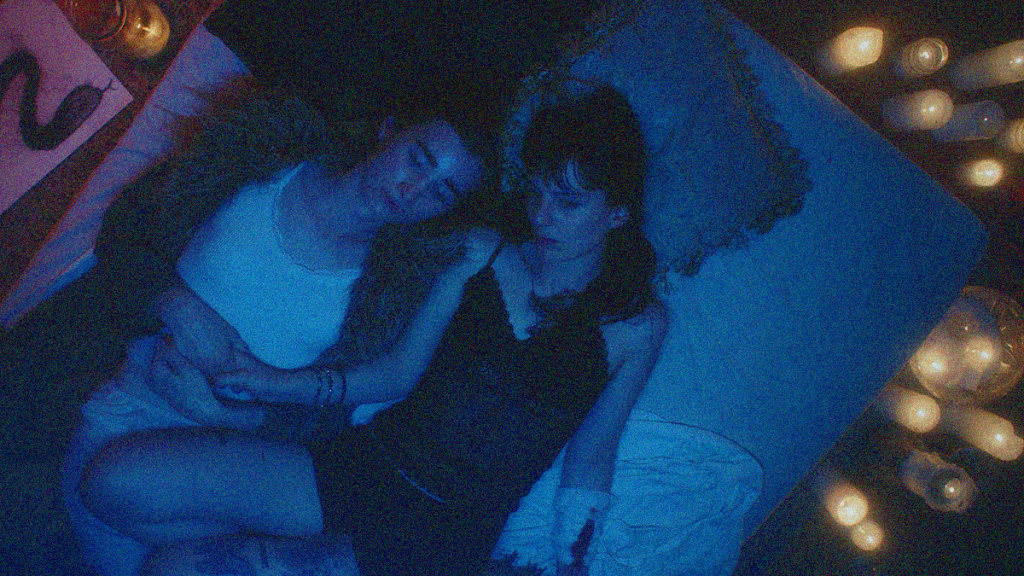
With The Serpent’s Skin, Mackay and co-writer Benjamin Pahl Robinson are less interested in explaining their central mythology than letting it simply unfold with as much ambiguity as necessary to keep us as in the dark to what might happen next as their characters. Visual overlaps and crosscuts portray the connection between Anna and Gen (Avalon Fast) before they meet and images of an ouroboros threatens their happiness before causing real pain.
The whole plays with the trans-ness and queerness of the plot, cast, and crew insofar as giving Anna and Gen abilities passed down through generations yet lost by time. It leans into the duality of good and evil, weaponizing the notion that some people have of the “other” being something they must fear. These two women seek to defend themselves from a world that seeks to harm them and yet they don’t fully understand the source of that strength.
They are being forced to confront the consequences of their powers and the reality that using them for good doesn’t necessarily excuse the bad things that occur as a result. Anna isn’t going around “popping” the brains of random strangers who look at her the wrong way, but there remains a cost to “popping” malicious predators regardless of the benefits that arise from taking them off the street. So, you must also ask if the powers themselves can take the wheel.
Enter Danny (Jordan Dulieu), Dakota’s neighbor and willing participant to usher Anna into the complex with a one-night stand. He’s a sweet guy despite what the woman living beneath his apartment thinks due to the constant noise born from his sexual exploits. We’re shown this truth so many times that his sudden turn towards hostility can only be the product of an external force. Why has he gone demonic? Can Anna and Gen stop him? Are they the cause?
Mackay cares little about a three-act structure, so don’t presume to know what’s happening, where things are going, or if you’ll ever get any answers. The film moves as though its floating on pure stream of consciousness wherein scenes push Anna into corners to see how she reacts rather than providing something to solve. Everything just flows. Sex to new connections. New relationships to fresh coincidences. Unexplained phenomena to self-sacrifice.
The Serpent’s Skin is therefore happening to its characters and Mackay and Robinson are brainstorming their responses. Danny becoming an antagonist isn’t a foreshadowed heel turn, but a random development to confront. It’s another case of duality wherein his actions don’t align with his personality. He’s a good guy doing bad things outside his control just as the women are good people doing bad things inside theirs. The world is too complex for any binaries.
While Mackay’s films are very intentionally not looking for mainstream appeal in their subject matter, the narrative structure might even alienate some of those coming to it with that fact in mind. Scripts that keep escalating without a release can be tiring—especially when nothing about them even alludes to there being an end in sight. We’re pretty much being led into a brick wall wherein the climax is less of an escape through rebirth than just a return to calm.
Because the point isn’t about stopping the evil running rampant in town. It’s not about teaching Anna to control her powers or even giving those powers purpose. Plot itself is an afterthought to the desire to give these characters agency over their lives in a place that seeks to control, subdue, and erase them. It might even be about their restraint from actually becoming what the world believes them to be already. They’re fighting hate with love instead.
That it all arrives through an obvious homage to 90s-era supernatural fare (the “Buffy” talk becomes unavoidable after seeing the make-up work for their vampire) is the draw. We get the genre trappings and music video-esque sex scenes for nostalgia and familiarity. By supplying its messaging via universally understood packaging, maybe its intent can be better absorbed too. The final product is quite messy, but its earnest desire to open minds is not.
Alexandra McVicker and Avalon Fast in THE SERPENT’S SKIN; courtesy of Dark Star Pictures.



 jaredmobarak.com
Leave a comment