
Rating: NR | Runtime: 118 minutes
Release Date: December 18th, 2025 (Germany) / March 20th, 2026 (USA)
Studio: Progress Film-Verleih / Janus Films
Director(s): Sergei Loznitsa
Writer(s): Sergei Loznitsa / Georgy Demidov (book Two Prosecutors)
It’s already hopeless.
The hindsight provided by living almost a century after the events depicted in the film left me with no choice but to laugh when an old prisoner reads aloud the notes he’s been tasked to destroy by fire. Written by fellow inmates, each one begs Joseph Stalin to save them. That they’ve been imprisoned unjustly by the NKVD (The People’s Commissariat for Internal Affairs) despite them all being Bolsheviks loyal to him. They don’t realize he’s the one who ordered it.
So, when a young prosecutor (Alexander Kuznetsov’s Kornyev) arrives at the prison with one of the notes that should have been destroyed, we must wonder more about the nightmare awaiting his naive idealism in chasing its request for an audience than how it broke containment. Because nothing is going to save its author (Aleksandr Filippenko’s Stepniak). The chaos ensuing from an outsider just knowing he’s being held captive guarantees that.
The question is therefore whether Kornyev will ever see the light of day again himself. Even though he’s the protagonist of Sergey Loznitsa’s Two Prosecutors (adapted from Georgy Demidov’s novella), I braced for him to be shot in the back of the head the moment the duty assistant (Andris Keiss) leaves him alone in his office. The lack of that inevitable execution erodes my preconception instead. Maybe Stalin isn’t aware. Maybe Kornyev’s position will keep him safe.
Or, as this Kafkaesque existential journey with a wry smile soon posits, the NKVD just like to play with their food before eating it. Because, as I said, Stepniak is already dead despite the painful breath that resides in his lungs. Sure, they could do the same to Kornyev right now without facing any consequences, but why not first see what he does with what he learns to deduce whether he might be useful to the cause. It’s no skin off their back.
The film’s progression through its series of bureaucratic black holes and intentional tactics meant to wear down the Soviet Union’s last honorable citizen is thus toeing the line between farce and thriller. So much of the runtime is composed of scenes with Kornyev waiting in silence, ignorant towards whether that waiting will ever end. In one instance he’s even purposefully made to believe it’s his turn before being comically rebuked.
We’re truly given a front row seat to the chaos and confusion of living through Stalin’s Great Purge. The way Kornyev still believes his party membership means something. How Stepniak assures him that making Stalin aware of what’s happening will end it. This is a secret arm of the government turning on those it deems a threat while its victims continue holding onto the delusion that they are on the same side. That an unknown third actor is to blame.
It’s the sort of mental gymnastics we see today whenever the media finds a Trump voter being persecuted by the very campaign promise they voted for because they thought the persecution was for the “bad ones.” They say they voted for criminals to be deported, not their neighbors. They say they misunderstood crystal clear messaging that half the country parsed the second it was uttered. The words “then they came for me” are never not prescient.
So, we’re watching Two Prosecutors in a constant state of unease. Just like Stepniak cannot truly trust that Kornyev isn’t a NKVD plant, we cannot trust that there’s not a second game built upon the first. What if the prison handed that letter directly to the new young prosecutor as a loyalty test. Dare him to visit the prisoner. Dare him to wait long enough to actually see him. Dare him to go over his superiors’ heads with his account. Let him hang himself.
Because that’s exactly what Stepniak reveals is happening inside the prison with torture-induced self-incriminating confessions that give the NKVD cover when finally executing them. Why couldn’t it also be happening outside? The paranoia moves from “Will Kornyev be allowed to leave?” to “Will anyone he runs to for protection actually be an ally?” Every interaction is a “Can I trust you?” stare down. The answer is invariably “No.” and yet the best of us try anyway.
That’s the point of fascism. To beat you down so often that you stop believing there will ever be a chance to exit out the other side. It makes you unable to trust reality. It erodes the truth. It places you in a cage of your own making that’s built on the fear that fighting back is worse than staying quiet. You can’t therefore help but be inspired by Kornyev’s perseverance and bravery even as you lament his inability to recognize he lost the second he entered those prison gates.
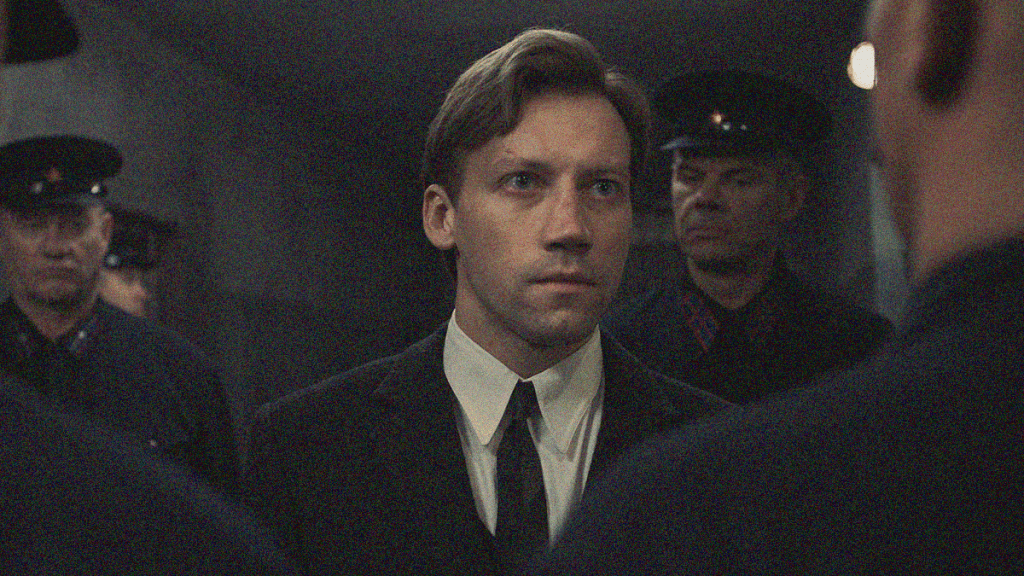
Credit Kuznetsov’s performance for constantly getting us to embrace the hope he keeps conjuring for himself. We want him to be right. We want him to be a beacon of light revealing other incorruptible souls rather than the death knell of justice. Yes, we know in our hearts that he’s forever walking into lion’s dens populated by strangers boring holes into him or knocking him off-balance with kindness, but maybe it’s not already too late. Not just for him. For us too.
Alexander Kuznetsov in TWO PROSECUTORS; courtesy of Janus Films. © SBS Productions.



 jaredmobarak.com
Leave a comment