
Rating: R | Runtime: 102 minutes
Release Date: March 13th, 2026 (USA)
Studio: Bleecker Street Media
Director(s): Amy Wang
Writer(s): Amy Wang
Let’s just hope we don’t have any children.
Writer/director Amy Wang’s Slanted is forever captured from the perspective of its protagonist, Joan Huang (Shirley Chen). That doesn’t mean it’s shot from a first-person vantage point, though. Just that we see her insecurities and shame projected upon the screen courtesy of those around her. The scowls of a white couple walking past her on the street. The racist expression of a white classmate mocking her Asian-ness. Joan’s own love for a “white” filtering photo app.
We also witness this phenomenon in how Joan sees her parents. Sofia (Vivian Wu) and Roger (Fang Du), despite kind eyes and smiles, are often portrayed as weak, stubborn, and othered. Yes, this is a product of the very “white America” town in which they reside treating them as such, but it mostly exemplifies just how much their daughter has aligned with the latter against them. Because Joan could come to their defense. She chooses to distance herself instead.
Ethnos founder Willie Singer (R. Keith Harris) knows this truth courtesy of what we can assume is an aggressively pervasive data mining algorithm built into the back of his AI filter. The statistics show how much Joan uses the software. It surely has its tentacles in her shopping and texting history to see how much she fantasizes about being “normal.” So, the system offers a once-in-a-lifetime deal to make that dream a reality. To give her a path towards “true” equality.
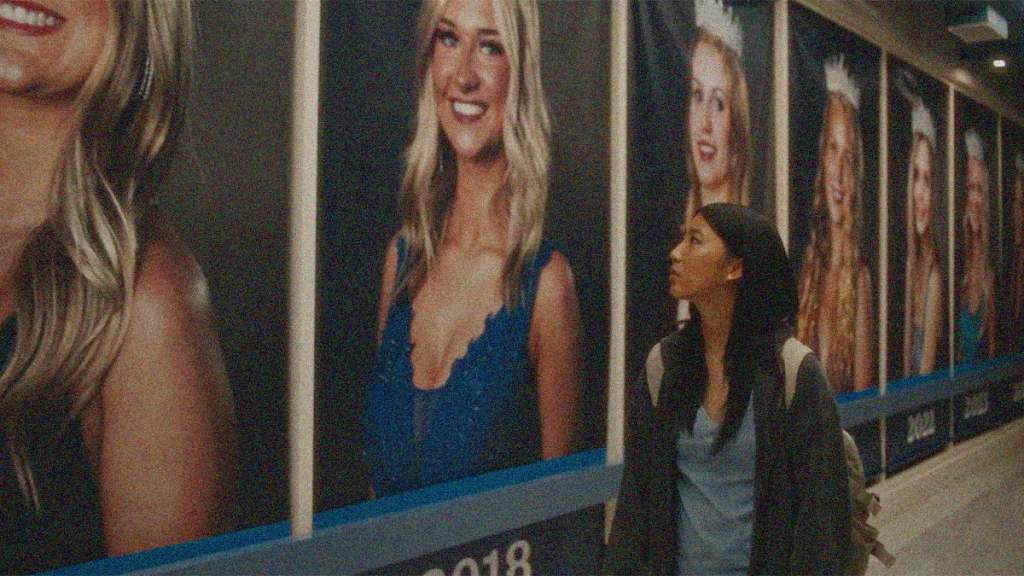
The sci-fi conceit is augmented by a shift in aspect ratios. Slanted‘s prologue is shown in widescreen to portray the hopefulness and ignorance of youth. Joan (Kristen Cui as a child) doesn’t yet know what she doesn’t know. Her father says everything will be alright. She faces racism in school, but maybe it’s just that one kid. And she spies on the beauty and glory of a prom queen being crowned amongst her peers. The American Dream is hers for the taking.
We can therefore presume the shift to full-frame upon meeting high school-aged Joan is proof that reality has officially scrubbed that possibility from her mind. Now it’s all about assimilation and pasting over the existential weight of her identity with aesthetic choices that were meant to blur the line but only end up making it more apparent. Joan is fighting for survival. She’s yearning for one more shot at tricking everyone into believing she’s actually one of them.
And then comes Dr. Singer’s gift of going one step further. Because what’s better than fooling the world? Fooling yourself. It’s not presented in those terms. The pitch is that waking up with a new face and voice (Mckenna Grace’s renamed Jo Hunt in widescreen) will provide a fresh start. But that doesn’t work when the past remains intact, her parents unchanged, and her best friend—another minority at school (Maitreyi Ramakrishnan’s Brindha)—is tossed aside.
Jo’s recognition of this fact is all the more damning as a result because it finally exposes what she’s done. Yes, she’s erased her identity and heritage in physical terms where it concerns appearance, but, as her parents explain, she’s also erased it psychologically and historically insofar as how her face connected to her ancestors. How her grandmother’s eyes have now been replaced by a homogenized visage barely discernible from the next.
Because what is the so-called “American culture” Joan strove to embrace? White supremacy. The true ideal at the back of this country is one that highlights the melting point of ethnicities and religions its experiment was meant to create. But what happened when that potential finally manifested in the impossible? What happened when equality made its way to the White House by the election of a Black president? America’s real culture was brought back to the forefront.
There are a lot of indelible moments throughout Wang’s film from the grotesque body horror to Stepford Wives satirical conformity, but none hit me more than a later scene inside the home of Joan’s idol (Amelie Zilber’s Olivia). The white-washed American flag canvas. The utter lack of color anywhere. The inability of her father to even speak the word “race.” It epitomizes just how deep-seated white supremacy is to America’s genocidal desire to make ideology into law.
As POCs in America, we must be very cognizant of our actions. We must find ways to reject the notion that being a “good one” is actually counterintuitive to our goal of equality since it further normalizes the idea that “normal” should be synonymous with “white.” Joan wants life to be easier and becoming Jo allows for that to happen, but at what cost? Is that ease worth voluntarily giving them the power to erase who you were and who your loved ones still are?
Think of Slanted as the reverse Get Out. Its script might not be as nuanced, but it is just as insidious. It also very effectively points to the shame inherent to being a non-white citizen of a country hellbent on infantilizing, exploiting, destroying, and/or becoming you. Peele showed white America’s power to enslave. Wang reveals an immigrant’s propensity to let themself be enslaved. But Americans often forget they’re all immigrants. Whiteness is an aberration here too.
Shirley Chen in SLANTED; courtesy of Bleecker Street and Tideline Entertainment.


 jaredmobarak.com
Leave a comment