
Rating: NR | Runtime: 120 minutes
Release Date: 2026 (USA)
Studio: Sumerian Pictures
Director(s): Beth de Araújo
Writer(s): Beth de Araújo
I see him everywhere. All the time.
Presented from the eyes of its eight-year-old lead (played by Mason Reeves), Beth de Araújo’s Josephine looks at the unpredictable nature of trauma as well as the delicate process in which to deal with it when the affected party is a child. You have the confusion insofar as comprehending what happened. The curiosity of wanting to figure it out. And the fear that results both inherently from the act itself and subsequently as its severity comes into clearer focus.
There’s also the too often disregarded reality that these such incidents leave a web of collateral damage. Josephine might not be the “capital-V” victim of the crime that occurs on-screen, but she is victimized by it. Witnessing the violence. Experiencing the pain. Feeling helpless whether from ignorance or inability. Wondering if you’ll be next. It’s no small detail that de Araújo waits until after the assailant turns his focus Josephine’s way before finally letting her father appear.
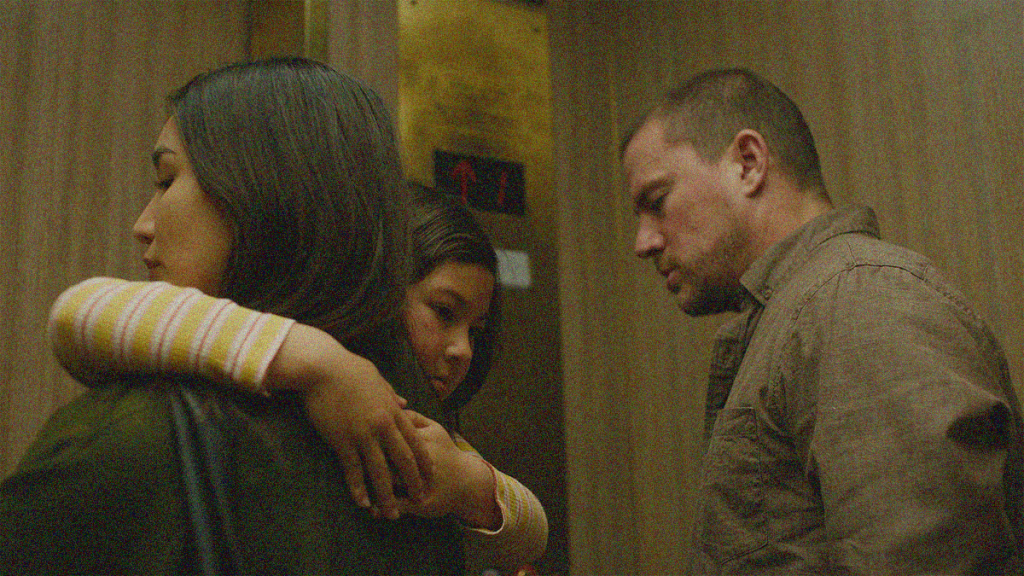
And what about him? What about Josephine’s mother? How do they react? How should they react? As Channing Tatum relayed during the Q&A: while there is a wrong way to parent, there isn’t necessary a right way. Everyone is just trying to do their best. Some are simply better equipped to do so. Claire’s (Gemma Chan) initial response is to face it. Talk about it. Visit a psychologist. Confront the uncertainty. Damien’s (Tatum) approach is more … destructive.
It’s why I loved what de Araújo said about her goal with the film after looking back and recalling an incident she witnessed as a young girl that affected her in a similar way. That this story isn’t just about “female fear” of rape and assault. It’s also about experiencing the myriad different forms of male aggression. Because it’s one thing to deal solely with the crime and its reverberations. It’s another to point out that a man not being a rapist doesn’t absolve him being violent.
de Araújo presents it in the opening scene without us being fully aware of what it is we’re seeing. Yes, it’s just a dad coaxing his daughter out of the garage with a cool maneuver (running out before the door closes all the way) to help condition her to not always be afraid, but there is an implicit sense of force in the way he does it before giving her a high-five and being sweet afterwards. We see it again from the officer tasked with watching her at the crime scene.
That cop has zero bedside manner. No “please.” No “thank you.” Just “get in the car” and “stop doing that.” It’s an undercurrent of control and power that only serves to augment Josephine’s growing sense of futility. It’s not as overt as Damien undermining Claire to promise their daughter that she doesn’t need a psychologist if she takes self-defense classes (made less subtle due to his previous refusal to undermine her about getting an iPad), but we notice it.
Add bullying (expertly handled by having the bully Josephine confronts be a boy who gets bullied by others). The adult world’s ambition to sweep difficult conversations under the rug leading her to research things herself and cement interpretations without proper context. Her desire to own a gun. Her ease to spit in someone’s face due to seeing a complex example of it. Her impulse to inflict harm in a different scenario from that which permission to do so was given.
This is a child being asked to shoulder emotions no child should and parents stuck between wishing for that truth and realizing that protection and justice are often hopes rather than promises. Josephine is thrown in the fire of ambiguous extremes (Is Dad raping Mom if he’s doing what the bad man did?) and the harsh fact that an eight-year-old’s testimony is legally crucial since open-and-shut cases don’t exist in societies willing to blame its victims as a defense tactic.
The most powerful example of trauma’s lasting effect, however, is the “ghost” following Josephine around. Even before she understands what happened, she knows it was horrific. Her mind feels the danger regardless of comprehension and puts the visage of “the bad man” (Philip Ettinger) everywhere. Sitting on her bedroom floor. Standing in the hallway to close the front door. Always present. Always watching. Always threatening with a silent smile.
We can’t help but think the worst as a result. Will this man remain a ghost in the background or will he begin to project himself onto others and risk Josephine harming them in an attempt to harm him? There’s a very intense scene wherein she learns something that de Araújo has conditioned us to see as a red flag (due to a visceral response to being told a dog wasn’t female as originally assumed) while holding scissors. I braced for the worst.
That’s the undeniable strength of the storytelling in Josephine. Its ability to keep us as on edge as Damien and Claire (Tatum and Chan are excellent at providing nuance to intentionally conflicting parenting styles and demeanors). Because no one knows how Josephine will respond—what she will say or do before earning a response that teaches her it wasn’t correct. Kudos to Reeves for portraying that uncertainty at such a young age because this is heavy subject matter.
Any instance that might feel weird can therefore be chalked up to the assumption that de Araújo was shielding her from the full scope of the scene. I must imagine certain techniques were required to get the right response without traumatizing Reeves as much as the character. And yet some moments do feel like she fully understands the hypocrisy at play behind its impossible situation’s honest mix of anxiety, fear, and hope. It’s a testament to all involved.

Gemma Chan, Mason Reeves, and Channing Tatum in JOSEPHINE; courtesy of Sundance.



 jaredmobarak.com
Leave a comment