
Rating: R | Runtime: 133 minutes
Release Date: September 12th, 2025 (Norway) / November 7th, 2025 (USA)
Studio: Nordisk Film / Neon
Director(s): Joachim Trier
Writer(s): Eskil Vogt & Joachim Trier
But what the house disliked more than noise was silence.
I was very worried towards the end of Sentimental Value. Gustav’s (Stellan Skarsgård) latest, highly personal film started falling apart in ways that made its continuation seemingly impossible to drive home the point that it wasn’t his age or that of those he wanted to collaborate with that was derailing his vision. It was him. His choices. His neglect. I loved the message behind this realization and reveled in the fact Gustav might actually learn he’s too late to be redeemed when director Joachim Trier and co-writer Eskil Vogt tease the opposite.
The transformative power of art does heal wounds and repair relationships. It helps people figure out the cause of their pain and better process a way forward. See Chloé Zhao’s Hamnet for another example of exactly that. But it’s tough to accept that truth when it’s presented via a character who hasn’t earned it. Yes, Gustav’s choice to be an artist first and father last (not even second) affected him as much as his daughters, but the distance he put between them isn’t his to erase. Not after so many years. Not after they built their lives without him.
Thankfully, Trier and Vogt don’t fall prey to that impulse. Not only would it have felt disingenuous in the moment, it also would have been contrary to the whole considering the script’s three-headed story mainly focuses on Gustav’s eldest Nora (Renate Reinsve). To have him or her sister Agnes (Inga Ibsdotter Lilleaas) somehow cajole her into believing he’d changed despite her struggle to exist outside the shadow of his absence would have undercut her despair. They needed it to be a springboard towards closure rather than healing.
I think they pulled it off. The ending is perhaps a bit rushed considering the room they gave everything else leading up to it, but the remodeling work of the Borg family’s home perfectly expresses the remodeling work Nora and Agnes must undergo to both accept their father’s place in their lives and find the strength necessary to ensure he realizes that acceptance is on their terms rather than his. That’s the real evolution that’s undertaken here. What used to be about wanting their dad has now become about him needing them.
Agnes calling her father’s screenplay “overwritten but impactful” is funny since I’d use the same description for Sentimental Value. The film often lingers on moments of epiphany—generally the result of an outsider (Elle Fanning’s actress Rachel Kemp) giving her objective read on what’s too personal to the others—as if they should shock to us as much as them despite Trier and Vogt doing well to ensure the reverse. We get what’s happening from the start. The question is whether Gustav and Nora will be vulnerable enough to talk about it.
In great cinematic fashion, however, that “talk” manifests in a much less literal way. It comes from Nora and Agnes talking about something alluded to early on but never confirmed until later. It comes from a silent look of respect by Nora and Gustav rather than the previous yearning to be loved. This family has suffered for generations, and the resulting anguish lingers in their bones (and the house’s) regardless of their ability to acknowledge as much. It’s rare that a film with this subject matter recognizes the cleansing nature of a fresh start.
Hence the title—found in a line of dialogue spoken by Agnes when organizing the objects left behind in their childhood home now that their mother has died (and where their father hopes to shoot his new film). She talks about everything having sentimental value and how Nora should want to keep something when it’s probably healthier to not. Why trap yourself with the emotions and memories of a time that hurt as much as her childhood? Because it’s not a trap for Agnes. Their circumstances were the same, but their experiences weren’t.
Reinsve and Lilleaas are constantly revealing this truth through their characters and performances. Nora’s perpetual state of anxiety causing her to self-sabotage. Agnes’ perpetual state of worrying in order to protect those she loves. I know we need to spend as much time with Gustav (Skarsgård is equally heartbreaking and narcissistic) as we do because it’s his flash of inspiration that ignites the potential for his daughters to let go of his hold upon them, but the film is never better than when those two women are on-screen together.
The film deserves the critical acclaim, but I do feel like it’s a bit too perfect and obvious when compared to Trier’s other work. It’s still legitimately great and that final scene between Reinsve and Lilleaas is worth the price of admission alone, but it kept me at an arm’s length for a good portion. The infinite abrupt cuts to black didn’t help by forever jarring me out of the moment, but the hilarious choice for Gustav to give his eight-year-old grandson Irreversible and The Piano Teacher as birthday gifts proves an even trade.

Winner:
International Feature
Nominee:
Motion Picture, Directing, Lead Actress, Supporting Actor, Supporting Actress (Fanning), Supporting Actress (Ibsdotter Lilleaas), Original Screenplay, Editing
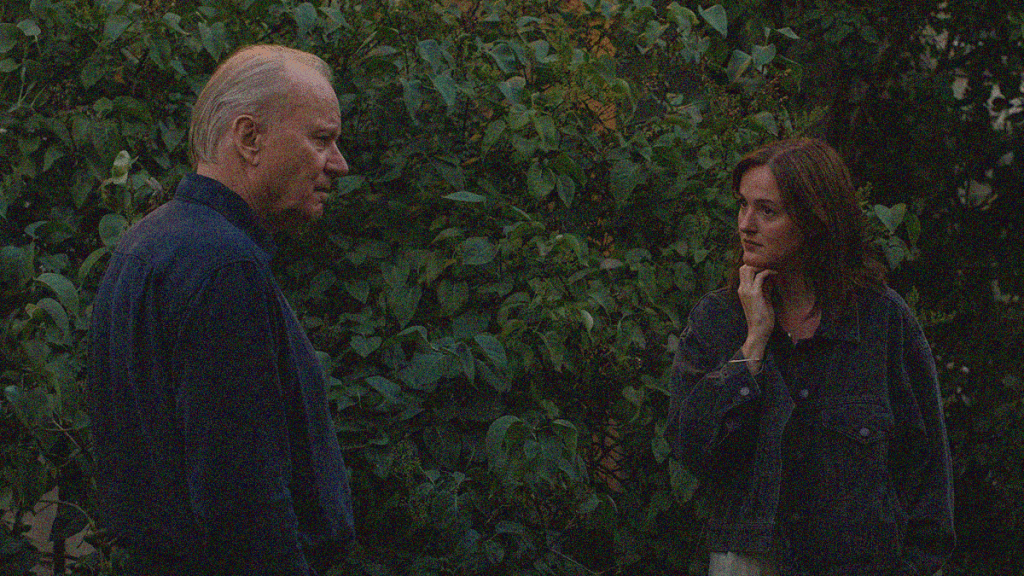
Stellan Skarsgård and Renate Reinsve in SENTIMENTAL VALUE; courtesy of Neon, photo by Christian Belgaux.



 jaredmobarak.com
Leave a comment