
Rating: R | Runtime: 106 minutes
Release Date: December 12th, 2025 (USA)
Studio: Roadside Attractions
Director(s): Bryan Fuller
Writer(s): Bryan Fuller
I wished for you too.
If you told me the plot of a new film about a little girl who tries to hire her mysterious neighbor to kill the monster under her bed that ate her parents, I’d ask who Lee Pace was playing because it sounded like something Bryan Fuller would conjure out of his singular imagination. Well, since that is exactly what Dust Bunny is about, I’d be half correct. Fuller is the brain, but Pace isn’t the brawn. No, he gave the Pie Maker (or Aaron Taylor, if you prefer) time off for this one and enlisted his Hannibal Lecter to come aboard instead.
Why does Aurora (Sophie Sloan) think her Intriguing Neighbor (yes, that’s Mads Mikkelsen’s character credit) can get the job done? Because she’s seen him do it before. This girl has dealt with the beast rising from the floorboards any time she touches her apartment floor many times. She’s desperate for a solve and her neighbor’s shady schedule keeping him out during the night before coming home a bit worse for wear seems to fit the bill. So, she follows him to Chinatown one night and watches him slay a dragon with her own two eyes.
Or did she? We know the truth because Fuller reveals it. While Aurora watches shadows on the wall of her neighbor gutting a Chinese dragon, we see the reality of him beating on a group of men using said costume as a disguise. It therefore begs the question: is there really a monster under her bed? We’ve seen evidence that there is, but why couldn’t it just be that Fuller is showing us those scenes through the girl’s mind? If she believes a monster keeps her scared at night, a monster is what she sees. And if her parents are gone, well … there it is.
This ambiguity is a feature of Dust Bunny‘s script. It is asking us to have faith in what Aurora is saying even if what she’s saying isn’t entirely true. Because regardless of the supernatural filter being used, her fear is authentic. Her desperation isn’t an act. And, to her neighbor’s credit, he believes this to be true—presumably from experience. Not the monster manifesting itself to consume everything in its path before leaving the floor seemingly untouched, but the idea of “monsters” threatening abuse. He wants to protect her.
He also thinks he must since he believes he’s the reason this “monster” took her guardians. That they were after him and simply got the wrong apartment. He feels guilty. He admits as much to his handler Laverne (Sigourney Weaver) who in turn worries if he’s gone soft. Not only is he putting himself on the line (and her by extension), but he’s doing it for someone who now knows his face. Her advice is therefore to kill Aurora, pack-up his things, and leave. Live to fight (and kill) another day. Because it won’t just be one monster coming for them anymore.
I truly love the way Fuller delivers nightmarish metaphor and horrible truth simultaneously so that we don’t know which to believe until one of his two main characters sees the evidence necessary to change their mind. Either Aurora must see the “monster” is just an assassin looking to clean-up a mess or Mikkelsen’s neighbor must see the monster to realize he’s in worse shape than he thought. Add more strangers to the mix and there arrives more inconsistencies. Because if he’s killing one assassin in the hall, who (or what) got the one in the bedroom?
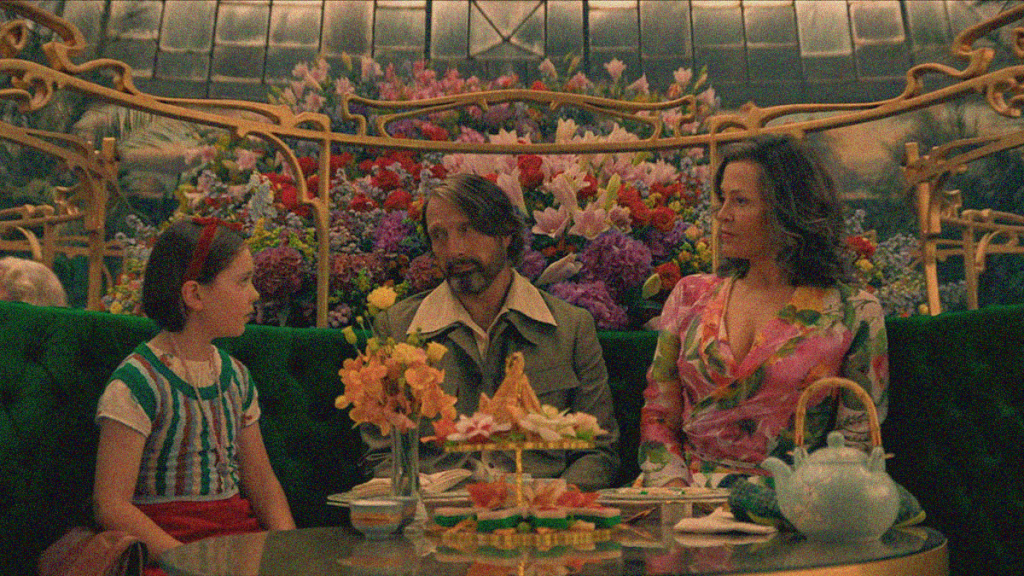
The film proves a perfect vehicle for Fuller’s dual sensibilities. The subject matter is dark like “Hannibal” and “Dead Like Me”, but, thanks to a child’s perspective, is absorbed through an absurdly surrealistic lens a la “Pushing Daisies” and “Wonderfalls”. Look no further than Mikkelsen being Intriguing Neighbor or David Dastmalchian being Conspicuously Inconspicuous Man. Or the gorgeous shot of an assassin perfectly camouflaged by the apartment’s wallpaper. Or whatever it is two FBI agents are doing sliding back and forth on a hallway floor.
Every set is meticulously designed. Big flourishes like the Chinese Dragon shadow and little ones like the animated bunny-shaped dumplings at dim sum maintain the off-kilter whimsy Fuller conjures to make heavy subject matter look lighter despite never undercutting the impact of its weight. And the cast plays it just left of natural but not quite all the way to caricature whether Dastmalchian’s shadowy figure or Sheila Atim’s stylish social worker. He also knows how to keep landing a good joke without it overstaying its welcome (“uh-ROAR-uh”).
Beyond just aesthetic, Dust Bunny also crucially needs Sloan and Mikkelsen to carry the comedy and drama. Because this isn’t merely a lark. The back story we get about both Aurora and her neighbor reveals the real horror on-screen and the lasting effect it can have on a child. Fuller gets very vulnerable in his director’s statement to reveal his own experience with an abusive father and the desire to wish he’d disappeared by any means necessary. It’s neither a silly fairy tale to Aurora nor a mistaken identity action flick to her neighbor. It’s about survival.
That we understand this fact while still getting to enjoy two hours of high concept entertainment shouldn’t be understated. Fans of Fuller’s television shows won’t be surprised at the effectiveness of that psychological layering, but maybe it will get new audiences to seek out a cult classic like “Wonderfalls” and realize there’s meat to the superficially candy-coated bones of “Pushing Daisies”. Aurora didn’t choose to need a monster to do her bidding or a hero to dispatch of it once finished. But she did make that choice. And these are the consequences.
Sophie Sloan, Mads Mikkelsen, and Sigourney Weaver in DUST BUNNY; courtesy of Roadside Attractions.


 jaredmobarak.com
Leave a comment