
Rating: NR | Runtime: 145 minutes
Release Date: November 20th, 2025 (Germany) / January 9th, 2026 (USA)
Studio: X Verleih AG / Visibility Films / Watermelon Pictures
Director(s): Cherien Dabis
Writer(s): Cherien Dabis
Your humanity is also resistance.
What can’t the Zionists take from a Palestinian? It’s not a literal question that writer/director Cherien Dabis asks during her latest film All That’s Left of You, but it is one that ultimately does get answered. Because a lot is taken from the central family’s three generations during its seventy-four-year account. Homes. Country. Security. Lives. All taken at gunpoint with a grin by children indoctrinated to believe their senseless brutality is heroic. But, despite leaving only trauma in return, they never can take this family’s soul.
While Dabis wasn’t physically displaced herself, it felt as though she was due to the stories and scars left by the Nakba on her father. She talks about visiting her native village in Palestine at eight-years-old as a Palestinian American and having to endure a twelve-hour hold wherein their possessions were rifled through and their bodies strip-searched regardless of gender or age. How was she to prepare herself for such an event? How can a world taught that Israel could do no wrong believe it true when Zionists control the narrative?
It’s why the recent influx of Palestinians films proves so crucial to helping turn the tide at a moment when a literal genocide against them somehow hasn’t. They give a voice back to the oppressed and context to the pain. Because it’s coming to a point where the Palestinians themselves are all that’s left of a stolen country. A people scattered across the globe in exile—many of whom have never even seen the beauty of their birthright with their own eyes. Refugees with more rights to walk freely in the streets as tourists than ancestors who still call it home.
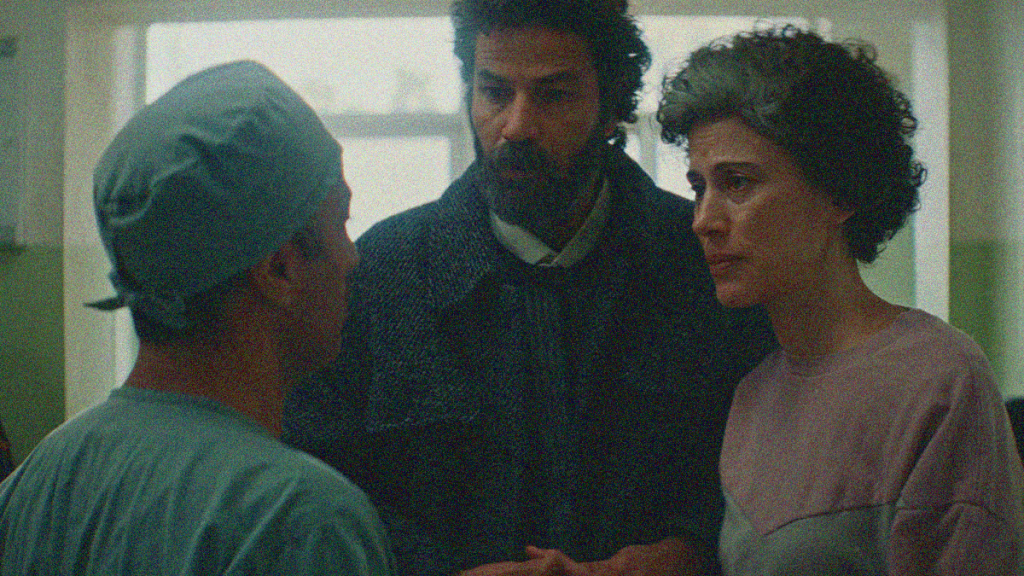
All That’s Left of You presents itself as the story of a teenager told by his mother. We don’t yet know what happened to him or to whom she’s speaking—just that Hanan (Dabis) cannot properly explain who he was without first talking about his grandfather. So, we rewind to 1948 and find Sharif (Adam Bakri) as he tries to reconcile the safety of his family with the defense of his nation. Israel is on the move and the British promise to protect the Palestinians is over. Hope remains that Arab armies will still intervene, but Jaffa residents are fully on their own.
The lies compound. The terror Sharif optimistically believed was merely scare tactics proves real. And we eventually fast-forward to 1978 to see his youngest son Salim (Saleh Bakri) grown and raising his own family in the Occupied West Bank. It’s here that we witness the nightmare of Apartheid and the depths of the Zionist effort to dehumanize Arabs into animals. Salim and Hanan (his wife) try to survive the situation by centering what they have while Sharif (now played by Mohammad Bakri) fights to ensure they never forget what they lost.
Dabis beautifully and tragically mirrors the two decades by showing the escalation and normalization of violence against them as well as the sustained uncertainty of its victims to have only prayer as a means of defense. We watch as futility and nihilism seep into the psychology of those who’ve never known any better. Parents coming to grips with the reality that they cannot protect their children in a police state that deems their lives forfeit. Children coming to grips with a life balanced upon two choices: surrender or death.
It’s these choices that ultimately place Noor (Muhammad Abed Elrahman) in the position we first meet him and eventually return to as the timeline shifts to 1988. The oppressive state of Israel forcing his grandfather and father to make a choice between leaving like so many others or staying to remind the world that Palestine exists. The constant abuse of that oppressive force shutting down schools, playing with curfews, and fighting protests and rocks with live ammunition. And, even when Noor’s inevitable fate is sealed, the Zionists still take more.
This portrayal of generational trauma is successful enough in its resistance-by-daring-to-exist narrative, but Dabis truly cements its powerful potential to change hearts and minds when it goes one step further towards the opposite moral quandary than you might assume. Rather than have her characters wrestle with the desire to seek revenge and continue to perpetuate the never-ending cycle of violence, she presents them with the opportunity to save lives instead. To be better than their opposition. To give rather than take.
The acting is impeccable from Dabis to the Bakris (father and sons) to the heart-wrenching child actors dealing with extremely intense scenarios. The period-specific production design delineating eras and place is impeccable. The script is perfectly measured to know exactly when to skip ahead via thematic and emotional narrative overlaps. And the dialogue is full of memorable lines that get to the core of Dabis’ humanist messaging. Because while it is an unavoidably political film in its content, love and empathy are what resonate most.
Sharif loses his identity when driven from his home, but his love for his family pulls him through. Salim loses his appetite for compassion when held at gunpoint by soldiers who find his fear to be funny, but he risks his life for his son. And both remain in Palestine despite the horrors to maintain their connection to the land and ensure their children know where it is they belong. It’s neither an easy choice to make nor an objectively correct one in hindsight. But there’s little room for regret when they shouldn’t have needed to choose at all.
The hope is therefore that humanity and dignity prevail. That despite what is done to you, you can still choose to be better. Not to be superior as they do, but to remind them that they aren’t as different as their hatred demands. I said above that All That’s Left of You reveals how Zionists can take everything from a Palestinian except their soul, but with that comes one more thing: their identity. No matter how hard others try to erase it, Palestine remains alive in its people. Its history remains alive in their stories. Its heart still beats.

All That’s Left of You had an Oscars-qualifying run on December 5th, 2025.
Cherien Dabis and Saleh Bakri in ALL THAT’S LEFT OF YOU; courtesy of Watermelon Pictures.


 jaredmobarak.com
Leave a comment