
Rating: NR | Runtime: 95 minutes
Release Date: November 21st, 2025 (USA)
Studio: Gandom Films
Director(s): Sara Khaki & Mohammadreza Eyni
You all have the power to do anything.
Once we discover Sara Shahverdi is running for village council, we can assume what’s going to happen next. Her victory is almost assured regardless of there never having been a woman elected because we recognize just how much the Iranian area’s youth (she was midwife to many) and women champion what she stands for as a pillar of feminist strength amidst patriarchal tradition (the men always add ‘tradition’ when discussing ‘rules’ as though they’re synonymous). But history tells us radical wins rarely lead to substantial progress right away.
As Cutting Through Rocks filmmakers Sara Khaki (an Iranian American who’s lived half her life in both countries) and Mohammadreza Eyni (a Turkish Azeri speaker who grew up in the same region as Shahverdi and knew he could never gain this access to their subject and the women she helps alone) reveal through the eight years they followed Sara, however, democracy can still wield power if the person elected by the people has enough integrity to act in their interests. Sara Shahverdi’s promises were solid. Her intent was pure.
As a result, we begin to feel as hopeful as she does about the changes she’s striving to enact. Because it’s not just about infrastructure like a new park and long-awaited gas lines to village homes. It’s also about curbing widespread corruption at the hands of elders who refuse to evolve and empowering young girls and their too-young mothers to fight for education over pre-teen marriage. To watch as Sara shrewdly uses the gas service to force men into giving their wives ownership of their land is impressive. She knows exactly which buttons to press.
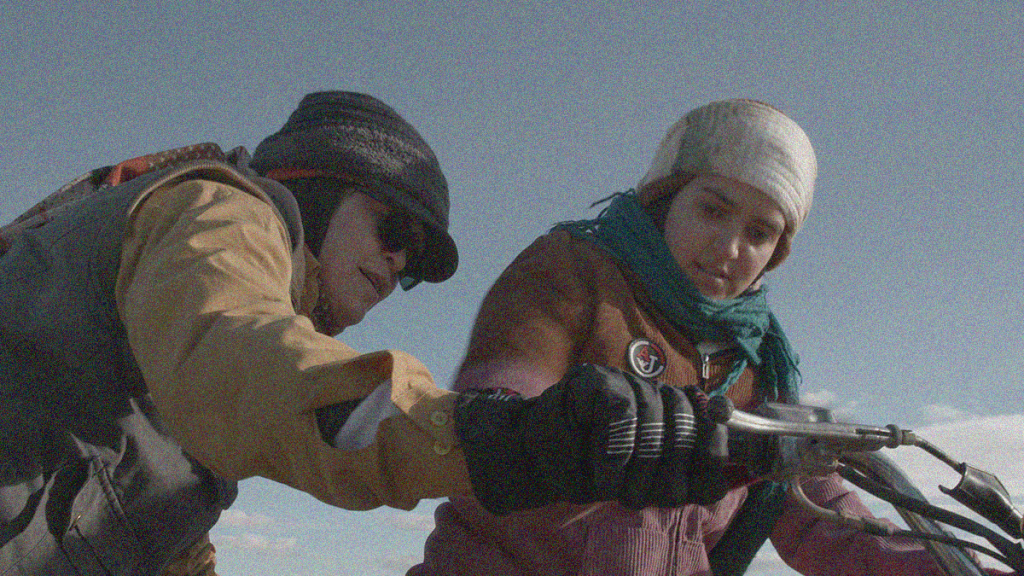
The reason why is a captivating tale itself considering how fate and tragedy led Sara to possess the confidence so many women in this community lack. She was the sixth of six girls, and her father needed help working. So, he let her dress the way she wanted, taught her how to ride a motorcycle, and kept her in school while her sisters were getting ready to be married. Yes, Sara’s parents would eventually have four boys too, but her father sadly passed away when they were still too young. She was sixteen at the time and became the family’s breadwinner.
What I really enjoyed about the film is that we see first-hand just how much the gender inequality dealt with as “normal” is cemented via indoctrination. Whenever a neighbor is abusive to his niece for daring to have fun or a brother is patronizing to Sara and demanding she fall in line, she calls out the fact that none of them had problems with who she was or how she lived her life in youth. She was one of two girls in an all-boys’ class. She fulfilled the duties of her father when her siblings couldn’t. It’s only “bad” now that it threatens their control.
Even so, I didn’t expect how insidiously that control would be weaponized. Sara’s brother sabotaging her work to call it his own was obvious. The council elders’ complaining about needing her permission to stamp official documents (the member who earns the most votes has always received the stamp and their disappointment that she isn’t taking the role “seriously” is because she won’t just approve their illegal plans bought by monetary and political bribes) perfectly exemplifies how toxic men are babies. This stuff happens everywhere.
I wasn’t even surprised that a complaint was filed accusing Sara of having a “dishonorable” house since calling a woman a whore or lesbian has always been an easy way to vilify them. Where that accusation led via the court system, however, was absolutely insane. Khaki and Eyni set the stage by bringing us inside teenage Fereshteh’s divorce hearing as far as showing how a judge would rather tell a woman to compromise and subjugate herself to her husband or father than admit a power imbalance, but it still didn’t prepare me for what was threatened.
That’s a product of my naïveté, though. It’s my American brain still believing in a time where morality and decency would somehow prevail over injustice. That calls to question a person’s identity in order to defame them for personal gain would only play out in the court of public opinion rather than an actual courtroom. Because the elders in Sara’s village don’t just seek to ruin her reputation. They set into motion a process to physically change her in a way that forces her to conform to their archaic psychopathy.
It’s one of many sobering realizations by the end of Cutting Through Rocks that exposes how progress and hope move much slower than tyranny and oppression. Yes, Sara’s victory showed this village wanted a better future, but it also lit a fire under those who thought their status as rulers was secure. We saw it here in America when Obama became president. Eight years of progress for one side’s thinkers became eight years of fomented hate for the other’s bagmen. It’s one step forward, two steps back, but the seeds for real change are planted, nonetheless.

Nominee:
Documentary
Sara Shahverdi training Fereshteh in CUTTING THROUGH ROCKS; courtesy of Gandom Films.




 jaredmobarak.com
Leave a comment