
Rating: NR | Runtime: 174 minutes
Release Date: June 6th, 2025 (Japan) / February 6th, 2026 (USA)
Studio: Tôhô Co. / GKIDS
Director(s): Sang-il Lee
Writer(s): Satoko Okudera / Shûichi Yoshida (novel)
Your beautiful face might consume you.
Famed kabuki actor Hanjiro Hanai (Ken Watanabe) accepts the hospitality of a Yakuza leader (Masatoshi Nagase’s Gongoro Tachibana) in Nagasaki when his latest show passes through. With it comes an invitation to the infamous man’s annual New Year’s Party where his own son (Soya Kurokawa’s Kikuo) would perform as the centerpiece play’s onnagata (female role played by a man). So taken by the performance’s emotion, Hanai presumes a geisha is on-stage. Gongoro is proud of his son and pleased to correct the error.
More than just a chance encounter, however, this occasion proves the genesis of the rest of Kikuo’s life once the Tachibana clan is attacked at the conclusion of the play. The teen’s stepmother implores him to run and hide, but he wants only to stay and defend his father. Hanai helps to hold him back as they both watch Gongoro live up to his fearsome reputation. He might have even taken them all out with his katana if not for an intruder’s gun. So, as his father yells for him to watch his victory, Kikuo inevitably watches his death instead.
Director Sang-il Lee’s Kokuhô, adapted by Satoko Okudera from Shûichi Yoshida’s novel, soon fast-forwards and shifts setting to Osaka. It’s there that Hanai’s family lineage has taken root and prospered with an acclaimed theater and school where he trains his own teenage son (Keitatsu Koshiyama’s Shunsuke) to follow in his footsteps. Much like with the Yakuza, heritage and bloodline rule the kabuki scene. The art form is passed down through the generations with a succession of revered titles. Shunsuke will be Hanai’s heir and Kikuo will be his apprentice.
Lee was previously interested in kabuki as a subject for film but could never quite find a way to do it. Every attempt to write around an actual actor’s biography didn’t get him where he wanted, so he pushed the idea aside until reading Yoshida’s novel (Lee previously adapted his book Villain). He took the story and found a way to bring it to life by focusing on Kikuo’s rise from Yakuza orphan to kabuki celebrity and the tragedies, betrayals, and deceit endured and ignited along the way. Lee only had to find an actor capable of carrying the role.
Because it’s not long before these teenaged amateurs grow into a performing duo with the pedigree to hit a blockbuster stage earlier than most. Lee chose specific kabuki plays that aligned thematically with the boys’ evolutions—providing the title of each in Japanese characters along with a description in English for those of us unversed in the art’s canonical entries—for them to perform. So, Ryô Yoshizawa (Kikuo) and Ryûsei Yokohama (Shunsuke) not only needed to act their characters’ real-life drama, but their onstage dancing too.
Kokuhô is epic in length at almost three hours, so you can assume things won’t be as copacetic as they are during Kikuo and Shunsuke’s initial run. Yes, they are living up to the potential of the “Hanjiro” moniker and their shows are selling out, but there’s still the matter of both living under a shadow that possesses the room for just one successor. Will it be the son who was destined and groomed to take over from birth? Or the objectively more talented apprentice taken under wing? Which is more important to Hanai’s legacy? His blood or his art?
You can ask the same question about Japan’s legacy considering Kikuo’s origins as the son of a criminal whose back tattoo ensures nobody will forget. What happens when Hanai’s shield of legitimacy goes away? In a perfect world, audiences and benefactors will show loyalty to the craft and accept this outsider. After all, every lineage must start from somewhere since you’ll eventually hit an ancestor whose father didn’t train them. Humanity is flawed, though. An inspiring tale of a reformed Yakuza quickly transforms into one of a conniving thief.
And it’s not just Kikuo’s star losing its luster. It’s also Shunsuke reckoning with the reality that his blood didn’t make him the best. That all the time and effort to live up to his father might not have given him the one thing he needed to succeed: a love for kabuki itself. There’s a difference between being good at something and enjoying it. Whereas Kikuo yearns to improve for his own sake, Shunsuke’s more relaxed partier enjoyed making his father happy and fooling around on-stage with his best friend. One fought to be something. The other was by default.
What’s really captivating about the film, however, is that these parallels and contrasts are never steeped in jealousy. Kikuo and Shunsuke are brothers by every definition besides biology. They do genuinely want the best for the other and can’t even pretend to be angry when the other takes what they assumed was theirs for longer than a second before admitting it would actually be easier if they could hate one another. We’re instead watching the complex machinations behind trying to honor where you came from while also cutting a path for yourself.
Lee takes us from the 1970s all the way to the 2010s, so there are as many periods of struggle and separation as there are camaraderie and joy. Both men make horrible mistakes when choosing between themselves and their fates. Both men leave loved ones in tears while exploiting their positions or those in a position to be an asset to their goals. None of the women are treated particularly well whether Shinobu Terajima, Mitsuki Takahata, Ai Mikami, or Nana Mori. Hanai, Kikuo, and Shunsuke all hold kabuki as their one true love instead.
Add a “deal with the Devil” and an aging onnagata gatekeeper (Min Tanaka’s Mangiku) and Kikuo’s journey is rife with ups and downs thanks to his heritage placing a ceiling on the heights his talent deserves. It’s not fair in a general sense, but one could argue it’s also a karmic necessity considering the lives he hurts to reach that pinnacle. The most interesting characters are often those with the most flaws and Kikuo has plenty. Kokuhô, however, does not thanks to a great cast, impeccable direction, and poignant kabuki plays to tie it all together.
Kokuhô had an Oscars-qualifying run on November 14th, 2025.

Nominee:
Makeup and Hairstyling
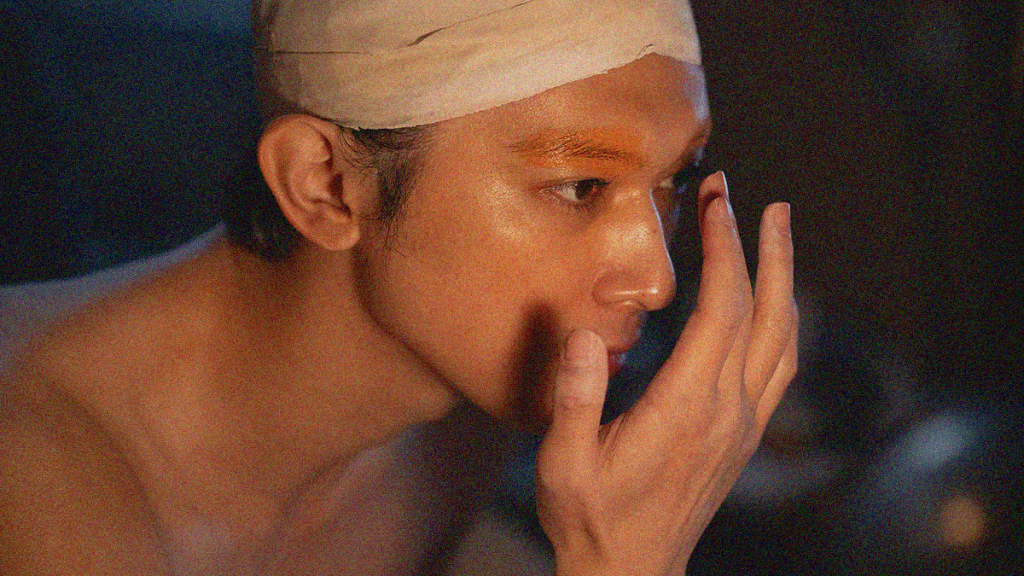
Ryô Yoshizawa in KOKUHÔ; photo by Shuichi Yoshida/ASP, courtesy of GKIDS.




 jaredmobarak.com
Leave a comment