
Rating: NR | Runtime: 76 minutes
Release Date: November 7th, 2025 (USA)
Studio: Janus Films / Sideshow
Director(s): Ira Sachs
Writer(s): Ira Sachs / Linda Rosenkranz (book)
This is the original.
Linda Rosenkrantz wrote Talk in 1968, a “novel in dialogue” born from the taped conversations of three friends about to go on vacation at the beach. In the same vein a few years later, she came up with the concept of asking her artist friends to describe a day in their lives to write a book that could help her reconcile with what she personally believed added up to a lot of wasted time in her own life. The idea was that the exercise might lend clarity and meaning to what seemed like routine machinations. Minutiae as an in-road to identity and purpose.
The project never came to fruition, but a transcript of one of the interviews she conducted for it was eventually found many years later. Published in 2021 as a curated self-portrait entitled Peter Hujar’s Day, the book ultimately found its way to director Ira Sachs. Already a fan of the late photographer, he saw the potential of adapting it into a vehicle for actor Ben Whishaw. So, with the interviewer and interviewee’s words at his disposal, he crafted a sort of cinematic stage play set in Rosenkrantz’s apartment as Hujar orates his recollections.
It’s a fascinating curio wherein Sachs plays with the idea of facsimile in ways that obviously infer upon the act of taking and developing photographs—the description of which fills up a large portion of Hujar’s (Whishaw) tale. The film begins by exposing its artifice via a set-up shot of him riding the elevator to Rosenkrantz’s (Rebecca Hall) flat with clapboard in full view and the director’s voice heard in the background. Another moment later reveals the boom mic almost as if Sachs wants us to remember none of what we’re seeing is real.
Does it help us to focus more on the words? Maybe. Is that the goal? I’m not so certain considering all the location changes throughout. Because while the premise alludes to this being a seventy-minute-long dialogue presumably conducted in one take, we go from the living room to the balcony to the bedroom and more so the visuals never remain static. And within those room we watch as Whishaw refuses to sit still for any length of time. He eats shelled nuts, pours a drink, plays a record, etc. His body bounces around as much as his mind.
A majority of Hujar’s story centers on a paid gig through the New York Times to photograph Allen Ginsberg. From there we hear his thoughts on the city, laundry list of celebrity name-drops, and penchant for lying to those who call him so he doesn’t paint himself into a corner with concrete plans. The best moments are those where Rosenkrantz is familiar with the characters so she can add her own insight and spark a laugh while also coaxing out more of Hujar’s infectious personality. It’s two friends riding the current into quirks and asides.
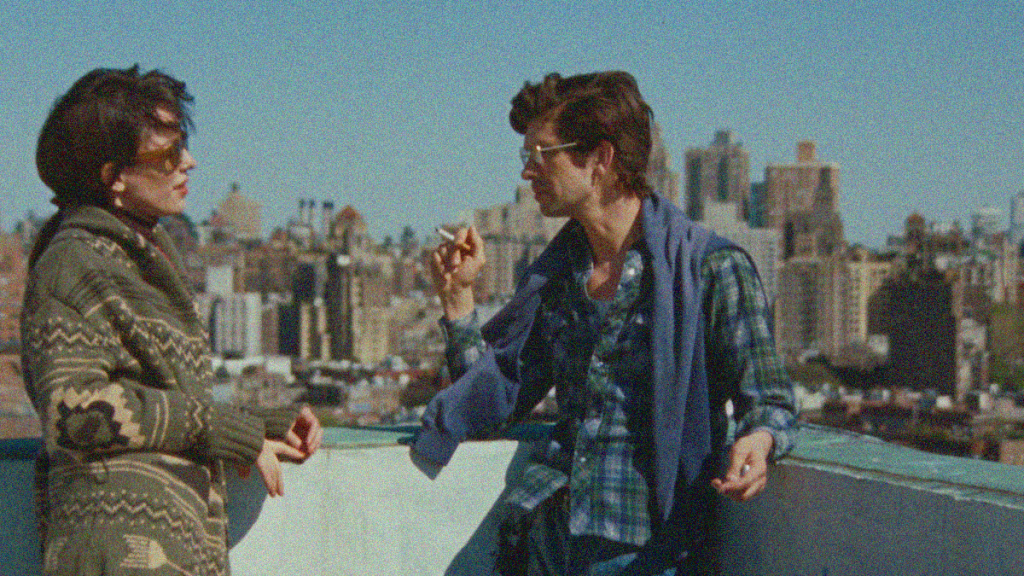
And it truly is just them using this day to get his previous day’s journey down. Alarm times. Phone calls. Food choices. Hujar keeps lighting cigarettes. Rosenkrantz keeps adjusting her microphone to capture his words as he dances around the space. It’s a time capsule of New York City in 1974 courtesy of two perceptive residents with a way of bringing its vibrancy, shadows, and monotony to colorful life. So, don’t go in thinking Sachs will surprise you by jumping off this premise. If you aren’t here for what the film promises, steer clear.
Peter Hujar’s Day is more about formal exercise than narrative drama. Finding ways to animate conversations without leaning on flashbacks or camera tricks. Most set-ups are static. If the characters aren’t moving, the shot merely switches from Whishaw’s face to Hall’s. And besides a quick music interlude and some extended shots of silence creating moving portraits, it’s just the free-flowing ruminations of an artist connecting mundane events to contextually relevant touchstones. The immortalization of a forgettable day in an unforgettable life.

Ben Whishaw and Rebecca Hall in PETER HUJAR’S DAY directed by Ira Sachs; courtesy of Janus Films.



 jaredmobarak.com
Leave a comment