
Rating: NR | Runtime: 170 minutes
Release Date: October 29th, 2025 (USA) / October 31st, 2025 (Romania)
Studio: Independenta Film / 1-2 Special
Director(s): Radu Jude
Writer(s): Radu Jude
No one can throw eggs at me.
It started with a lie when no one seemed interested in the film he did make: “Well, actually, I have a Dracula film.” Of course, a pitch that generic would perk up festival buyers’ ears and threaten to open wallets. Timeless IP sells. Weird Romanian films prone to multiple five-minute-long historical and political context dumps do not … well, not as much considering Radu Jude has no trouble finding international distributors for his work. So, he took the lie’s interest and made another weird Romanian film out of it.
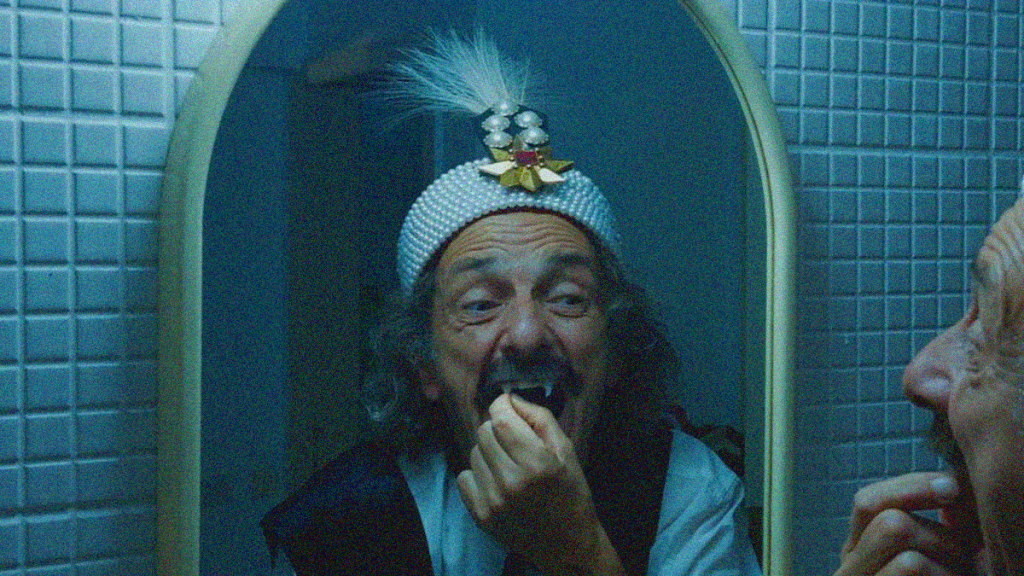
Centered upon a fledging director (Adonis Tanta) who has decided to turn to AI to fulfill his obligations to producers, Dracula unfolds as an anthology piece built atop an outlandish tale of a secret dinner club where you can bid on having sex with the stars (Gabriel Spahiu’s former mental patient and Oana Maria Zaharia’s OnlyFans goth) and then bring your children along to hunt them through the streets with giant wooden stakes. This duo’s attempt to escape the low pay and disrespect is the “big idea,” but Tanta knows attention spans always wane.
In great absurd fashion, he decides to expand an hour of story into three hours of content courtesy of faux generative AI pitches to keep audiences glued to the screen. So, each time something is about to happen to Spahiu and Zaharia, Tanta cuts back to his sparse bedroom to feed another prompt into his tablet. A love story that has nothing to do with Dracula but ends with an impalement. An adaptation of Romania’s first literary Dracula myth. A capitalist metaphor where Dracula (Alexandru Dabija) is Blake from Glengarry Glen Ross.
While Jude writes the whole film, he does augment the “AI” portions with actual AI imagery that proves as good a reason as any to bury the phenomenon six feet deep. It’s like he ended each ask with, “but make it as dumb as possible,” so the technology’s inherent problems remain in full bloom. Yes, he’s experimenting with cinema as a medium, but these moments also generally stand-in for big action sequences to show he’s doing whatever possible to stay under budget. Financing was admittedly in constant flux.
In that vein, Jude was also forced to be creative in the live-action portions of the film. That main narrative with Spahiu and Zaharia is constantly switching camera quality. The longest chapter of the whole at around fifty minutes (according to the AI’s warning when agreeing to bring that Dracula adaptation to life) is staged like a regional theater production complete with cardboard cutouts as extras. And most of the cast is tasked with playing numerous roles throughout—a fact that actually leans into generative AI being a recycling tool.
You must therefore applaud the ingenuity regardless of whether you enjoy the finished product. I found myself nodding off more than once as the whiplash of moving from one vignette to next had me looking at my watch instead of forcing engagement. All the Jude hallmarks are here, but it proved too meandering and gimmicky for full investment—especially with that fifty-minute sequence dragging simply because my brain had already been trained on ADHD-levels of pornographic content swipes. (But I did love those Nosferatu ad placements.)
It’s a case of the parts being more worthwhile than the whole. A film that may have benefited from being released on TikTok as a series of increasingly strange mini movies like the final tale of a street sweeper (despite him actually being a garbage man). Because I do appreciate the idea of dissecting vampire lore and stitching it together like Frankenstein’s monster. I just don’t think this was the vehicle or format to do so. Jude diehards will surely love it, though. Cinephiles craving subversive chaos will too. The rest of you should temper expectations.
Gabriel Spahiu in DRACULA; courtesy of 1-2 Special.


 jaredmobarak.com
Leave a comment